 泰互帮
泰互帮加载中…
Practical guides and professional knowledge for life in Thailand
Living in or visiting Thailand goes much more smoothly if you understand local customs and taboos. The key ones: first, respect the monarchy — disrespect toward the King and royal family is a serious matter in Thailand, involving the law, so never publicly comment or act irreverently; second, the head and feet — the head is regarded as the most sacred and shouldn't be touched (including children's), while feet are the lowest, so don't point with your feet, put your feet toward people or Buddha images; third, religious respect — monks, Buddha images and temples deserve reverence, and women must not touch monks; fourth, social etiquette — greet with a wai, communicate with a smile and gentleness, and avoid public anger or loud arguments (which cause loss of face). There are also smaller points like removing shoes indoors, giving with the right hand, and gift and colour customs. This guide covers the everyday customs and taboos worth knowing so you fit in and conduct yourself well, subject to local culture and law.
Bangkok's Erawan Shrine (San Phra Phrom, the "Four-Faced Buddha") sits in the Ratchaprasong district in the city centre and is one of Thailand's busiest and best-known places of worship. It enshrines the four faces of the Hindu god Brahma, symbolising loving-kindness, compassion, sympathetic joy and equanimity, which popular belief links to different wishes — career, love, health and safety, wealth and connections. Worship follows a clockwise order starting from the front, with common offerings of flower garlands, candles and incense, and dancers performing as a form of thanksgiving. Many return to give thanks once a wish is granted. Dress modestly, be respectful, and follow on-site etiquette. The shrine is right by BTS Chit Lom and surrounded by malls, so it's easy to reach. This guide covers its origins, what each face is for, offerings and worship order, thanksgiving and etiquette so you can pay a respectful, orderly visit.
Drink driving in Thailand is a criminal offence, not a simple fine. Police checkpoints are common (especially on holidays, alcohol-ban days and at night), and a blood or breath alcohol level over the legal limit is an offence, with penalties including fines, imprisonment (often suspended), licence suspension and community service — sharply increased if you cause injury or death. Refusing a breath test is usually treated as a presumption of drink driving and penalised, so refusing doesn't pay. Foreigners are covered too; with a language barrier, stay calm, cooperate, and ask for an interpreter and lawyer if needed. Thailand also has statutory alcohol-ban days (certain Buddhist holidays, election days) when sales are prohibited and enforcement is stricter. This guide covers the legal limit, penalties, the cost of refusing, what to do if arrested, and how to avoid trouble; standards and penalties follow current Thai law — consult a lawyer if charged.
If you're taken in, summoned or caught up in a criminal case in Thailand, the two urgent things are: contact a lawyer as soon as possible, and notify your embassy or consulate. You have the right to remain silent and to a lawyer — don't sign Thai-language documents you can't read without a lawyer and interpreter. Finding a criminal lawyer means checking they're licensed, have experience in similar cases, and can arrange Chinese/English interpretation; if you can't afford one, Thailand also has legal aid and public defender systems. Fees depend on case type, stage (investigation, bail, trial) and complexity, usually quoted by stage, with bail bonds separate. Your embassy can provide consular help — visits, relaying information, lists of local lawyers — but cannot interfere with the courts or guarantee an outcome. This guide covers finding a lawyer, how fees work, legal aid and interpreters, and the limits of consular help; procedures and rights follow current Thai law, and you should consult a licensed lawyer for your case.
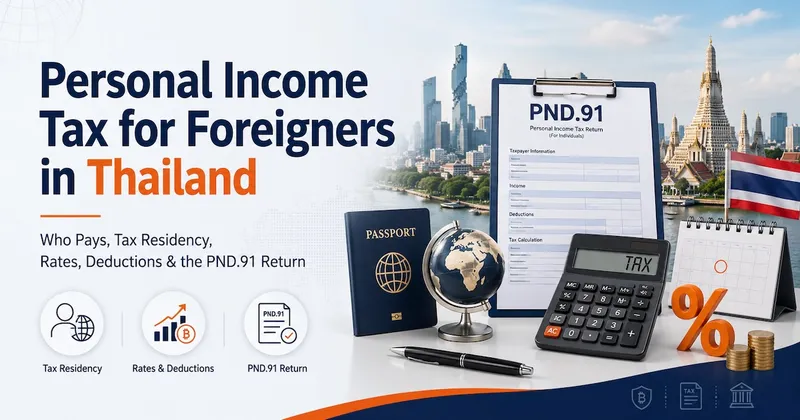
Foreigners working in or earning Thai-source income generally owe personal income tax. It has three layers: who pays — employment/service/business income earned in Thailand is in principle taxable there, regardless of tax residency; residency — staying 183 days in a tax year makes you a tax resident, and residents may also be taxed on foreign income remitted into Thailand (rules have tightened recently); and how to compute and file — tax is on a 0%–35% progressive scale after allowances and deductions, employees commonly file the annual PND.91 while employers withhold monthly (PND.1). Overpayments can be refunded. This guide covers a foreigner's tax liability, residency, rates and common deductions, and the filing and refund process, subject to current Revenue Department rules on rates, thresholds and foreign income; consult an accountant for your case.

Since foreigners can't directly own Thai land or landed houses, some think of "registering a Thai company to hold the land." That route exists in specific compliant cases, but the most common version on the market — using Thai people as nominee shareholders to make up 51% Thai ownership while a foreigner actually controls the company — is an illegal nominee arrangement: Thai law prohibits using nominees to circumvent the ban on foreign land ownership, and if caught you can face forced disposal of the land, fines and even criminal liability, with the nominee Thais also liable. True compliance depends on whether the company genuinely operates and whether the Thai shareholders genuinely invest and hold rights — not a shell set up purely to hold land. For safer holding, foreigners more commonly buy a freehold condo (which foreigners may own), sign a long-term lease (leasehold, up to about 30 years, renewable), or use BOI/special permits where qualified. This guide covers the red lines of company land-holding, nominee risks and safer alternatives, subject to the Land Code; consult a lawyer for major decisions.

Once you register a Thai company, you must keep books and file taxes monthly and annually — even with no revenue — and most foreigners outsource this to a local accounting firm. Outsourcing covers monthly bookkeeping, VAT filing (PP.30), withholding-tax filing (PND.3/53) and social-security filing, plus annual financial statements, an audit (Thai companies generally require a licensed auditor) and the annual income-tax return (PND.50). Fees are usually a monthly bookkeeping fee plus a separate annual audit/filing fee, tiered by company size, transaction volume, VAT registration and whether you need service in your language. Choosing a firm means checking credentials, communication, whether the quote includes the audit and annual return, and whether they proactively flag deadlines. Key pitfalls: don't assume zero revenue means no filing (missed filings incur penalties), don't pick the cheapest that can't produce compliant statements, and keep invoices in order. This guide covers scope, fees, the monthly/annual process and how to choose a firm, subject to Revenue Department rules.

For a foreigner setting up in Thailand, the first step isn't rushing to register — it's choosing the right entity. There are five common ones: the Private Limited Company (the mainstream vehicle that can actually trade, hire and invoice, but with foreign shareholding capped under the Foreign Business Act), the partnership (rarely used), the Representative Office (limited to non-revenue activities like market research and liaison — it cannot earn income), a Branch of a foreign company (an extension of the parent with no liability separation), and a BOI-promoted company (which can lift some foreign-ownership limits and grant tax benefits, but with industry thresholds). Which to pick depends on whether you'll genuinely trade and earn revenue, whether you can accept foreign-shareholding limits, whether you need full foreign ownership, and whether you qualify for BOI. Pick wrong and you can't do business, get stuck on ownership ratios, or overpay tax. This guide compares the five entities' purpose, foreign-ownership limits, liability and tax, subject to current DBD, BOI and agency rules.

Buying property in Thailand doesn't let you stay legally — a purchase carries no residency, and you still need a valid visa to live there long-term. Common lawful long-stay routes for owners include: a retirement visa for those 50+ retiring, an Elite visa for easy long stays, the LTR 10-year visa for qualifying high-asset/remote/specialist profiles, a work visa for the employed, a dependant visa if your spouse is Thai, and DTV for remote workers. Which to choose depends on your age, whether you work, your income/assets and your long-stay goal — and has little to do with which property you bought. Owners should also mind obligations like 90-day reporting and TM30 address notification. This guide explains a property owner's visa options by profile and how to pair property with a visa, subject to current Immigration and agency rules.

Planning to live in Thailand long-term, many agonise over spending the budget on an Elite visa membership or on property. In fact the two solve different problems and don't replace each other: the Elite (Thailand Privilege) visa solves "what lawful status lets you stay long-term" (long-stay convenience, but no work rights and it expires or must be renewed/repurchased), while buying property solves "where to live and whether to sink assets into Thailand" (own-use/investment, but buying grants no residency). To truly live long-term you usually need both — a visa for status and housing (rented or bought) for a home — not one or the other. If the budget stretches to only one first, it comes down to your core goal: for lawful long stay first, choose the visa; for asset landing or long-term own-use first, consider buying but still arrange a visa. This guide weighs them across the problem solved, cost nature, flexibility and exit difficulty, subject to current Immigration and agency rules.
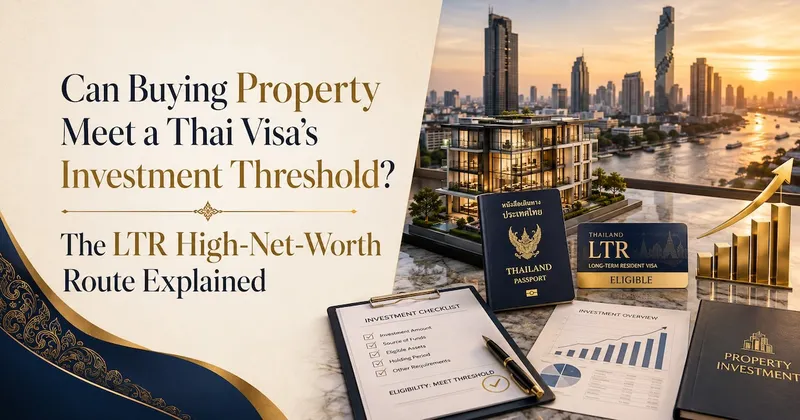
People often ask whether buying property in Thailand can earn a long-term visa. The answer needs care: buying alone grants no visa, but certain long-term visas — especially the LTR high-net-worth category (Wealthy Global Citizen) — set "investment into Thailand at a threshold" as one condition, and property investment may count toward that requirement where it complies. That is "using a purchase to meet a visa threshold," not "a purchase automatically granting a visa." To use property this way, you typically must meet multiple thresholds — total assets, annual income, and investment into Thailand (which can include property, government bonds, direct investment) — with defined rules on investment form, valuation and holding, and strict documentation. This guide explains the relationship between property investment and visa thresholds, the LTR high-net-worth category's broad requirements, and how this differs from "buying doesn't grant status," subject to current BOI and agency rules on qualifying investment.

For foreigners buying a condo in Thailand, eligibility has little to do with what visa you hold: as long as you're within the foreign-ownership quota, buying a freehold unit foreigners may own, and remitting the purchase funds in foreign currency to obtain an FET certificate, you can buy even entering short-term on a tourist visa. What actually differs by visa is the convenience of ownership and long stay — not whether you can buy: loan eligibility (local banks are relatively friendlier to foreigners with work or long-stay visas), a lawful basis to live there long-term, and the fact that buying property doesn't automatically grant residency. Don't conflate "buying property" with "getting status" — to live long-term you need a separate visa. This guide compares buying with an Elite, LTR, retirement, work visa or tourist status across eligibility, loans and long stay, subject to current Land Office, bank and Immigration rules.
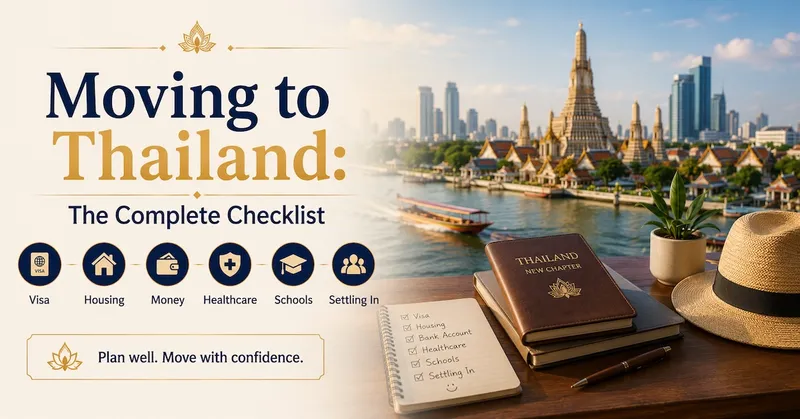
Planning to move to Thailand feels overwhelming, but it breaks down into a clear timeline: decide how you'll stay long-term (visa), which city and district to live in (housing), how to bring and spend money (finances), how to handle healthcare and insurance (medical), how children will attend school (education), and the pile of on-the-ground tasks after arrival — SIM, broadband, utilities, driving licence, transport and community (settling in). This is a master checklist and roadmap for moving to Thailand, organised into three stages — before you go, the first month, and once settled — linking each step to the detailed guide that expands on it, so you build your life without missing anything. Specific rules follow current agency regulations; consult on professional matters.

There's no single answer to how much a month in Thailand costs — it depends mainly on the city, housing tier and lifestyle. The biggest item is rent (central Bangkok condos are priciest; Chiang Mai and Pattaya are cheaper), followed by food (street food is very cheap, while restaurants and imported groceries push it up sharply), transport (BTS/MRT and taxis in Bangkok, motorbikes elsewhere), utilities, health insurance, and visa and sundries. Roughly three tiers: frugal (local food, a small unit outside the core), comfortable (a one-bed in a decent area, eating out often with occasional leisure), and generous (a good unit in the core, restaurants often, a helper, insurance). This guide breaks down each cost by city and spending tier to help you estimate your monthly budget; actual figures fluctuate with exchange rates, location and personal habits.

More Chinese families in and heading to Thailand are choosing postpartum confinement care there. Thai confinement centres typically offer postpartum lodging, confinement meals, mother-and-baby care, lactation support and postnatal recovery, with the environment and care experience as the main selling points. Choosing one comes down to four things: credentials and hygiene (properly registered, professional carers), services (carer ratio, meals, infant care, medical links), price and packages (per day/per package, whether care and meals are included), and location and hospital links (distance to the delivery/paediatric hospital and whether emergencies can reach care quickly). If you're travelling to give birth, also plan the visa, delivery hospital, birth registration and the baby's documents in advance. This guide covers services and pricing, how to choose, and how it connects with delivery and visas, subject to the centre's actual conditions and agency rules.

Thailand is a popular destination for cosmetic surgery and aesthetics — prices are relatively reasonable and some procedures (gender-affirming surgery, rhinoplasty, facial contouring) have deep experience — but travelling for surgery means getting four things right: a legitimate facility, a qualified surgeon, a proper consultation, and adequate recovery. Procedures range from injectables (mesotherapy, fillers, botulinum toxin) to surgery (double-eyelid, rhinoplasty, liposuction, breast augmentation, facial contouring), with wide price ranges across public teaching hospitals, large private hospitals and small clinics. Key pitfalls: choose a licensed hospital/clinic and a board-certified plastic surgeon, don't chase the lowest price or influencer before-and-afters, get a proper consultation and risk disclosure, leave enough time for recovery and follow-up, and enter legally on a tourist or medical-related visa for surgery. This guide covers common procedures, price ranges, how to vet a facility, and visa and recovery planning; outcomes and risks are for a licensed hospital and treating surgeon to assess.
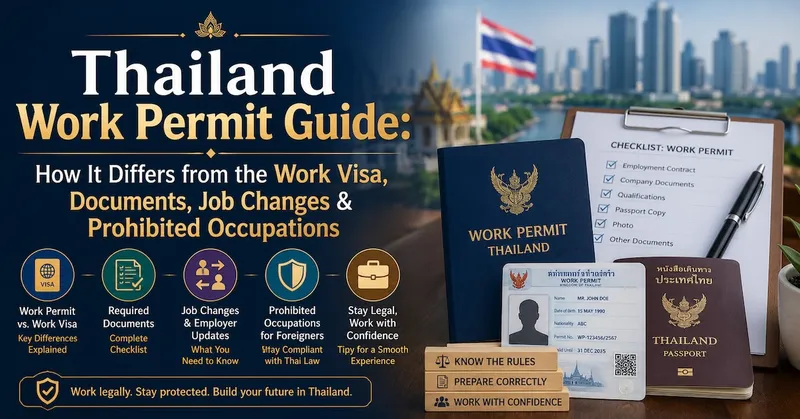
To work legally in Thailand, a work visa (Non-B) alone isn't enough — you also need a Work Permit, and the two are different: the work visa is permission to enter and stay, while the work permit authorises you to do a specified job for a specified employer. Typically you first hold a Non-B visa, then the company applies for your work permit, and only both together make employment legal. The permit is employer-initiated and tied to a specific company and position, so changing jobs means reapplying or amending it, and the company must meet capital and Thai-to-foreign staff ratio requirements (commonly four Thai employees per foreigner). Thailand also has a list of occupations prohibited or restricted for foreigners; working out of scope or without a permit is illegal and can bring fines, deportation and a blacklist. This guide covers the permit-versus-visa distinction, documents and process, handling job changes, and prohibited occupations, subject to current Ministry of Labour rules.

Getting from Bangkok to resort towns like Pattaya and Hua Hin comes down to three options: a private charter (fixed-price, hotel-to-hotel, most relaxed), a shared van/minibus (cheap but you wait to fill seats and use fixed stops), or a long-distance bus (cheapest but you transfer again on arrival). Bangkok to Pattaya is about 1.5–2 hours, to Hua Hin about 2.5–3 hours, and you can depart from a city hotel or straight from the airport. A charter is priced per car per trip including fuel and tolls, often cheaper than per-seat tickets once split among a group, and it can stop en route (a floating market on the Pattaya run, the Maeklong Railway Market toward Hua Hin). Avoid the traps: clarify point-to-point vs with-stops, whether waiting and cross-province fees are included, watch for low-price-then-add-on, and book ahead in peak season. This guide covers fares, travel time, the option comparison and booking tips.
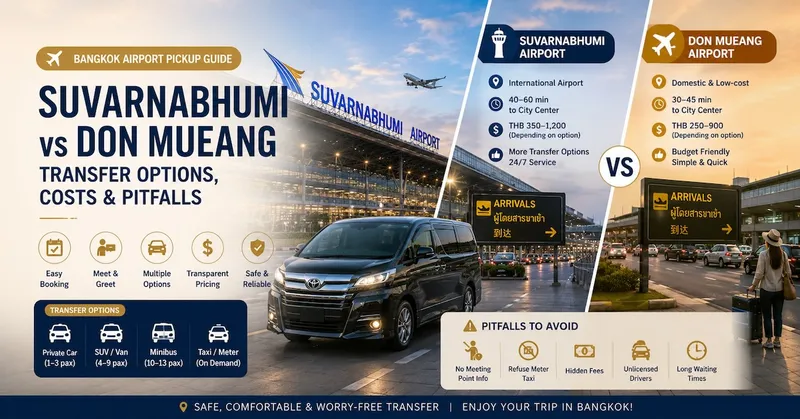
Bangkok has two airports: Suvarnabhumi (BKK, most international flights) and Don Mueang (DMK, mostly budget carriers). Both are about 30–45 minutes from the city but on opposite sides, so confirm which one you land at before booking. Three main ways reach the city: a pre-booked private transfer (driver meets you with a sign — easiest for first-timers, families, heavy luggage and late-night flights), the airport's official metered taxi (queue at the public taxi rank, meter plus airport surcharge and tolls), and — only at Suvarnabhumi — the Airport Rail Link (cheapest but you haul your own luggage and change lines). Key pitfalls: use the official taxi rank rather than touts, prefer a pre-booked car late at night or in heavy traffic, and leave plenty of time for cross-airport transfers. This guide covers the differences, the options' costs and trade-offs, and how to book a private transfer.

For a day trip around Bangkok, chartering a private car with driver is more relaxed than a group tour: one car and driver stay with you all day, you set the pace, and pricing is per vehicle and route. Popular routes are Ayutthaya's ancient temples, the Damnoen Saduak / Amphawa floating markets, Kanchanaburi (Bridge over the River Kwai, waterfalls) and the seaside town of Hua Hin — typically 8–10 hours including fuel, tolls and parking, with extra charges for overtime or cross-province trips. Choose the vehicle by group size and luggage: sedan for up to 3–4, MPV for 5–7, van for 8+. Avoid the traps: confirm whether it's a driver-only or driver-plus-guide, whether entrance fees and lunch are included, and use a licensed operator with passenger insurance. This guide covers routes, vehicles, what pricing includes and common pitfalls; final routes and prices depend on your actual booking.
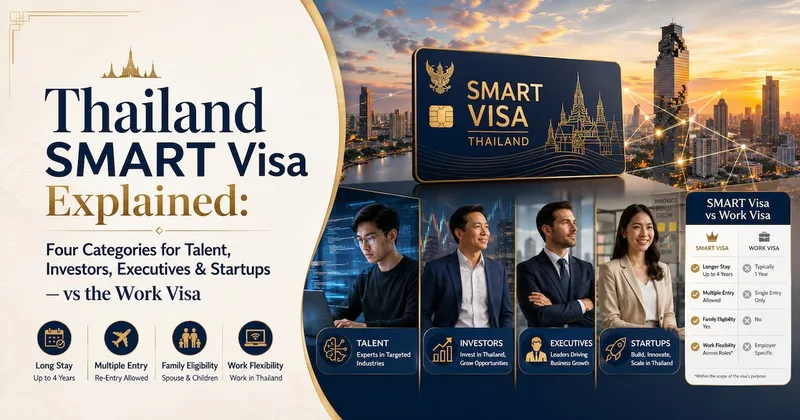
The SMART Visa is Thailand's special visa to attract talent in targeted industries (technology, digital, innovation), in four categories: Highly-Skilled Talent (T), Investor (I), Executive (E) and Startup (S). Its appeal: up to a four-year visa for those who qualify, the ability to work within the approved scope without a separate work permit, 90-day reporting relaxed to once a year, and dependants who can join — with spouses generally allowed to work. But the bar is defined: your role must fall in a BOI-endorsed targeted industry and meet salary or investment thresholds, with certification by the relevant authority, so vetting is stricter than an ordinary work visa. It differs from the standard "work visa + work permit" route, which suits most employed foreigners, whereas SMART targets high-end talent, investors and founders in targeted industries. This guide covers the four categories' requirements, benefits and how to choose between SMART, the work visa and LTR, subject to current BOI and agency rules.
The rainy season is peak time for dengue and other mosquito-borne disease in Thailand: standing water breeds Aedes mosquitoes, dengue spreads via daytime-biting mosquitoes, and typical symptoms are sudden high fever, severe headache and pain behind the eyes, muscle and joint pain ("breakbone fever") and rash. Most recover, but a few progress to severe dengue (bleeding, shock) needing prompt care. There's no specific cure — treatment is supportive with fluids — and you must avoid self-medicating with aspirin/ibuprofen, which can worsen bleeding. Beyond dengue, the rainy season also brings gastroenteritis, colds and flu, fungal skin infections and leptospirosis (from contaminated water). Prevention centres on clearing standing water, avoiding bites and food hygiene. This guide covers dengue symptoms and warning signs, mosquito prevention, other rainy-season illnesses, and when you must see a doctor and insurance-claim points — subject to a doctor's and clinic's advice.
Thailand's rainy season roughly runs from May to October (varying by region — Bangkok and the central plains usually see the heaviest rain in September and October, while the Andaman side of the south starts earlier and lasts longer). It doesn't rain all day; typically a sharp downpour arrives in the afternoon or evening, coming and going fast, but short intense rain easily floods low-lying roads, snarls traffic and delays flights. The keys to a good rainy season are: carry an umbrella and waterproofing, avoid flood-prone roads and the downpour peak, damp-proof your home, drive slowly and away from standing water, and guard against dengue and other rainy-season illnesses. This guide covers the timing and pattern, getting around on flood days, damp-proofing at home, driving safety and what to prepare — subject to local weather forecasts.
Thailand offers plenty of fitness choices: premium chains (Fitness First, Virgin Active and others), mid-range and budget gyms, condo gyms, Muay Thai camps and yoga studios. Before choosing, be clear on needs and budget — premium chains have great facilities, full equipment and classes but pricey memberships often tied to long contracts; budget gyms and monthly/pay-per-visit options are more flexible for those who don't want to be locked in; condo gyms are free but limited. The biggest trap when signing is long contracts with auto-renewal, hard cancellation and high-pressure personal-training sales, so read the term, refund and freeze clauses carefully. This guide covers choosing a gym, paying for membership wisely, contract traps, whether personal training is worth it, and how to try Muay Thai — subject to each venue's current policy.

Once your pet is in Thailand, day-to-day care is easier than expected: veterinary care is well developed and generally affordable, and big cities have plenty of animal hospitals, clinics, groomers, pet shops and boarding, with chain hospitals and 24-hour emergency in Bangkok and Chiang Mai. Key points are finding a reliable vet for vaccinations and deworming, keeping a pet passport and health record (needed to leave or return home), guarding against ticks and heartworm (common in the tropics), and arranging boarding or home feeding when you travel. Note many condos restrict pets. This guide covers choosing a vet, vaccinations and deworming, grooming and boarding, tropical health precautions, and linking pet renting with importing and future export — subject to the relevant authorities' and clinics' current requirements.

Hiring domestic help in Thailand is more common and affordable than many expect. Common needs include a cleaner (by session), a live-in or live-out maid (cooking and childcare), a nanny, and elderly care. Channels include agencies, brokers, personal referrals, condo management and online platforms, and rates float by city, live-in or not, workload and whether the helper speaks Chinese or English — a Chinese-speaking helper usually costs more. Watch compliance: employing a foreign (e.g. Myanmar) helper engages their work permit and legal status, and long-term live-in employment involves wages, rest and social security. This guide covers choosing the type of help, where to find it, negotiating rates, contracts and deposits, and employment compliance and background checks — subject to Thailand's current rules on employment and permits.
Foreigners can get a credit card in Thailand, but the bar is higher than for locals: most banks require an existing local bank account, a valid long-term visa and a work permit (or proof of stable Thai income), and a tourist visa rarely qualifies. There are two common paths: with a work permit and local income, apply for a local card the normal way; without a permit or income proof, use a secured card — a fixed deposit as collateral for a credit limit, the safest route. Also, local payments lean heavily on PromptPay and mobile-banking QR scans, so many daily situations don't use a credit card at all. This guide covers eligibility, workable options by profile, how a secured card works, and why sorting your bank account and local payment habits first matters more — subject to each bank's current policy.

For a long stay or frequent visits to Thailand, a few Thai phrases make taxis, ordering, shopping, seeing a doctor and dealing with landlords far smoother, and help you fit in. Thai is a tonal language with its own alphabet, so short-term you needn't force reading and writing — start with high-frequency survival phrases like hello, thank you, how much, not spicy, this, the bill, and I don't speak Thai, plus numbers and polite words, and you can handle daily life. To study systematically, choose a language school (which can pair with an ED student visa), one-to-one tutoring, online courses, or tools like Duolingo and ChatGPT — learning by using is most efficient. This guide gives the most practical survival phrases, pronunciation and politeness points, and a learning path from zero to daily conversation.
Getting around and eating in Thailand runs largely on apps: for rides, Grab and Bolt let you pin a location, see the price, book and pay online or in cash — more transparent than flagging a car and less prone to detours and overcharging; for food, Grab Food, Lineman and Robinhood deliver meals, groceries, medicine and errands (Foodpanda has left Thailand). The first step to using them is a local phone number and a payment method (a local bank card or in-app wallet); Chinese support is limited but the flow is intuitive. This guide covers choosing ride and delivery apps, signing up and adding a card, paying and tipping, and avoiding traps like wrong pins, peak surge and unclear addresses — so you can order smoothly from day one, subject to each app's current rules on coverage and fees.

For travel or errands in Thailand, a private charter (a car with driver) is often more hassle-free than self-driving or hailing taxis: ideal for families with elderly and children, multi-stop cross-city trips, heavy luggage, language barriers or flexible itineraries. Charters are usually charged by the day, including car, fuel and driver, while overtime and extra mileage, tolls, driver accommodation and attraction tickets are typically extra. Choose the vehicle by headcount and luggage (sedan, 7-seat MPV, 9–13-seat van, minibus for larger groups), and clarify in the quote whether fuel and tolls are included, how overtime is charged, and whether crossing provinces costs more. This guide covers when to charter, how to pick by headcount, what day-trip and multi-day quotes include, common traps, and how to negotiate a transparent price — subject to the provider's current rates.
Holding and trading cryptocurrency in Thailand is legal, but it must be compliant: Thailand regulates and taxes digital assets (crypto and tokens), exchanges must be licensed, and gains from personal trading are taxable income. Selling for profit, crypto-to-crypto swaps, mining, airdrops and staking rewards can all trigger personal income tax, and funds repatriated from overseas exchanges also engage the tax-residency and overseas-income remittance rules. Recent adjustments (such as VAT relief on some trades via licensed local exchanges) aim to support the sector, but the personal income tax obligation hasn't disappeared. This guide covers who pays, which actions may be taxed, how overseas trading and remittance are treated, and how to keep records and report compliantly — subject to the Revenue Department and SEC's current rules.
The LTR (Long-Term Resident) visa is Thailand's long-stay visa to attract wealthy individuals, affluent retirees, remote-working professionals and highly skilled experts. It offers up to around ten years of residence (typically issued in stages, renewed on continued eligibility), plus perks such as annual reporting instead of 90-day reporting, multiple re-entry, the option of a digital work permit, and preferential personal income tax for some categories. It targets people with higher income, assets or investment, so the bar and paperwork are higher than a tourist visa or DTV — but you get a far more hassle-free long-term status. This guide covers the four LTR categories, their income/asset thresholds, the perks, and how to choose between LTR, the Privilege visa, DTV and retirement visas — subject to the BOI and Immigration's current rules.
Beyond drugs, the criminal trouble foreigners most often fall into in Thailand includes assault, fraud and financial disputes, illegal work, visa overstay, drink-driving and traffic offences, and defamation. Once criminal proceedings begin, the path is roughly report/arrest, police investigation, prosecution and trial, with bail available while awaiting trial. The key moves are: stay silent, don't sign documents you can't read, engage a criminal lawyer quickly, and contact your embassy if needed. This guide explains common criminal offences in Thailand, the full path from arrest to judgment, how to apply for bail, and traps foreigners should watch — so you know which step you're at and what to do next, subject to Thai law and a practising lawyer's advice.
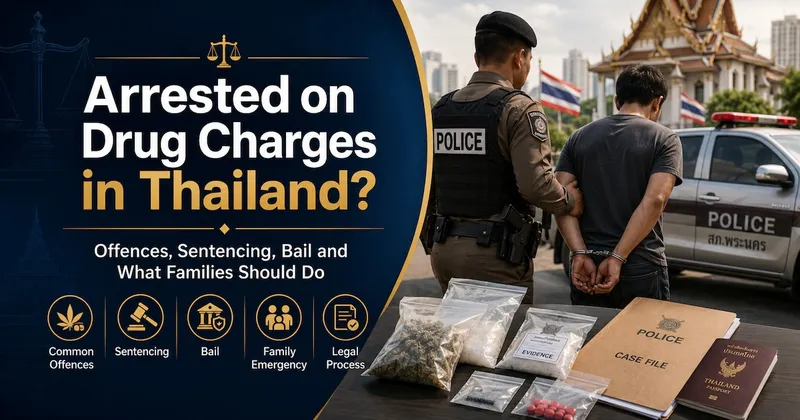
Drug offences in Thailand are serious crimes with heavy sentences. The line between possession, transport and trafficking mainly turns on quantity and circumstances, and larger amounts or an inferred intent to distribute can mean long imprisonment or worse. If arrested, the key is to stay calm, not sign Thai documents you can't read, and get a lawyer and your embassy involved quickly; families should immediately engage a criminal lawyer to learn the charges, place of detention and bail prospects. Thailand allows bail, but in drug cases it is often hard, with high sureties, and always at the court's discretion. This guide explains common drug offences and sentencing logic, what the accused and family should do, and how bail and consular help work — subject to Thai law and a practising lawyer's advice.
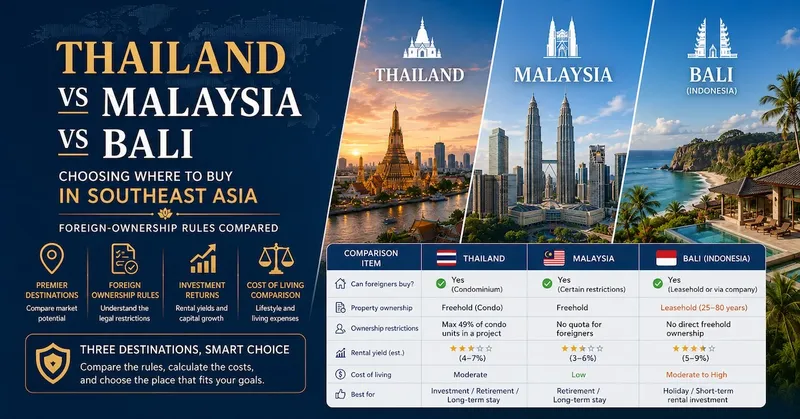
For buying in Southeast Asia, Thailand, Malaysia and Indonesia's Bali are three popular choices, but foreign-ownership rules, costs and suitability differ greatly. Thailand: foreigners can buy condo freehold (49% foreign quota), can't hold land individually, and villas use leasehold or a company; mature living, strong tourism, good value. Malaysia: foreigners can buy property above a local minimum price threshold (including landed property, rules by state), with the MM2H long-stay programme, widespread English and an English-style legal system. Bali (Indonesia): foreigners can't hold land title directly, commonly using Hak Pakai (right of use) or leasehold, with a strong holiday character and relatively complex rules. This guide compares the three on ownership, residency, cost and who they suit; each country's rules are subject to its official current rules, and this is not investment or legal advice.
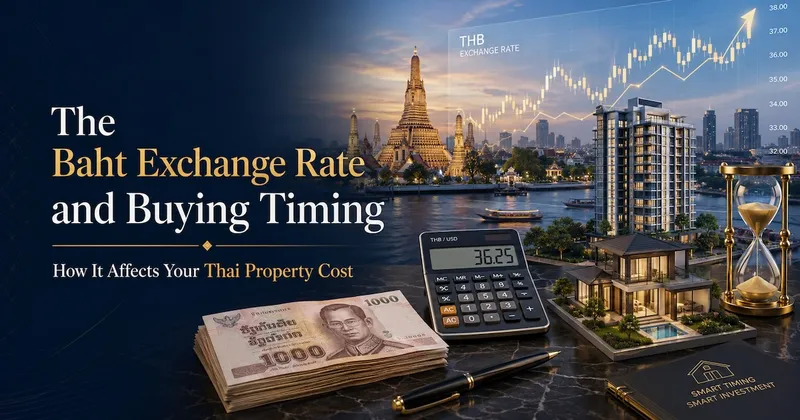
Thai property is priced in baht, but your funds are mostly in another currency, so the baht exchange rate directly affects your real purchase cost and your take-home proceeds when you later sell. Put simply: the stronger your currency against the baht (the more baht it buys), the cheaper the purchase; weaker, and it costs more. The rate also affects off-plan instalments (long span, big swings), the amount you repatriate on sale, and your return in your home currency. But be clear-eyed: rates are hard to predict, don't rush to buy chasing a rate, and don't count on the rate to make money — the home's location, title and price are what matter. The rational approach is to treat the rate as a cost variable in the budget, use tools to compute, and convert in tranches to spread risk. This guide explains how the rate affects buying and how to treat timing rationally; rates are live, not investment or financial advice.
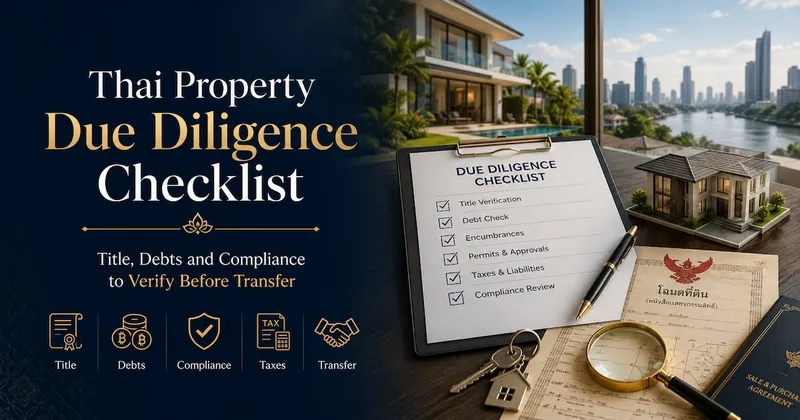
In Thailand, due diligence before transfer is the most important, most pitfall-blocking step. Five core areas to check: first, title — verify the deed type (whether Chanote), that the owner is the seller, and that area and boundaries match; second, debts and encumbrances — any mortgage, seizure, or unpaid management fees and utilities; third, the foreign quota (condos) and land limits (villas) — whether a foreigner can lawfully hold it; fourth, the developer and project (off-plan) — delivery record, EIA and construction permits; fifth, the contract and funds — review the sale contract and confirm funds can be remitted compliantly for the FET. Most of this needs a lawyer verifying originals at the Land Office. This guide gives a checklist to work against, subject to the Land Department's current rules and a lawyer.

Buying Thai property, you'll often see developers promise 'guaranteed X% for X years' or 'hassle-free rent-back' — it sounds like sure money, but be extra careful. Three core problems: first, high rent-back is often baked into a higher price, so you're paid with your own money; second, whether it's honoured depends entirely on the developer or operator's long-term operation — if occupancy misses targets, they underperform, or the operator vanishes, the rent-back fails; third, the paying party, term, end-of-term arrangement and default remedies in the contract are often vague. Rent-back isn't untouchable, but review it as a 'conditional, risky operating arrangement,' not a 'guaranteed fixed return.' This guide breaks down how rent-back works, common tricks and review points, subject to the contract; not investment advice.

Property a foreigner buys in Thailand (mainly condo freehold) can in principle be inherited, but it involves foreign-ownership limits, wills and legal procedure — handled poorly, heirs may face a requirement to dispose of or transfer the property. Key points: a foreigner's lawfully held condo freehold can pass to heirs as an estate, but if the heir is also a foreigner they're equally bound by limits like the 49% condo foreign quota, and in some cases may be required to dispose of (sell) the property within a set period; land, which foreigners can't own anyway, makes villa lease rights or company structures more complex to inherit. To avoid disputes and uncertainty, it's strongly advisable to make a proper Thai will covering the property and consult a lawyer in advance. This guide explains the basic rules and will points, subject to Thai law and a lawyer; not legal advice.
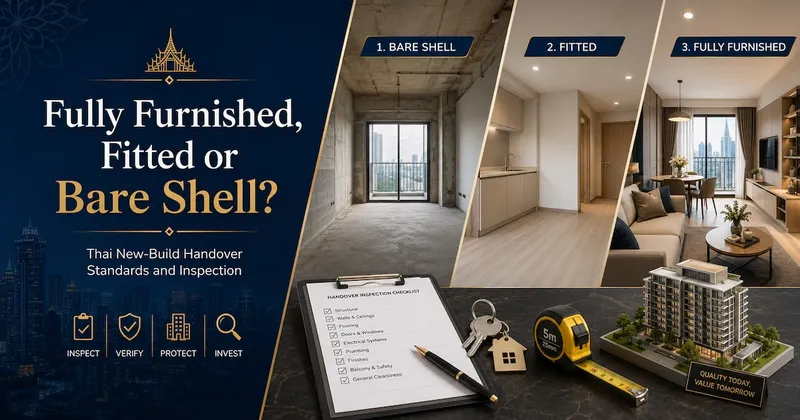
When buying a Thai new build (especially off-plan), the handover standard directly affects whether you'll spend more to fit it out. Thai condos commonly come in a few handover levels: bare shell (only basic floors, walls and utility points — you fit it out yourself), fully fitted (floors, kitchen cabinets, bathroom fixtures, air-con and other fixed finishing but no loose furniture), and fully furnished (move-in ready with furniture and appliances included). Show units are usually dressed to the highest spec, so the actual contract handover may be lower — before the deposit, spell out in the contract what the handover includes and excludes, and inspect strictly against it at handover. This guide explains the handover levels, contract points and an inspection checklist, subject to the developer's contract.

House-hunting in Thailand throws up a few easily confused property types. A Condominium (condo) is a strata-titled building where ownership is split per unit and foreigners can buy freehold — the mainstream route for foreign buyers. An Apartment is usually a whole building held by a single owner, rent-only, where foreigners generally can't buy title. A villa (house) is a landed detached home, needing a long lease or company holding since foreigners can't own land; a townhouse is also landed with the same restriction. There are also serviced apartments (hotel-style service, mostly leasehold). The key to telling them apart: whether title can be split per unit, whether foreigners can buy, and whether land is involved. This guide explains each type and how foreigners should choose, subject to the Land Department and a lawyer; not investment advice.

Hua Hin and Koh Samui are two very different lower-key resort destinations in Thailand. Hua Hin, southwest of Bangkok (about a three-hour drive), is a royal resort town — quiet, moderate living costs, good golf and beaches, favoured by retirees and Bangkok weekenders, slower than Pattaya and cheaper than Phuket. Koh Samui, in the Gulf of Thailand and reached by plane or ferry, is an upmarket resort island led by villas and sea-view condos, with many international tourists and strong but seasonal short-let potential, though island transport and amenities trail the big cities. In both, condos are freehold-eligible for foreigners and villas are equally bound by the ban on foreign land ownership. This guide covers each town's profile, who it suits and buying notes. The market moves with timing, subject to live data; this article is not investment advice.

You can complete a Thai property purchase from abroad without flying to Thailand, and the key is a compliant Power of Attorney (POA). The core hurdle is that the Land Office transfer usually requires the buyer to attend; if you can't be there in person, you can lawfully arrange a POA to authorise an agent in Thailand (usually a lawyer) to sign documents and handle the transfer. The full remote chain: remote viewing/due diligence, lawyer contract review, preparing and notarising the POA, remitting the price compliantly from abroad for the FET, the lawyer using the POA to transfer at the Land Office, and receiving the title. Remote handling demands more of documents, the scope of authority and fund compliance, and any weak link can block the transfer, so a reliable lawyer throughout is strongly advised. This guide explains the remote process, arranging the POA and the cautions, subject to the Land Department's current rules, with key steps verified by a lawyer.

Many buy a Thai condo hoping to earn high returns via Airbnb short-let, but compliance comes first: Thailand's hotel regulations clearly restrict daily short-let — renting a residential unit by the day to short-stay guests (hotel-like) is usually unlawful without a hotel licence; moreover the vast majority of condos' by-laws explicitly ban short-let, and breaching gets you reported by neighbours and penalised by management. Lawful long lets (generally 30+ days, or monthly/yearly) are not restricted. So counting on Airbnb daily-rent income carries real risk: fines, a management ban, and season-swung returns. To let compliantly, either do long lets or choose a project that itself permits short-let operation (rare). This guide explains Thailand's short-let restrictions, condo by-laws and the compliant approach, subject to Thai regulations and project by-laws; this article is not legal or investment advice.

In Bangkok, following the BTS Skytrain and MRT subway is almost an iron rule: condos on metro lines within a short walk of a station have commute certainty, so tenants and buyers prefer them, meaning easier rentals, lower vacancy, better value retention and faster resale. To judge whether a metro property is worth buying, focus on the walk to the station (a clear premium within 5-10 minutes), whether it's an established line or a planned/under-construction extension, the maturity of amenities around the station, and whether the price has already priced in the metro story. New extensions carry upside, but check that amenities actually follow rather than there being just a rail line. This guide explains the value logic of buying near Thai metro lines, how to pick stations and avoid fake metro projects. Prices move with timing, subject to live data; this article is not investment advice.
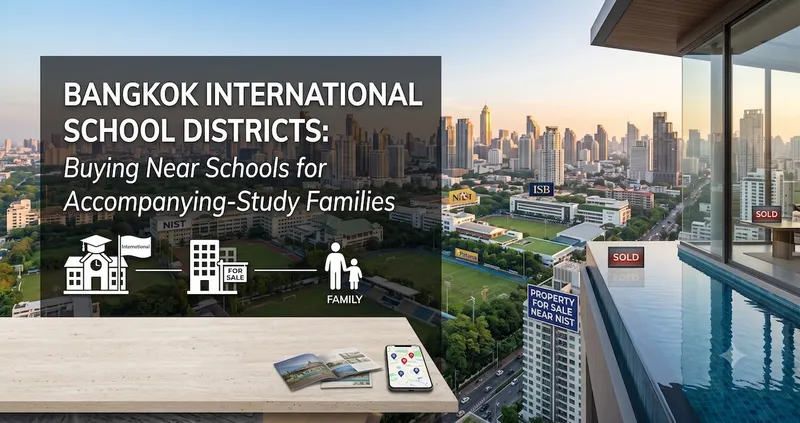
For families bringing children to Bangkok for international school, the core of choosing a home is being close to school, easy drop-off and full amenities, not price alone. Bangkok's international schools are scattered, many on the city's outskirts (eastern Sukhumvit, Bangna, the Ekkamai-Ramindra belt), so choose the school first, then the area, focusing on drive time and school-bus routes, nearby supermarkets and hospitals, and whether there's an accompanying-study community. Popular areas include Phrom Phong-Thonglor (Japanese community, mature living), eastern Sukhumvit (On Nut-Bangna, near several schools) and each school's own residential surroundings. Whether to buy or rent depends on how long you'll accompany the study. This guide explains Bangkok school-area logic, popular areas and the buy-vs-rent call. Admissions and catchments are per each school; prices are subject to live data; this article is not investment advice.
A foreigner selling property in Thailand (exiting the investment) runs the reverse of buying but through the same three gates — title, tax and funds: find a buyer and negotiate, sign the sale contract and take a deposit, transfer at the Land Office paying the seller's taxes, then repatriate the proceeds compliantly. Selling taxes fall mainly on transfer day: the transfer fee, stamp duty or specific business tax (about 3.3% if held under 5 years), and the seller's withholding tax, split by contract. Reselling after holding 5 years (or meeting the registered-residence condition) saves tax. A foreign seller's proceeds leaving Thailand need the original purchase FET and transaction documents to prove source. This guide covers the selling process, the taxes, and how to repatriate compliantly. Rates and policy can change, subject to the Land Department's and Revenue Department's current rules.
For a foreigner buying a condo and registering freehold in Thailand, there's a key fund-compliance step: the purchase price usually must be remitted from abroad in foreign currency, converted to baht at a Thai bank, which then issues a Foreign Exchange Transaction (FET) certificate (a formal document above a threshold amount). This FET is an important proof for registering foreign freehold at the Land Office, showing your purchase funds came from overseas; it's also the basis for later repatriating funds compliantly when you sell. So a purchase remittance can't be sent casually and certainly not settled in cash — note the purchase purpose, amount and project, and keep the bank's FET safe. This guide explains what the FET is, why it matters and what to watch when remitting, subject to Thai banks' and the Land Department's current rules.
When buying in Thailand, the title deed is the core document for verifying ownership. The highest and clearest is the Chanote (Nor Sor 4 Jor, a fully surveyed formal title); there are also Nor Sor 3 Gor, Nor Sor 3 and other possession/use certificates, descending in grade and protection. Foreigners can hold condo freehold, registered in your name; landed property, because foreigners can't own land, often has restricted freehold and instead uses leasehold (commonly 30 years, renewable). Before buying, always verify: whether the deed is a Chanote, whether title is clean with no mortgage or dispute, whether the area and boundaries match, and whether you're getting freehold or leasehold. This guide explains Thailand's main deed types and the freehold/leasehold difference, subject to the Land Department's current rules, with major title issues verified by a lawyer.
Phuket is Thailand's largest island and an international resort destination, its property market led by upmarket holiday villas and sea-view condos, drawing investment, holiday and retirement buyers, with prices and tiers above Pattaya. In Phuket, location is judged mainly by which beach, distance to the airport and convenience: the west-coast Patong (lively nightlife, touristy), Kamala/Surin/Bang Tao (upscale, quiet, villa-dense), and Rawai/Nai Harn (southern retirement and long-stay feel) each have a profile. Phuket condos are freehold-eligible for foreigners, while villas are equally bound by the ban on foreign land ownership — mostly long-lease or company-held. Holiday short-let has strong potential but swings with season and compliance, and villa management costs are high. This guide covers Phuket's areas, property types and investment notes. The market moves with timing, subject to live data; this article is not investment advice.
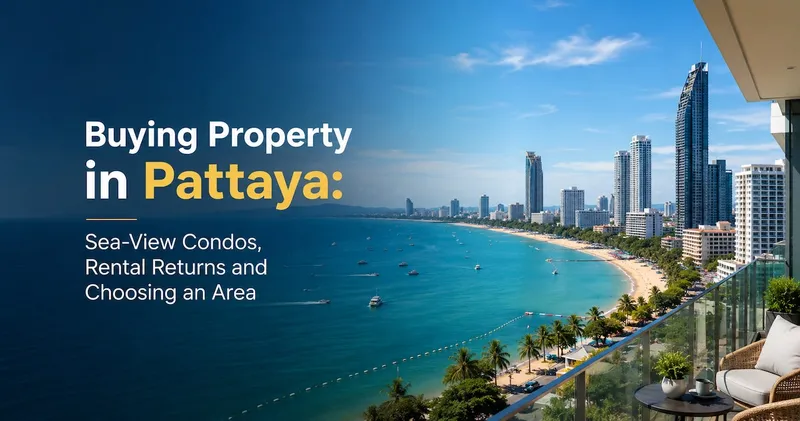
Pattaya is the beach city closest to Bangkok (about a two-hour drive), drawing investment and holiday buyers with sea-view condos, a resort vibe and relatively accessible prices. Unlike Bangkok's commute focus or Chiang Mai's slow living, Pattaya's core pitch is sea, holiday and short-let potential. Popular areas include the centre and beachfront (Beach Road, Central Pattaya — lively amenities), Jomtien Beach (quieter, sea-view condos, favoured by Chinese buyers), and the Pratumnak hillside (upscale, quiet, linking the centre and Jomtien). Pattaya condos are freehold-eligible for foreigners and often cheaper than Bangkok equivalents, but rental returns swing heavily with the holiday season, and short-let raises compliance issues. This guide covers Pattaya's areas, who it suits and investment notes. The market moves with timing, subject to live data; this article is not investment advice.

Chiang Mai is northern Thailand's slow-living city — pleasant climate, low living costs, and mature expat and digital-nomad communities — especially suited to retirement and accompanying-study families, and it draws long-stay own-use buyers too. Unlike Bangkok, Chiang Mai has no dense metro, so location is judged mainly by drive time to the Old City, airport, international schools and malls, and by convenience. Popular areas include around the Old City (convenient, touristy), Nimman (trendy, café culture, expat hub), and the southern airport side and Hang Dong and San Sai villa and low-density districts. Chiang Mai offers more villas than Bangkok, but the ban on foreign land ownership applies equally — villas are mostly long-lease or company-held. This guide covers Chiang Mai's areas, who it suits and buying notes. Prices move with timing, subject to live market data; this article is not investment advice.
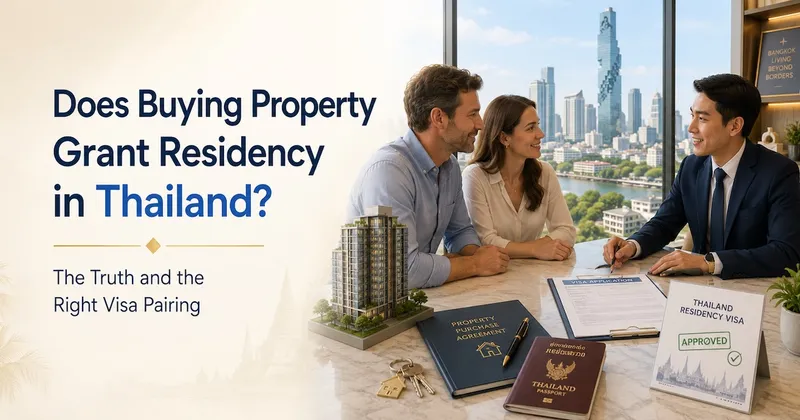
The bottom line first: buying property in Thailand does not automatically grant residency, a long-stay visa or a work permit — the most common misconception. Thailand has no buy-a-home-get-status policy; property is an asset, a visa is status, two different things. To live in Thailand long term you apply separately for a suitable visa: the Thailand Privilege (Elite) visa, a retirement visa (50+), the LTR long-term resident visa, or accompanying-study, work and marriage visas, each with its own conditions. The right approach keeps buying and residency separate yet coordinated: first work out which visa keeps you in Thailand long term, then decide the city, type and budget of your purchase. This guide explains the real relationship between buying and the visa and how each long-stay visa pairs with property, subject to Thai Immigration's current rules.

Renting in Thailand mostly means renting a condo, and the flow runs: set your budget and area, find and view places, negotiate the deposit and term, sign the lease paying two-plus-one, then move in and set up utilities. In big cities like Bangkok, long lets usually take two months' deposit plus one month's advance rent, with a one-year lease; short stays can use serviced apartments but cost more. Key things to check when renting: the term and early-exit clause, deposit-refund conditions, how utilities are charged, the furniture list, and whether the landlord will do your TM30 address registration. Compared with buying, renting is flexible and low-barrier, ideal for those newly arrived, still deciding, or staying short to medium term. This guide covers finding to moving out, with terms subject to the lease and local rules.

The pitfalls foreigners hit buying in Thailand cluster into a few types: using nominee Thai shareholders to hold land through a company and dodge foreign-ownership rules (non-compliant, and title may be lost), not checking the foreign quota before the deposit and then being unable to transfer, trusting verbal promises and ‘guaranteed rent-back’, buying off-plan from a weak developer that delays or stalls, not checking a resale home's mortgage and arrears, paying in cash so the source can't be proven and transfer is blocked, skipping lawyer due diligence, ignoring the FET certificate so funds can't move in or out, being misled by exaggerated renders and ‘sure-win’ talk, and assuming buying grants a visa. Avoiding them comes down to three things: use a lawyer for due diligence, remit compliantly and keep the FET, and put everything in the contract. This guide covers all ten and their fixes, subject to the Land Department and current law, with major decisions verified by a lawyer.

Rental yield on Thai property (gross rent ÷ price) has a reference range on core-city metro lines, but the ads' ‘guaranteed 6%–8% annual return’ mostly dress up gross yield, rent-back subsidies or short-term gimmicks — what you actually keep is only real after deducting management fees, sinking fund, property tax, vacancy, management costs and currency swings. To judge whether a Thai property is worth it, look at three things: location and rental certainty (metro-adjacent, stable tenant sources), net rather than gross return, and the taxes and ease of exit on sale. Be especially wary of ‘guaranteed rent-back’ — developers use high rent-back to inflate the price, and whether it's honoured depends on their ongoing operation, a real risk. This guide breaks down how to compute real returns, rent-back traps and common myths. The market moves with timing, subject to live data; this article is not investment advice.
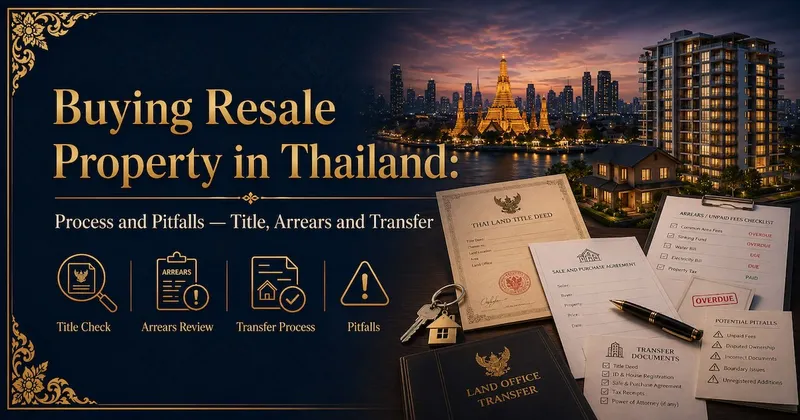
The big advantage of buying a resale home in Thailand is seeing the real thing, moving in now, with mature surroundings — and prices are often friendlier than new builds in the same area — but you must clear the title and condition gates yourself. The typical flow: view and inspect → check the title deed and foreign quota → negotiate, sign a reservation and pay a deposit → lawyer due diligence (mortgages, arrears, disputes) → sign the sale contract → remit funds from abroad for the FET → transfer and settle in one go at the Land Office. Resale pitfalls centre on: a seller who isn't the true owner, a home with a mortgage or unpaid fees, a full foreign quota blocking transfer, and unclear utility and management handover. This guide breaks down each step and the checks that matter, subject to the Land Department's current rules, with key steps verified by a lawyer.

Buying off-plan in Thailand means purchasing before a project is built, paying in stages by construction progress, and transferring only at handover. A typical sequence: sign a reservation and pay a deposit → sign the sale contract and pay the down payment (commonly 20%–30% of the price) → pay by milestones during construction → inspect at handover → transfer at the Land Office for the title. Off-plan's appeal is a lower unit price, spread-out payments and more choice of floor and layout; the risks are delayed handover, stalled projects, a gap between renders and reality, and whether the foreign quota is reserved. Before buying, check the developer's record, delivery history, EIA and construction permits, and pin down handover dates, penalties and refund terms in the contract. Subject to the developer's contract and the Land Department's current rules, with key terms verified by a lawyer.
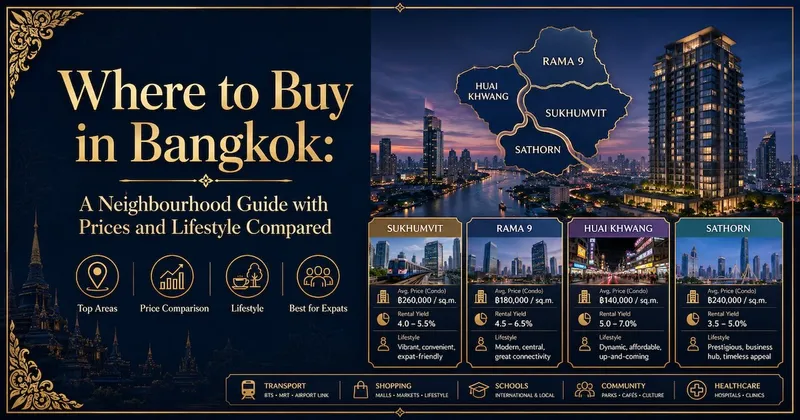
The first rule of choosing where to buy in Bangkok: follow the BTS Skytrain and MRT subway — rail-line locations mean easy commutes, strong rental and resale demand, and better value retention. Areas popular with own-use and investor buyers include the Sukhumvit line's Asoke, Thonglor and Ekkamai (mature, international, high rents); Sathorn/Silom (the central business district, full of offices); Ratchada/Rama 9 (an emerging CBD, friendlier prices, good metro access); and lifestyle areas like Phrom Phong and Ari. Own-use looks at schools, healthcare and community; investment looks at metro-adjacent units and rental demand. This guide explains how to pick a Bangkok location by area profile, commute logic, and own-use versus investment. Price ranges move with projects and timing, subject to live market data; this article is not investment advice.

Beyond the price, most taxes on a Thai property purchase fall on transfer day at the Land Office: the transfer fee (typically 2% of the appraised value), stamp duty (0.5%) or specific business tax (SBT, about 3.3% if the seller has held under 5 years — the two don't stack), and withholding tax (paid by the seller per the rules). How these split between buyer and seller is set by contract; in practice a 50/50 split or as agreed is common. During ownership there are annual costs too — common area fees, sinking fund and land and building tax. This guide totals it up across four lines: what's due on transfer day, who splits it, holding costs, and taxes when you sell. Rates and reliefs can change, so exact amounts are subject to the Land Department and Revenue Department's current rules.
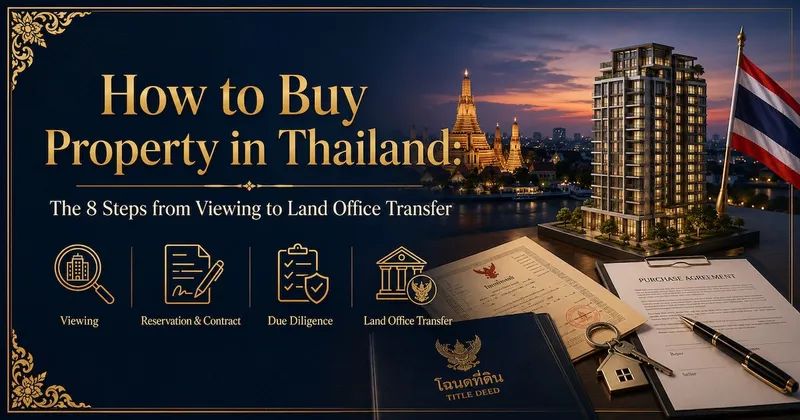
A full property purchase in Thailand roughly runs: set your budget and purpose (own-use/investment) → choose an area and view → check title and the foreign quota → sign a reservation and pay a deposit → have a lawyer do due diligence → sign the sale contract and pay by milestones → remit the price from abroad and obtain the FET certificate → transfer at the Land Office and receive the title. Off-plan is paid in stages by construction progress and transferred on completion; resale usually settles in one go. Throughout, use a lawyer to vet the contract and title — don't pay on an agent's verbal promise alone. This guide breaks down the 8 key steps and the traps at each, subject to the Land Department's current rules, with critical steps verified by a lawyer.

The single most important rule for foreigners buying property in Thailand: you can legally own a condominium (Condo) freehold, but as an individual you generally cannot own land. Across a whole condo building, the total area held by foreign buyers cannot exceed 49% (the foreign quota), and the purchase funds usually must be remitted from abroad with a Foreign Exchange Transaction (FET) certificate issued. For a villa or landed property, common routes are a long-term lease of the land (Leasehold, typically 30 years renewable) or holding through a compliant Thai company, though company landholding carries compliance risk and needs care. This guide covers what you can buy, ownership forms, the foreign quota, fund compliance, villas, and common myths — subject to the Land Department and current law, with major decisions verified by a lawyer.
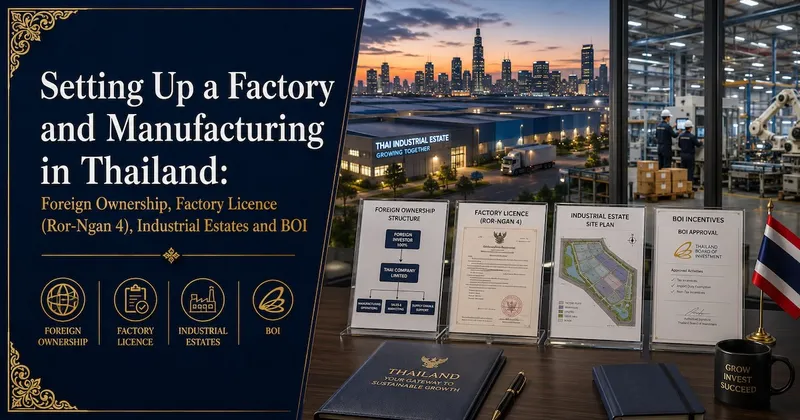
Thailand is a Southeast Asian manufacturing hub, and many Chinese firms want to set up a factory — but that's far more complex than a trading company: you handle foreign shareholding (manufacturing is relatively open but still needs a compliant structure), obtain a factory licence (Ror-Ngan 4 / รง.4, required for factories above a machinery-power or worker threshold), pick the right site (an IEAT industrial estate vs own land, and whether foreigners can hold it), do an EIA where required, arrange work permits for expat managers and local hiring, and pay duty on imported machinery and materials. A BOI promotion can secure a tax holiday, foreign land holding and expat-employee quotas. This guide covers foreign structure, factory licence, site/land, BOI benefits, and hiring/equipment import, subject to the DIW, BOI and relevant authorities' current rules.
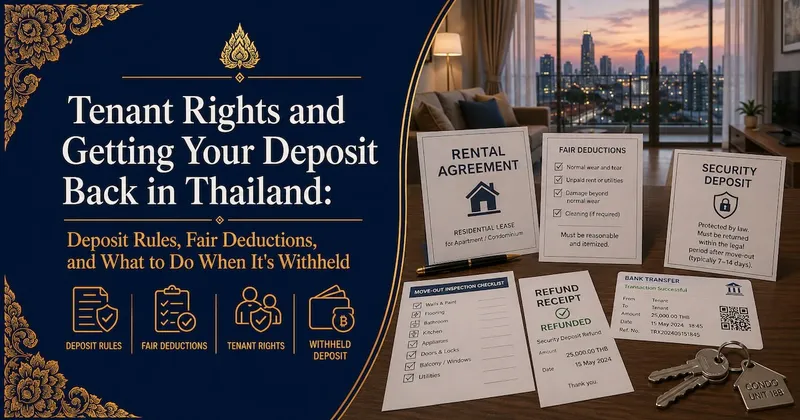
The most common rental dispute in Thailand is a landlord unfairly withholding the deposit at move-out. The bottom line: a deposit is security, not the landlord's money — normal wear and tear shouldn't be deducted, deductions must be reasonable and evidenced, and the balance returned. Since 2018, a controlled residential-lease rule for landlords with several units to rent (deposit capped at one month, no unreasonable withholding, prompt return) gives tenants more protection; even where it doesn't apply, the contract and the Civil and Commercial Code bind both sides. To get your deposit back, sign a proper contract, photograph the unit at move-in and move-out, and distinguish wear from damage; if talks fail, use consumer-protection channels or the courts. This guide covers deposit rules, what can and can't be deducted, and how to fight unfair withholding, subject to the relevant authorities and current law.
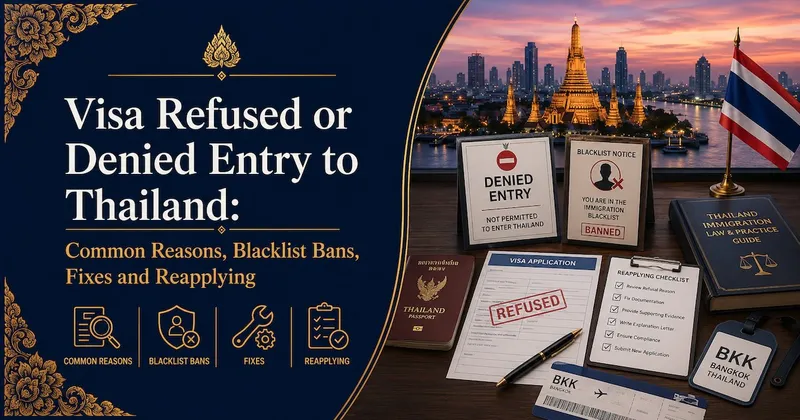
A refused visa, a stop at the border or being turned back at the airport are among the most stressful moments. First separate two things: a visa refusal at an embassy/consulate, and being denied entry by Immigration at a Thai checkpoint (turned back on the same flight). Thailand has broad discretion over visas and entry, and most refusals/denials have no formal appeal — the right move is to understand the real reason, fix it and reapply or switch to the correct visa. If overstaying etc. put you on a blacklist (entry ban), a ban period applies. This guide covers common reasons, the blacklist mechanism, whether you can appeal, and practical fixes, subject to Thai embassies and Immigration's current rules.

To trade goods into or out of Thailand, having the goods isn't enough — you must clear three gates: entity, customs clearance, and tax. Importing/exporting usually needs a lawful company registered as an importer/exporter in Customs' e-system; goods are classified by HS code, which sets the rate; imports pay import duty plus 7% import VAT (some goods also excise), and food, cosmetics, electricals etc. need permits and standards. A Form E certificate of origin under the ASEAN–China FTA can secure preferential or zero duty, but wrong classification, under-valuation or missing permits get goods seized with back-tax and fines. This guide covers entity, clearance, duty/VAT, preferential origin and common traps, subject to Thai Customs and relevant authorities' current rules.
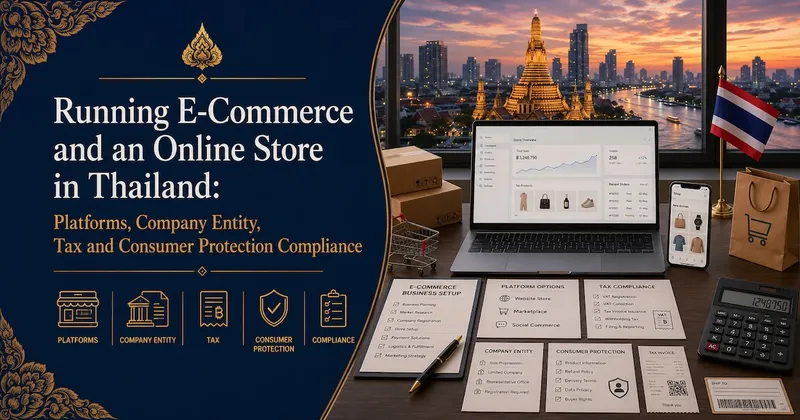
Doing e-commerce or opening an online store in Thailand looks low-barrier but has real compliance: selling to Thai consumers usually needs a lawful entity (a registered company, foreign shareholding and business scope), proper bookkeeping and tax (VAT registration above the threshold), and compliance with Thailand's electronic-transaction and consumer-protection laws (returns, truthful advertising, PDPA data protection); platform onboarding (Shopee, Lazada, TikTok Shop, etc.) has its own credentials and settlement rules. Operating without a license, false advertising or misusing customer data can be penalized. This guide covers the compliance essentials across entity, platforms, tax, consumer protection and payment/logistics, subject to the relevant authorities' current rules.
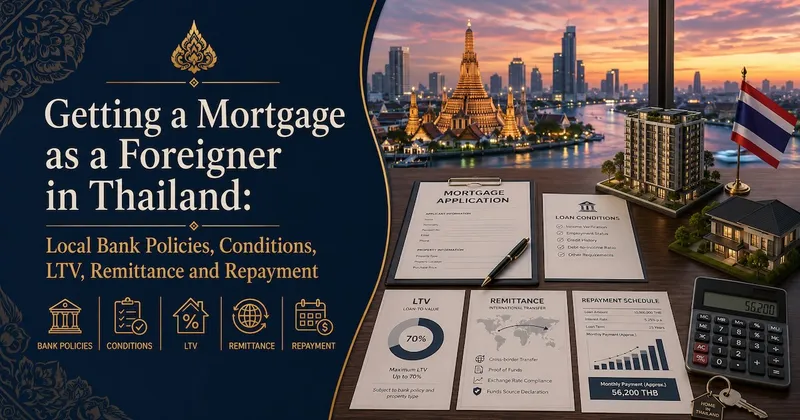
Many assume you can only buy property in Thailand with cash — foreigners do have mortgage routes, but they're far harder than for locals: Thai local banks are generally cautious about foreigner home loans, most requiring a work visa and local income, and pure overseas income rarely gets approved at a local bank; more realistic routes are foreigner-focused loan products (some banks' overseas branches or special products) or developer installments. Buying a condo also involves the requirement to remit the purchase funds in foreign currency and convert them onshore. This guide covers the realistic conditions, LTV, remittance rules and repayment points, subject to each bank's and the relevant authorities' current policies.
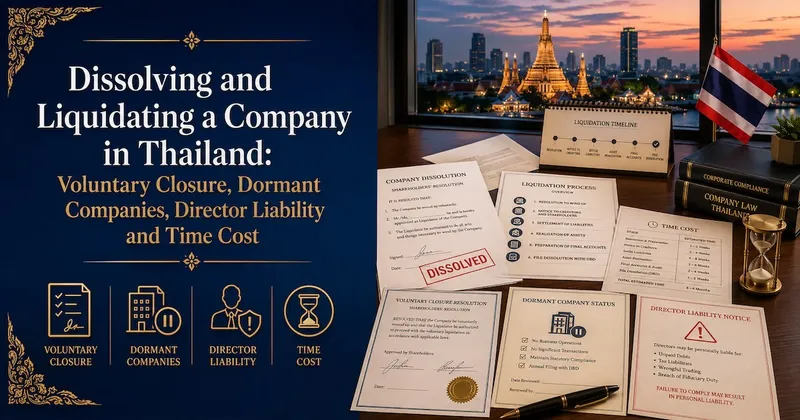
If your Thai company has stopped trading, don't just walk away: as long as it exists it must file audited accounts, financial statements and tax every year, and missing that keeps piling up fines and surcharges — directors can be liable too. To end it properly, follow the statutory dissolution (liquidation) process: a shareholders' resolution to dissolve, a liquidator settling debts and receivables, tax clearance, and deregistration with the DBD. This process has statutory steps, takes time and costs money. This guide covers when to dissolve, dissolution vs leaving it vs 'dormant', the rough process and common traps, subject to the DBD and Revenue Department current rules.
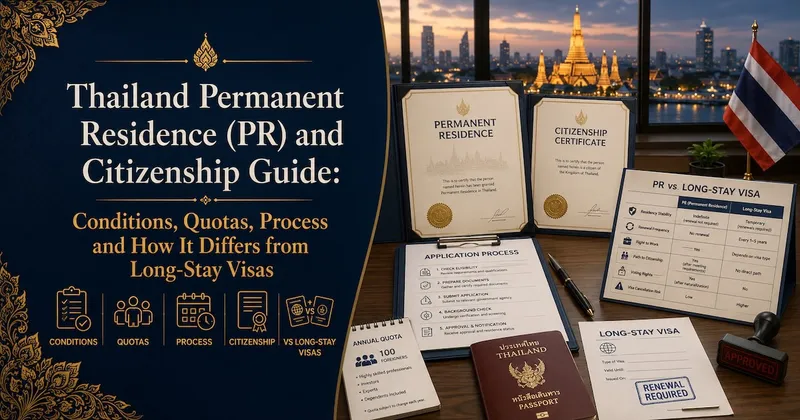
After living in Thailand a while, many ask: can I stop renewing visas every year, get a 'green card' or even naturalize? Thailand does have permanent residence (PR) and citizenship, but the bar is high, quotas are limited and timelines are long: PR usually requires several consecutive years on a work visa with tax filings, and there's an annual per-nationality quota; citizenship (naturalization) is higher still, typically needing PR first plus residence and language conditions. For most long-stayers, using the right long-stay visa is more practical. This guide covers PR and citizenship conditions, the rough process, and how they differ from long-stay visas, subject to Immigration and Ministry of Interior current rules.
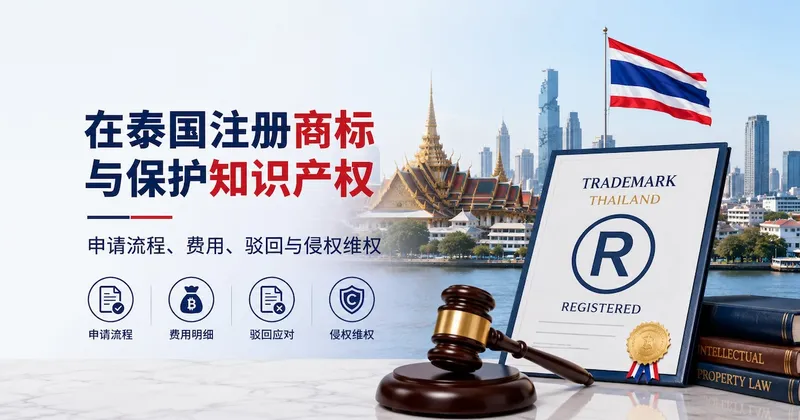
Doing business in Thailand, having your shop name, logo or brand registered by someone else first is a common trap for Chinese merchants — you build it up only to find the trademark belongs to another, forcing a rebrand or, worse, a counter-claim of infringement. Thailand's trademark system is 'first to file': whoever registers first is protected, largely regardless of how long you've used it. This guide covers the registration process, rough costs, common refusal grounds and how to respond, and enforcement routes when you're infringed or squatted, plus a note on patents and copyright — subject to the Department of Intellectual Property (DIP) and professional legal advice.
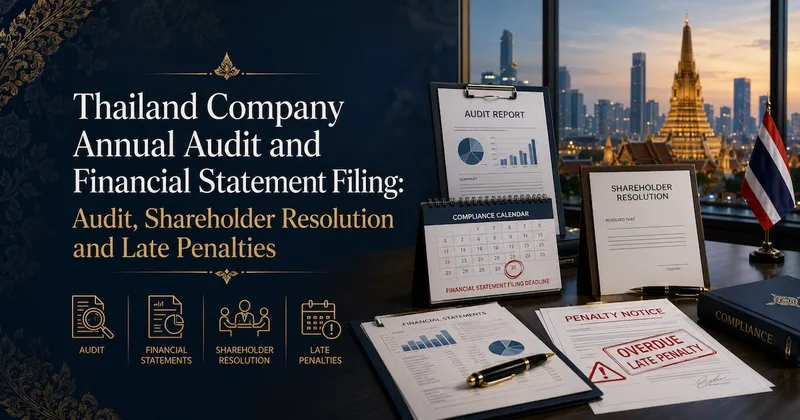
Every company registered in Thailand must, whether or not it actually trades or profits, do one thing each year: prepare financial statements, have them audited by a licensed auditor, approve them at a shareholders' meeting, and file with the Revenue Department and the Department of Business Development (DBD) within the deadlines. This is a statutory annual duty of a Thai company; missing it or filing late triggers fines and surcharges, and directors may be held liable. Many Chinese owners focus on monthly bookkeeping and overlook the annual audit, only realizing when a penalty notice arrives. This guide covers the process, deadlines, documents and consequences, subject to the Revenue Department and DBD current rules.
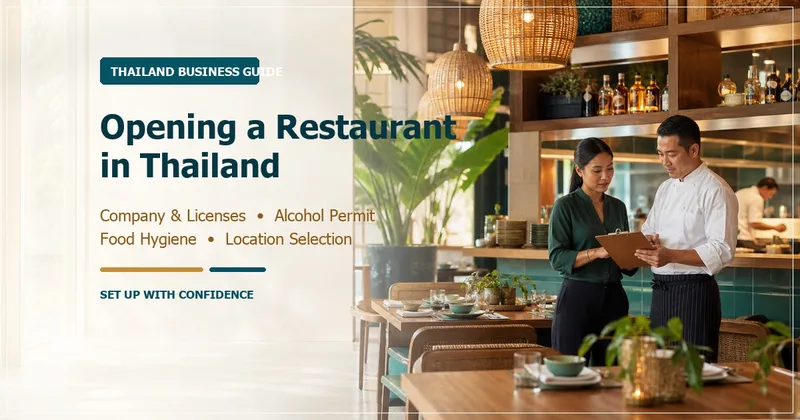
Opening a Chinese restaurant, hotpot or bubble-tea shop is a popular venture for Chinese in Thailand, but 'opening a shop' is far more than a lease and fit-out: you first need a lawful entity (a registered Thai company handling foreign shareholding and business scope), the relevant restaurant licenses and food-hygiene permits, a separate alcohol license to serve drinks, lawful staffing, plus location, TM30 and tax filings. Fall foul of foreign-ownership limits or operate without a license and you risk fines or closure. This guide covers the whole process across entity, licenses, alcohol, staffing, location and tax, with permit conditions subject to local government and relevant authorities' current rules.
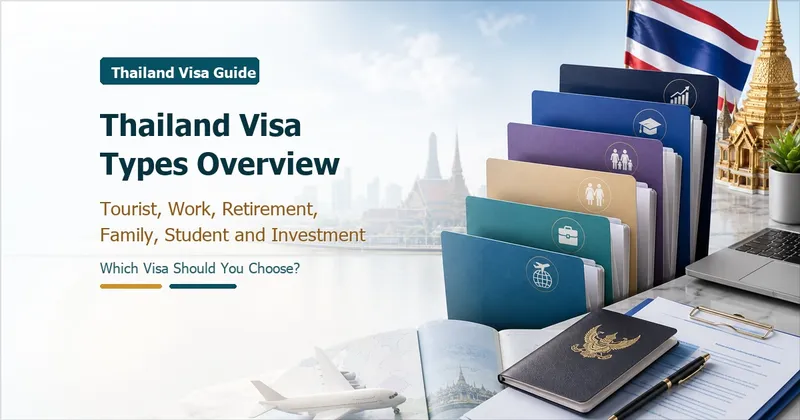
Which Thai visa you need depends on what you're coming to do and for how long: short trips use visa exemption / visa on arrival / a tourist visa; working needs a Non-B plus a work permit; retirement uses an O-A/O-X visa; joining a spouse uses an O visa; studying uses an ED visa; remote work uses the DTV; a hassle-free long stay with means uses the Privilege (Elite) visa; investing looks at BOI. Pick the wrong one and you may waste a trip — or overstay and land on a blacklist. This guide sorts Thailand's main visa types by what you're here to do, with links to in-depth guides, subject to Immigration and embassy current rules.

To pay respects in Bangkok, a few landmarks are unmissable: the Erawan Shrine (in the downtown shopping district, a popular site for love and career), Wat Pho (the 46-meter Reclining Buddha and the birthplace of Thai massage), Wat Arun (the Temple of Dawn, a Chao Phraya riverside landmark), Wat Traimit (a 5.5-tonne solid-gold Buddha), and the most solemn Grand Palace and Wat Phra Kaew. This guide strings together the must-visit temples' highlights, how to worship and etiquette, with a route to make a day flow — opening and rules per each temple's current practice.
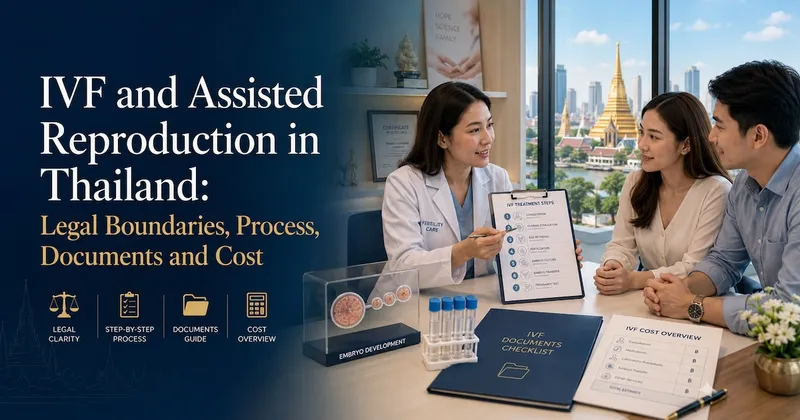
Thailand is a popular Asian destination for assisted reproduction (IVF): good hospital facilities, mature techniques and lower costs than the West. But the legal boundaries must be clear first — Thai law requires those receiving assisted reproduction to be a legally married couple, has banned commercial surrogacy for foreigners since 2015, and prohibits non-medical sex selection. This guide covers what's legally available, the treatment process, documents and cost, and the legal red lines agents most often mislead people about — per Thailand's current medical and legal rules.

Thailand is Asia's digital-nomad heartland: the DTV visa gives a legal long stay, Bangkok and Chiang Mai have mature coworking spaces and café networks, living costs are friendly, and the time zone is just one hour from China. But the 'nomad paradise' has a practical side too — internet stability, tax residency, health insurance, visa compliance and social isolation all need forethought. This guide covers visa, city, workspaces, cost, tax and community, to show how to turn remote work into a sustainable life in Thailand.
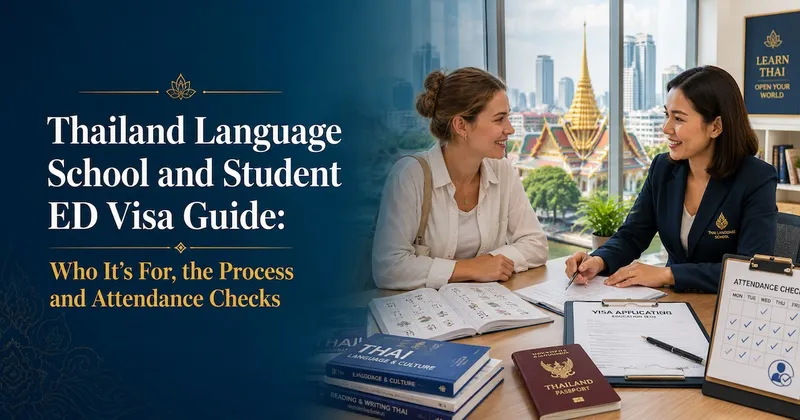
To study Thai or attend school in Thailand long term, the ED visa (education visa) is the legal route: enroll at a Ministry-recognized language school or institution, get the school's documents to apply for a Non-ED visa, stay to study and extend as required. But ED visas have faced tighter scrutiny — attendance, genuine study and language checks can all be examined, and the grey-area 'enroll-but-don't-attend' route to a long stay is increasingly risky. This guide covers who the ED visa is for, the process, renewal and attendance requirements, and how it compares to other long-stay visas — per Immigration's current rules.

Thailand's two most famous festivals are opposites — one loud, one quiet: Songkran (the water festival, April) is the nationwide Thai New Year revelry, and Loy Krathong (November) is the romantic night of floating wish-lanterns, with Chiang Mai's mass sky-lantern Yi Peng at the same time. Across the year, the major Buddhist holy days (Makha Bucha, Visakha Bucha, Khao Phansa and more) bring a nationwide alcohol ban and crowded temples. This guide covers the main festivals' origins, timing, regional styles and etiquette, to help you time your trip.
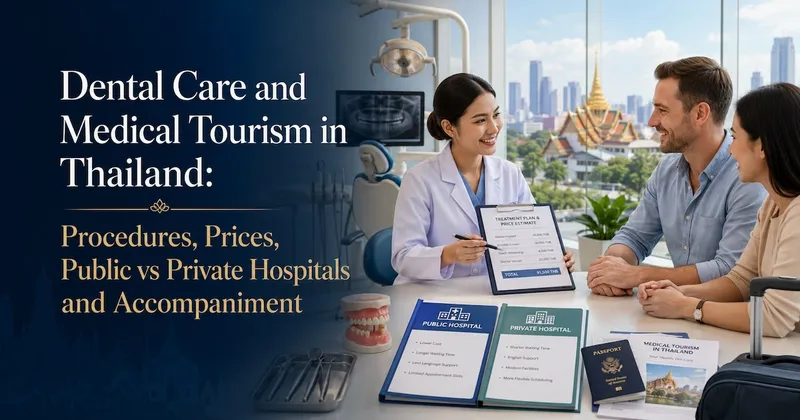
Thailand is a major Asian medical-tourism hub: dental work (cleaning, implants, orthodontics), check-ups, cosmetic procedures and some specialist surgery often cost less than in first-tier Chinese cities, with private hospitals offering great facilities, international accreditation and English/Chinese service. But cheap doesn't mean careless — verify licensed hospitals and doctors, discuss thoroughly before treatment, and plan follow-ups and complication contingencies ahead. This guide covers popular procedures, price ranges, public vs private differences and the value of accompaniment — diagnosis and treatment per medical providers and doctors.
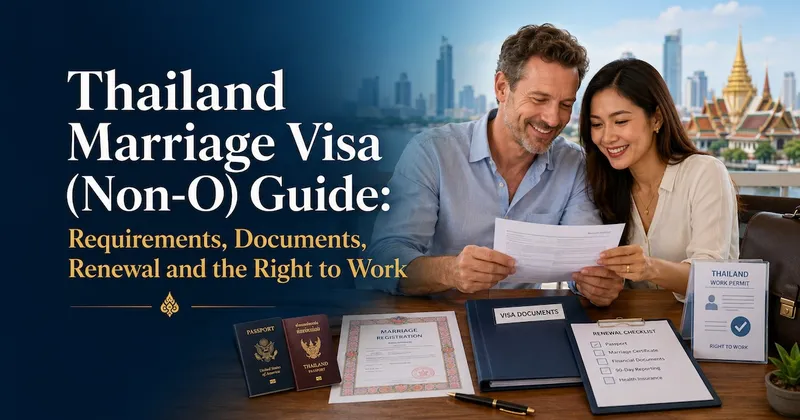
After marrying a Thai national, a foreign spouse can apply for the dependent Non-O visa (the 'marriage visa'): renewed yearly, requiring proof of funds (commonly about 400,000 baht in a Thai bank or qualifying monthly income) and a 90-day report. Its biggest difference from a tourist visa is that a marriage-visa holder can lawfully apply for a work permit and work. This guide covers the requirements, documents, renewal, the link to the right to work, and the funds and genuineness checks that often trip people up — per Immigration's current rules.
Retiring in Thailand comes down to four things to settle first: the visa (a retirement visa is available from age 50, needing about 800,000 baht on deposit or proof of monthly income, and often health insurance), healthcare (private hospitals are excellent but pricey, so arrange insurance and check-ups ahead), monthly budget (Chiang Mai around 30,000–40,000 baht, Bangkok and Pattaya higher), and long-term care and end-of-life matters (carers, retirement communities, a will). This guide lays out those four threads to help you judge whether retiring here suits you — policy per Immigration and healthcare providers' current rules.

To rent and drive legally in Thailand you need a Thai license or an International Driving Permit (IDP) together with your home license — your home license alone isn't accepted. Rent from a big platform or a proper company, buy full coverage (especially zero-excess CDW), and film the whole vehicle inspection at pickup. Thailand drives on the left with the wheel on the right, speed cameras are everywhere, and mountain roads are slick in the rainy season. This guide covers rental requirements, license compliance, choosing insurance, road rules and handling accidents.
Spend 183 days in Thailand in a year and you're a Thai tax resident. From 2024 the Revenue Department made clear that a tax resident's foreign income remitted into Thailand in the year must be included in personal income tax filing — ending the old 'remit the following year, tax-free' practice. This matters greatly for those living here on foreign income: what counts as 'remittance', how to avoid double taxation, how to use the China–Thailand tax treaty, and which cases may be exempt. This guide draws the lines per the new rules — per the Revenue Department's interpretation and professional tax advice.
Overstaying in Thailand is no small thing: 500 baht a day, capped at 20,000 baht. Turning yourself in and leaving via the airport means paying the fine and going, but being caught by police can mean detention, deportation and a spot on the entry blacklist — the longer the overstay, the longer the ban. This guide covers how the fine works, the huge gap between voluntary departure and getting caught, the blacklist ban tiers, and the right steps once you realize you've overstayed — per Immigration's current rules.
For a short stay in Thailand there are three main ways in: visa-exempt entry (with China–Thailand mutual visa exemption now in place, you enter on your passport for a short stay), visa on arrival (VOA, for certain cases), and a tourist visa (TR/eVisa) arranged in advance. Which to pick depends on how long you'll stay, whether you need an extension, and how often you'll travel back and forth. This guide covers the length of stay, documents and extensions for each, plus the risks of frequent entries and the limits of border runs — exact days and policy per the latest Thai Immigration and embassy announcements.
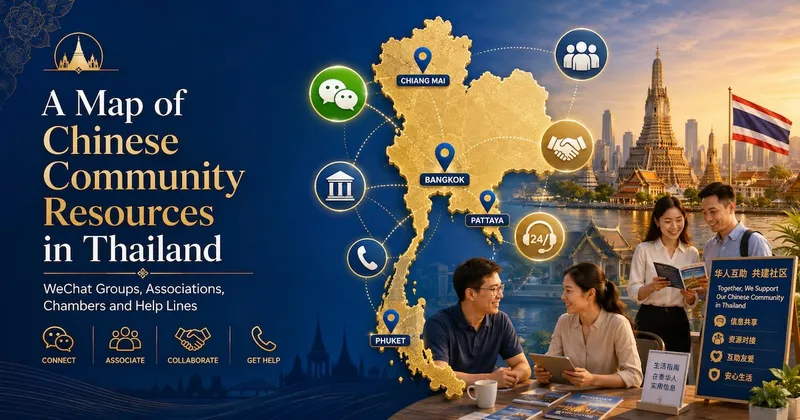
Newly arrived in Thailand, the fastest shortcut to settling in is plugging into a reliable Chinese community — but WeChat groups are a mixed bag, with romance scams, disappearing daigou, shady agents and fake job ads all lurking. The genuinely valuable resources are real-name hometown associations and chambers of commerce, legitimate Chinese media, and official help lines like consular protection and the 1155 tourist police. This guide maps community resources by tier and teaches you which groups to join and which people to avoid.

For internet in Thailand, most condos come with broadband or can arrange it, while a house means applying to AIS, True or 3BB yourself with your passport, lease and address — fiber plans run a few hundred baht a month and install in three to five days. TV is no longer the point: Thai households watch IPTV and streaming, Netflix, Disney+ and YouTube Premium all have Thai tiers at cheaper local prices, and Chinese-language shows are best watched on legitimate overseas platforms. This guide covers getting broadband, choosing a plan, watching TV and streaming legally.
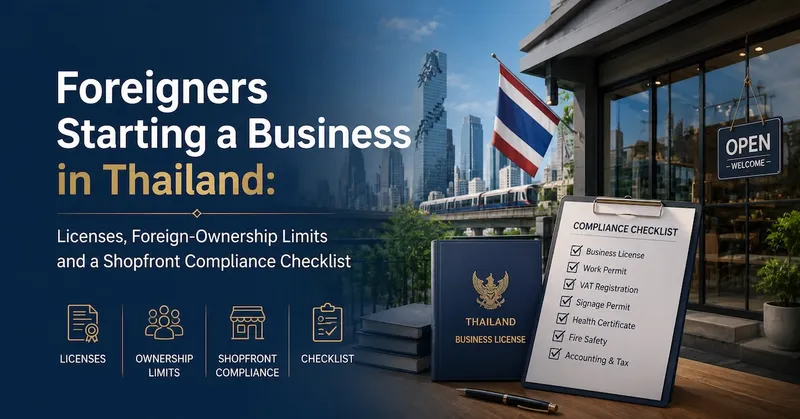
For a foreigner opening a shop in Thailand, the first wall isn't money — it's the Foreign Business Act. Food service, retail and most services are restricted, so a foreigner can't run them wholly foreign-owned. There are three legal routes: a limited company with 51% Thai shareholding, a Foreign Business License (FBL), or a BOI / US–Thai Treaty of Amity exemption. Beyond the company, a physical shop still needs food-hygiene, liquor, signboard-tax and VAT registration, and the owner needs a work permit and non-immigrant visa. This guide lays out the license tiers and the shopfront compliance checklist.
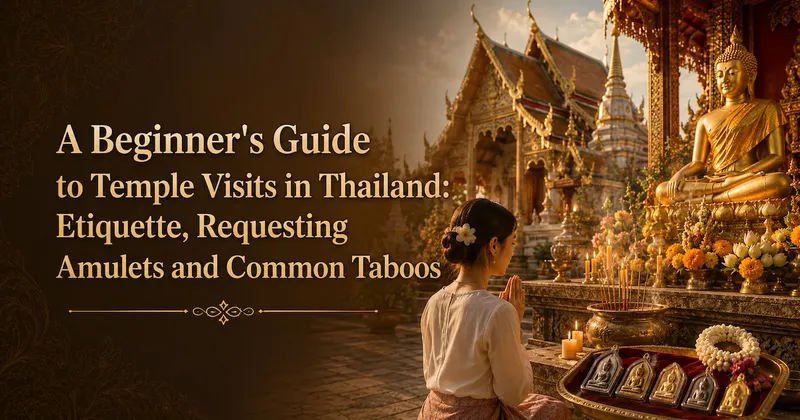
In a Thai temple, paying respects and requesting an amulet are two different things: worship is about dress, posture and taboos, while requesting an amulet involves dealing with the temple, arranging the process and bringing the item home legally. Never point your feet at a Buddha image, women shouldn't touch monks, remove your shoes before entering the hall — getting these wrong is both disrespectful and deflating. This guide covers dress, the order of worship, offerings, the amulet-request process and the customs limits on bringing amulets home, so a first visit goes smoothly.

Living in Bangkok puts a surprising radius within weekend reach: World Heritage ruins at 1.5 hours, beach or mountains at 2.5, a proper island at just over 3 — all workable as two-day-one-night runs. This guide ranks eight destinations by drive time, compares self-drive, minivans, trains and private charters, and flags what works with elderly parents and small children.
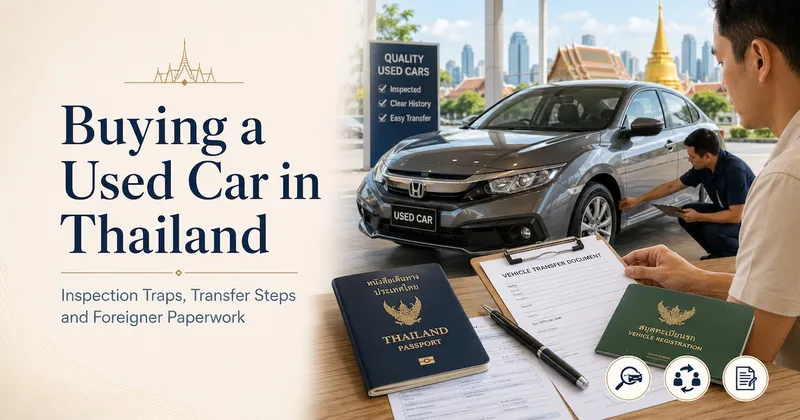
Thailand's used-car market has real depth and real traps: cars under outstanding finance legally cannot transfer, odometer-wound and flood cars sit on dealer lots, and any car whose blue book doesn't match the seller is untouchable. A foreigner transfers ownership at the DLT with a passport plus proof of residence for a few hundred baht. This guide covers channels, the inspection checklist, transfer steps and recourse when the car turns out doctored.

International schools in Thailand mostly teach Chinese as a foreign language — counting on school alone to preserve a Chinese child's mother tongue will fail. What actually works is a stack: a school track (native-stream programs or trilingual schools) as the base, home language policy to hold speaking, mainland or Jinan University textbooks for literacy, YCT/HSK exams as checkpoints, and early paperwork if the child will re-enter Chinese schooling.
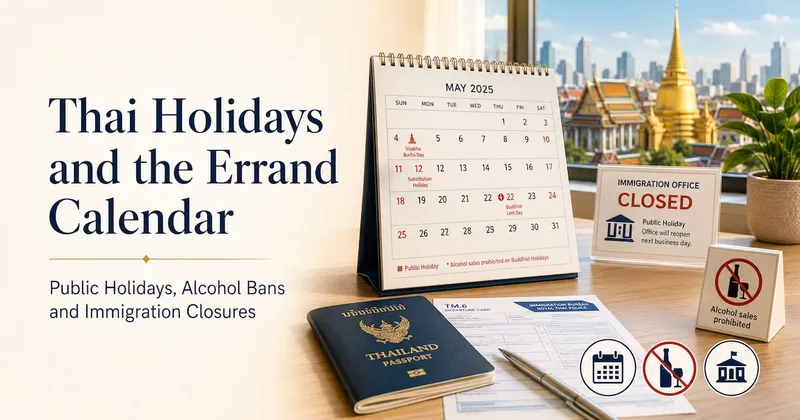
Thailand takes around 16 to 19 public holidays a year, Buddhist holy days ban alcohol sales nationwide, and government offices chain-close around Songkran while Immigration queues explode either side of it. Living here means scheduling by the Thai calendar: what happens when your visa expiry lands on a holiday, how bank and government holidays differ, and what Chinese New Year actually looks like in Thailand.
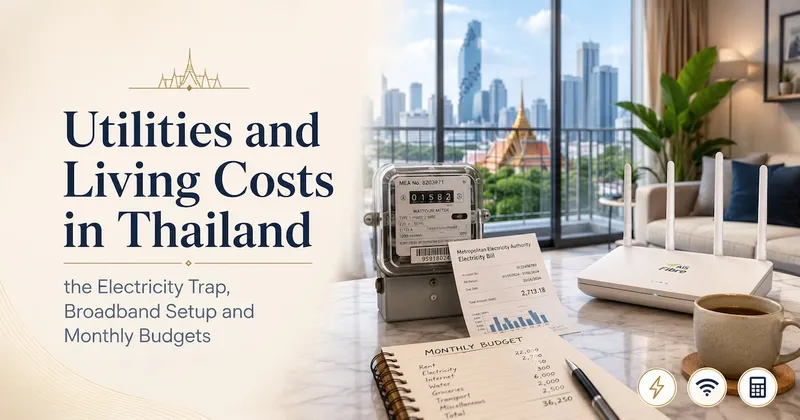
Utilities are the stealth cost of renting in Thailand: the official electricity rate is around 4 THB per unit, but many apartment buildings resell at 7–8 THB. Foreigners can get fiber broadband on a passport, at 400–700 THB a month. This guide covers meters and accounts, how to pay bills, broadband installation, and realistic monthly budgets for singles and families.

Chiang Mai's long-stay appeal is half of Bangkok's rent, half its pace, and mature international communities: digital nomads cluster around Nimman, retirees take villas in Hang Dong and Mae Rim, and international school fees run well below equivalent Bangkok schools. The price is the February-to-April burning season and car-dependent living. This guide covers area selection, real costs, visa routes and how residents actually handle the smoke.
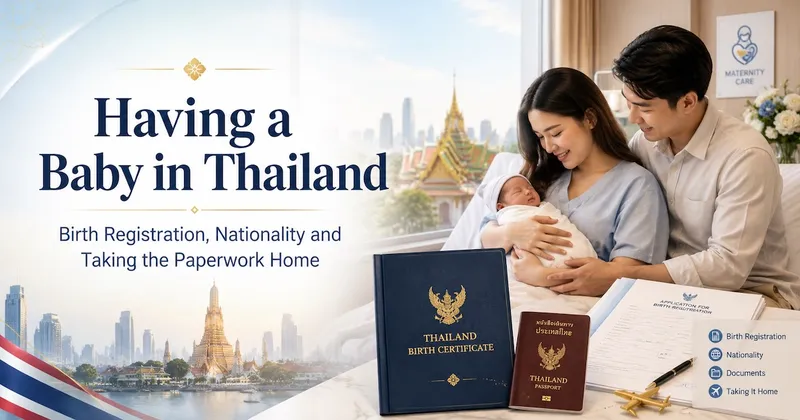
A child born in Thailand to two Chinese parents without Thai permanent residence does not acquire Thai nationality — the child is Chinese. The path runs: hospital birth notification, birth certificate at the district office, a Chinese travel document from the embassy, then translation and double legalization of the birth certificate for household registration back home. This guide walks the whole timeline, from hospital costs to single-parent applications.
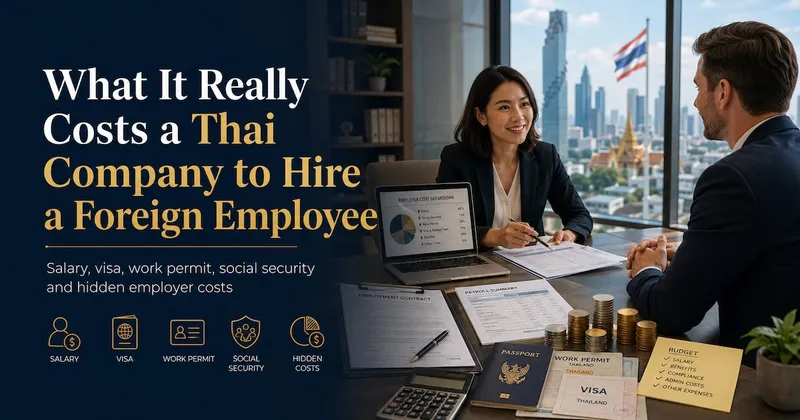
The customary threshold per foreign hire in Thailand is 2 million THB of paid-up capital plus four Thai employees on social security — which means the true cost runs far beyond salary: capital tied up, four Thai payrolls, annual work permit and visa fees, and a severance liability that scales with tenure. This guide itemizes the one-off and recurring costs from the employer's side, and when BOI or an EOR beats direct hiring.
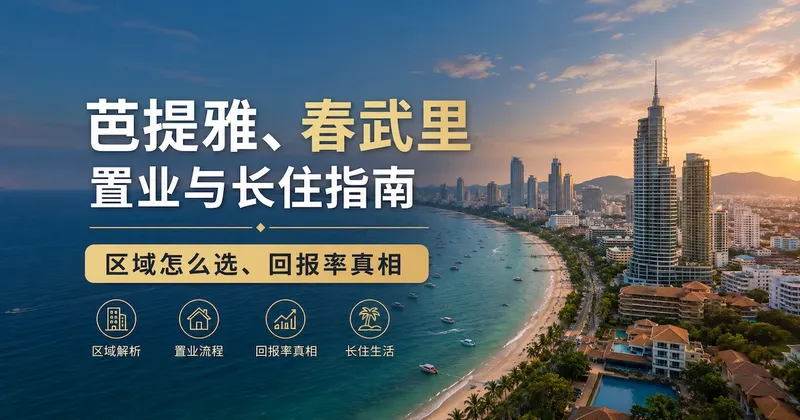
Pattaya and Chonburi are the leading choice outside Bangkok for Chinese buyers and long-stayers: sea-view condos from one to two million baht, two hours from the capital, and the EEC industrial corridor underneath it all. But advertised "8% guaranteed returns" carry heavy spin, and villa ownership structures carry legal risk. This guide profiles Jomtien, Na Jomtien, East Pattaya and Sriracha, then walks through buying, living infrastructure and long-stay visas.

In a Thai emergency, dialing the right number is half the battle: 191 for police, 1669 for ambulances, 1155 for the multilingual tourist police, 1441 to freeze scammed funds. This guide maps the channels by scenario, explains how to file a police report properly, and covers what consular protection can and cannot do.

Bangkok international schools range from bilingual programs at 100,000 THB a year to top British and American schools near 1,000,000 THB. This guide compares the three curricula, breaks down real costs, walks through admissions testing and entry points, and covers the guardian visa for accompanying parents.

If a foreigner with a condo, bank accounts or a car in Thailand dies without a Thai will, the estate follows Thai statutory succession — and the family must obtain a court-appointed estate administrator before touching any account. This guide covers the heir classes, foreign ownership limits on inherited property, how to make a Thai will and the probate process.
Consolidated freight is how most personal cargo moves from China to Thailand: air in 3–5 days, overland via Laos in 5–8, sea in two to three weeks, billed by weight or volume. All-inclusive "double clearance" is convenient but grey — seized goods are near-impossible to reclaim. Food, cosmetics and medicine need Thai FDA approval, and work permit holders can import used household goods duty-free. This guide covers channels, pricing, prohibited items and recourse.
Motorbikes are Thailand's default transport — and the area where foreigners get burned most often: a car license doesn't cover riding, surrendering your passport to a rental shop is a serious mistake, and health policies may exclude riding injuries. Here are the rules in one place.
Hiring in Thailand comes with hard statutory lines: minimum wage, the 119-day probation reality, overtime rates, and a severance ladder reaching 400 days' pay. This guide walks employers through the rules that decide labor court outcomes.

Registering a Thai company is only the start: every month brings fixed tax and social security obligations, and missed filings accumulate fines. This guide lays out the monthly, half-yearly and annual compliance calendar with cost references.
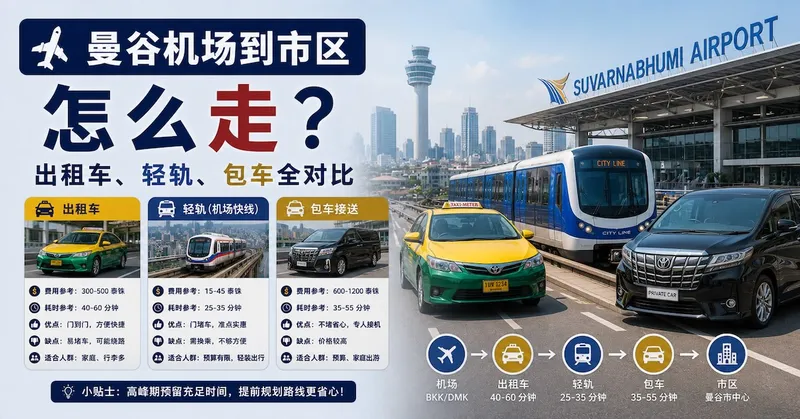
Every way into the city from Suvarnabhumi and Don Mueang airports: Airport Rail Link, public taxis, ride-hailing apps, and private transfers — with price ranges, journey times, and scam-avoidance tips.
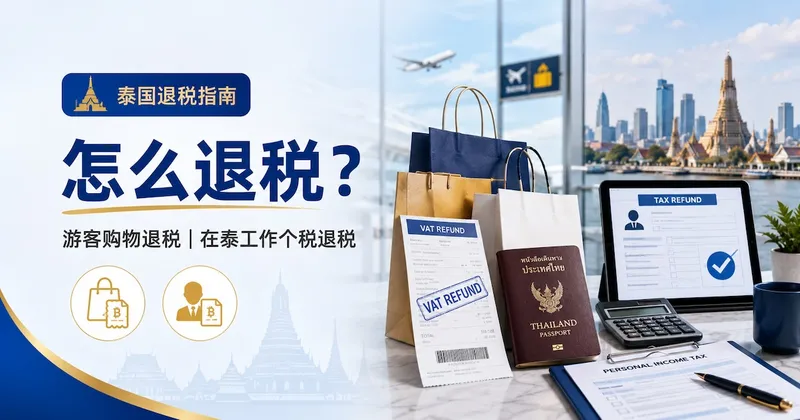
Tourists can reclaim VAT on shopping when leaving Thailand, and expat workers may get overpaid income tax back through the annual filing. This guide covers eligibility, documents, procedures, and common rejection reasons for both.
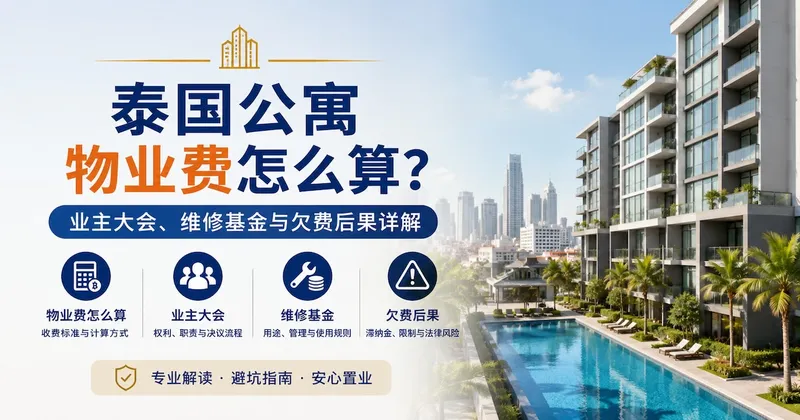
Owning a Thai condo comes with annual CAM fees, a debt-free certificate you cannot sell without, and an annual general meeting that decides how the building's money is spent — where foreign owners hold full voting rights. This guide explains the fee structure, how the juristic person works, and what to do about bad management.
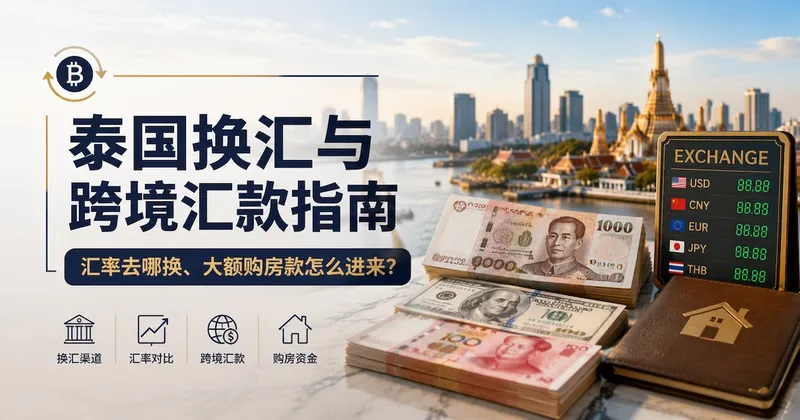
Exchange booths like Superrich beat airport and bank rates by a wide margin; property purchases must arrive as foreign currency with FET documentation or the transfer stalls at the Land Office. This guide compares exchange channels, covers sending money in and out of Thailand, and explains the tax rule on remitting foreign income.

Getting a SIM card is usually the first task after landing in Thailand. AIS and True dominate the market, every SIM must be registered against your passport, and prepaid numbers expire if you stop topping up. This guide compares tourist and long-stay options and explains the name-matching rule that ties your SIM to your bank account.

For long-term residents, health insurance covers hospital bills while life and personal accident policies backstop the big risks — death and disability. Foreigners on long-stay visas can buy locally, and life premiums are income-tax deductible. This guide separates the three product types, explains eligibility, beneficiary designation, the exclusions that most often void claims, and how cross-border payouts work.
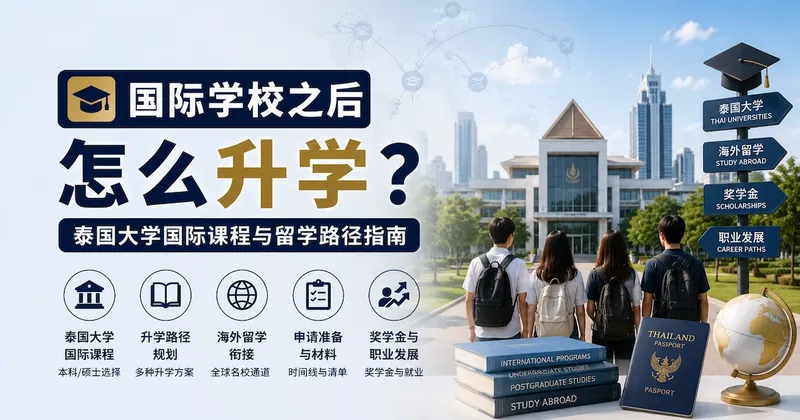
Your child is finishing international school in Thailand — stay for a Thai university or apply abroad? This guide covers international program tuition and admission requirements, the GED alternative route, student visa continuity, and degree recognition.
Thai private hospitals are excellent but expensive — one hospitalization can cost hundreds of thousands of baht. This guide covers the public-private hospital divide, how to choose insurance, visa-mandated coverage, and the claim traps to avoid.
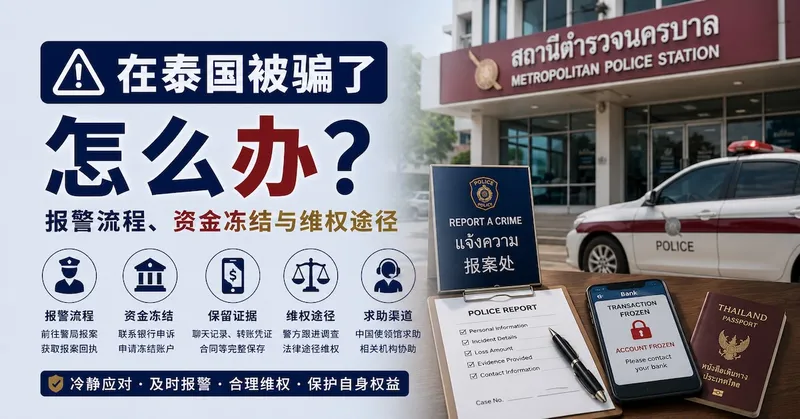
After a scam or dispute in Thailand, the first 24 hours largely decide your recovery odds. This guide covers reporting channels, the crucial difference between a daily record and a formal complaint, emergency bank freezes, and civil versus criminal routes.
Over 50 and planning to live in Thailand? The retirement visa is cheap but renews yearly; the Privilege visa buys up to 20 years of convenience. This guide compares funds required, paperwork burden, and hidden costs.
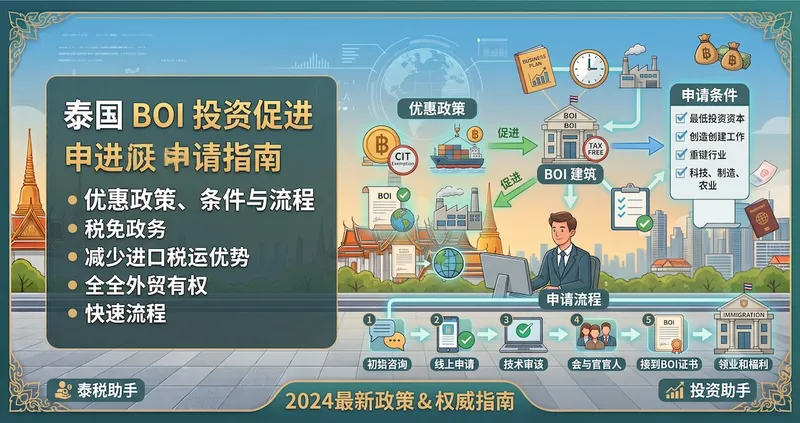
BOI-promoted companies can be 100% foreign-owned, enjoy corporate income tax exemption for up to 13 years, and get relaxed work permit quotas. This guide covers the incentives, eligible industries, requirements, and full process.

A marriage registered in Thailand can end by consent at the district office in minutes; a contested split — or a marriage registered abroad — goes through the Thai courts. This guide covers both routes, how community property divides, how custody and child support are set, and the cross-border complications foreign couples face.
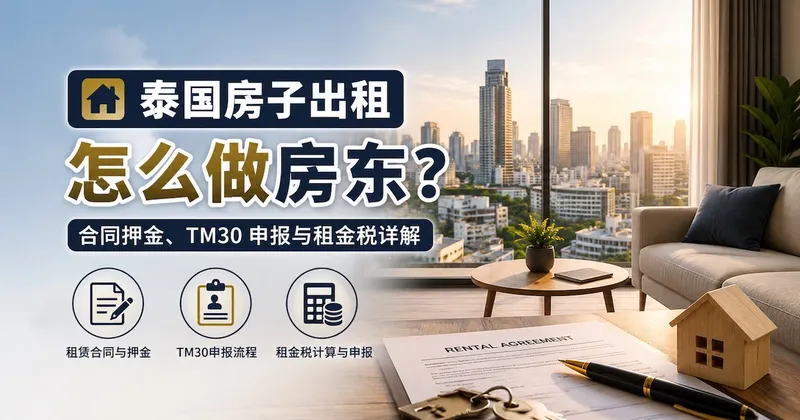
Renting out a condo you own in Thailand means getting four things right: a proper lease and deposit, the TM30 report for foreign tenants, personal income tax on the rent, and the Hotel Act line that makes most short-term rental illegal. This guide walks through each, plus what to do about non-paying tenants.
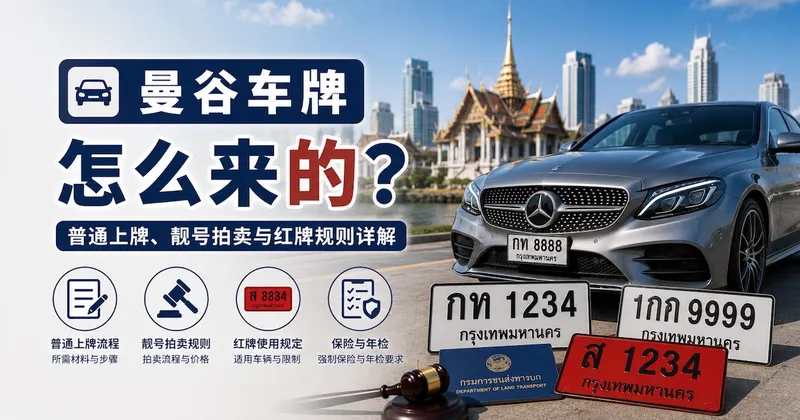
Thai license plates are assigned sequentially by the Department of Land Transport — the only legal way to get 8888 or 9999 is the official auction, where prices run from tens of thousands to millions of baht. This guide covers normal registration, how to bid, the rules on dealer red plates, and transferring or keeping a number.
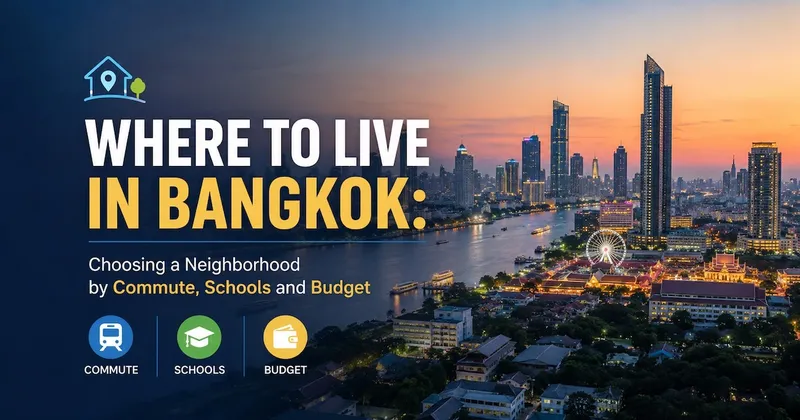
There is no single best neighborhood in Bangkok — only the one that matches your commute line, your children's school and your budget. Office workers should anchor to a BTS/MRT walking radius, school families should draw a 15-minute circle around campus, and tight budgets stretch dramatically two or three stations further out. This guide maps Sukhumvit, Silom-Sathorn, Rama 9, On Nut-Bang Na and more, with rent ranges and who each area suits.
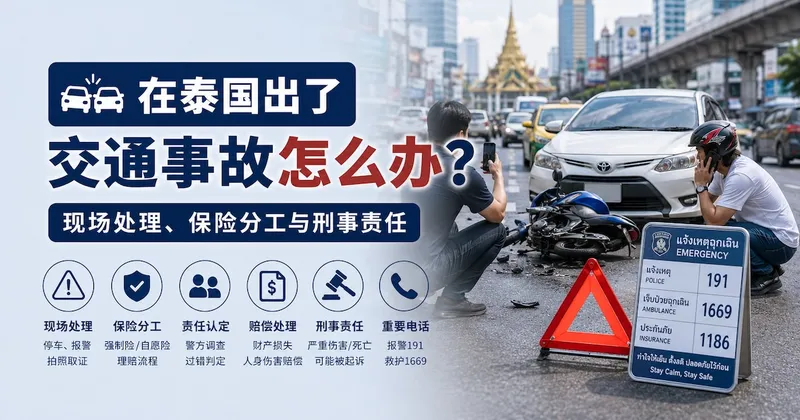
Thai accident handling works differently from what most foreigners expect: insurance surveyors assign fault at the scene, injuring someone can mean criminal charges, and a compensation settlement directly shapes the case outcome. Here is the timeline — scene, police station, insurance, and the points foreigners must watch.
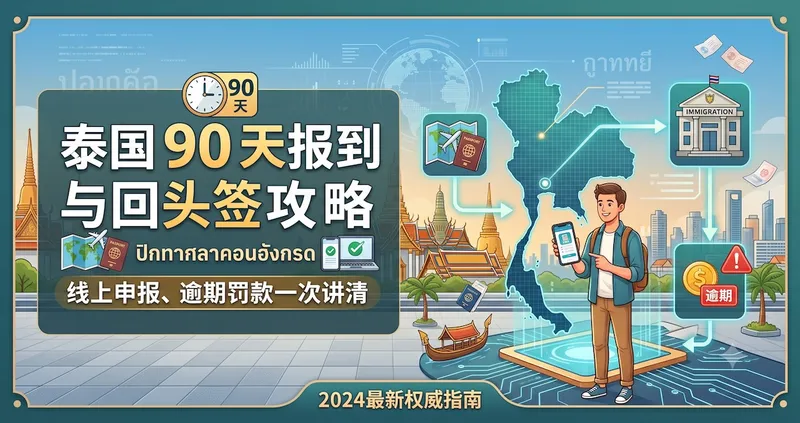
Long-stay visa holders must report their address after every 90 days in Thailand, and leaving the country without a re-entry permit voids your extension. These two small tasks are the easiest to forget and the most damaging — here are the rules, online filing, and remedies.
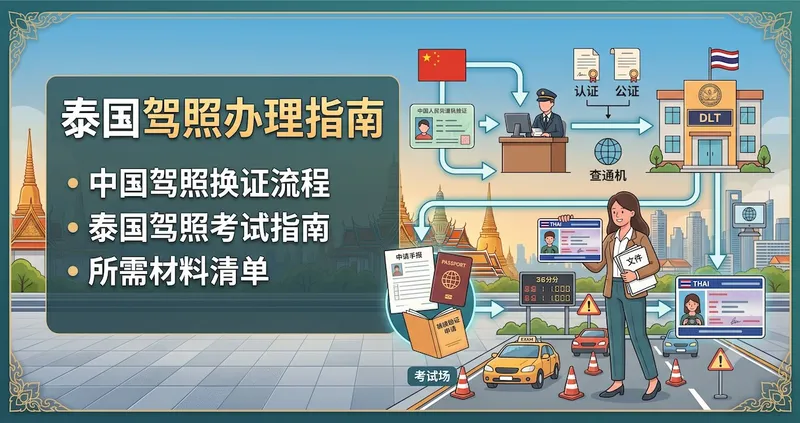
Holders of a valid foreign license can convert to a Thai license without the written or driving test — only physical checks. This guide covers both routes, the document checklist, fees, and the points where applications get stuck.
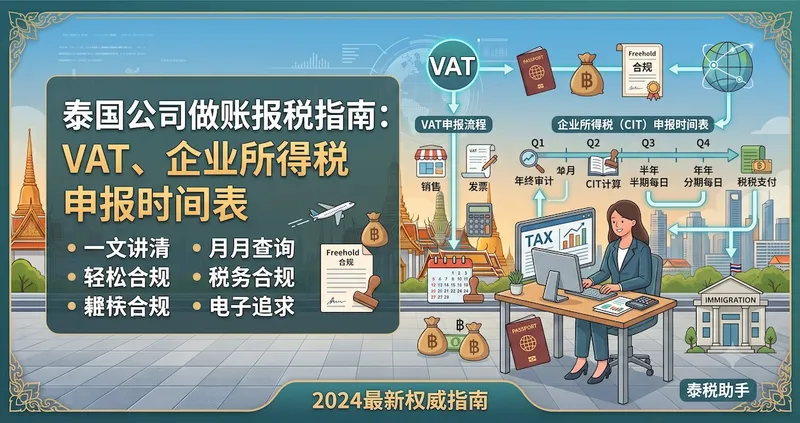
A Thai company must file monthly even with zero income. This guide organizes the deadlines, rates and late penalties for VAT, withholding tax, corporate income tax and social security — a full compliance calendar.
The Thailand Privilege visa is an official long-stay membership program granting residence for up to 20 years. This guide covers the post-2024 membership tiers and prices, benefits, application process, and who it suits.
A Thai work permit is tied to one employer, so changing jobs is never just a resignation letter: canceling the old permit, applying for the new one and keeping your visa alive must line up precisely, or you're leaving the country to restart. This guide covers job channels, salary benchmarks by nationality, the restricted occupations list and the freelance red line.

Thai healthcare runs on two tracks: public hospitals are cheap with long queues and limited English; private hospitals offer international service at three to ten times the price. This guide covers which Bangkok hospitals to choose, the outpatient process, emergency numbers, and how to pick a good-value annual checkup package.
Importing a cat or dog into Thailand requires an advance import permit, an ISO microchip, a rabies vaccine at least 21 days old and an official health certificate from your departure country. This guide covers the full timeline, airline cabin options, banned breeds, and the practical side of renting, vet care and re-exporting your pet.
In Thailand, compulsory insurance (Por Ror Bor) is required for the yearly tax sticker but pays out very little; what actually protects your wallet is voluntary insurance. This guide covers the class system, premium ranges, what drives the price, and the right moves when you have an accident.
Thai banks have tightened foreigner account opening sharply — the tourist visa route has essentially closed. This guide covers which visa statuses can still open accounts, what to bring, how the major banks differ in practice, and what to do after a rejection.
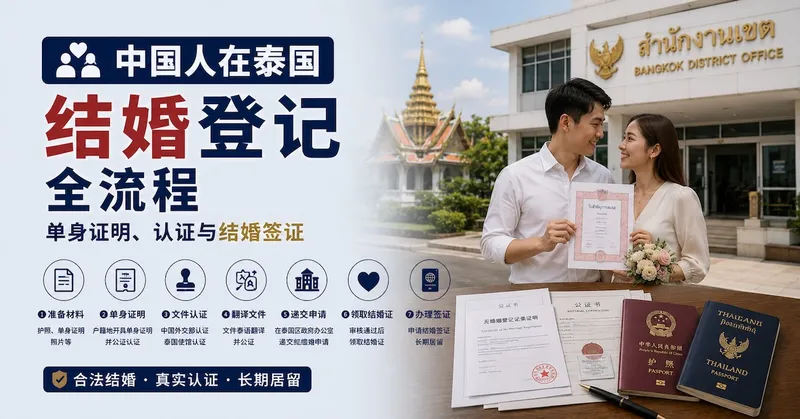
Registering a marriage in Thailand hinges on getting the affirmation of freedom to marry right: notarization, legalization and Thai translation in the correct order. This guide walks through the full process, timing, and the marriage visa that follows.
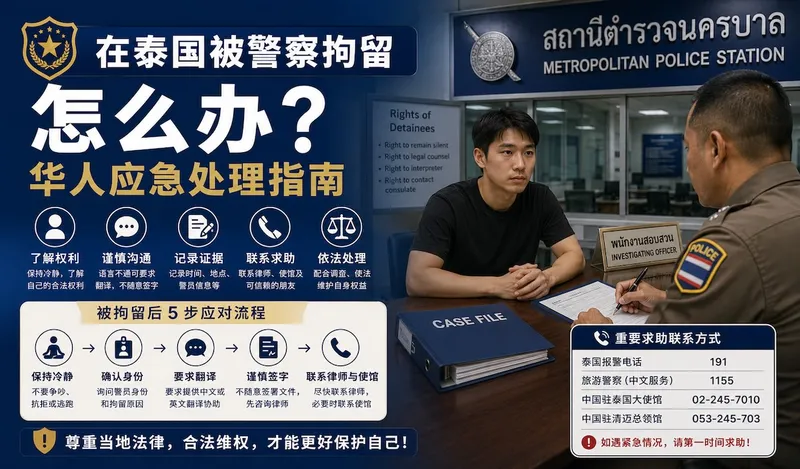
How you handle the first 48 hours of a detention in Thailand shapes everything that follows. This guide explains the key stages of Thai criminal procedure, your legal rights, bail rules, and what family members can do.
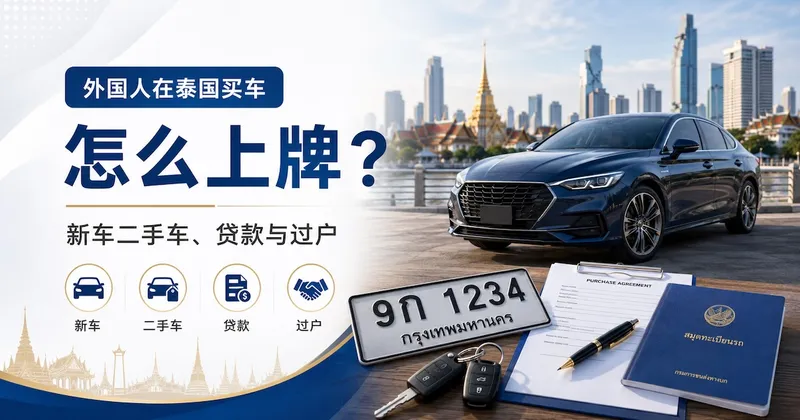
Foreigners can legally buy a car in Thailand and register it in their own name. This guide covers buying new and used cars, required documents, loan conditions, ownership transfer at the DLT, and yearly running costs.
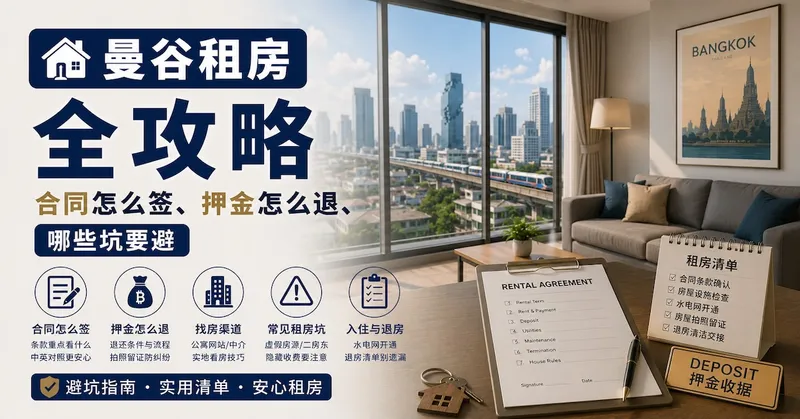
Deposit disputes are the most common rental problem expats face in Bangkok. This guide covers where to find housing, the contract clauses that matter, utility overcharging, TM30 registration, and how to actually get your deposit back.
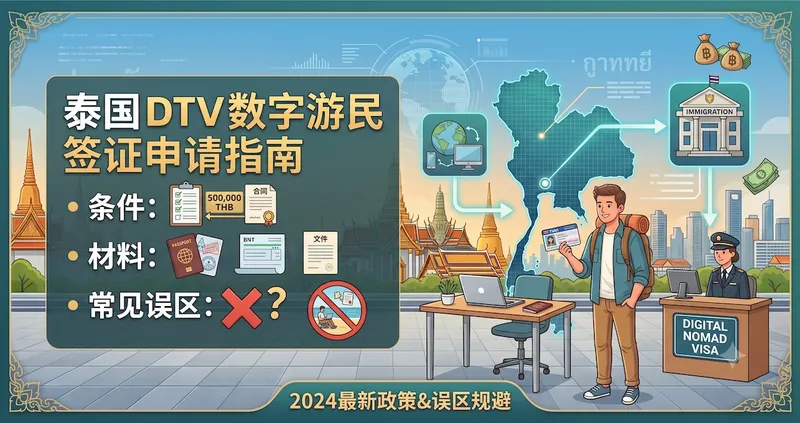
The DTV is valid 5 years with stays up to 180 days per entry, aimed at remote workers and Thai soft-power learners. This guide covers eligibility, the 500,000 THB financial proof, documents, and the most frequent rejection triggers.
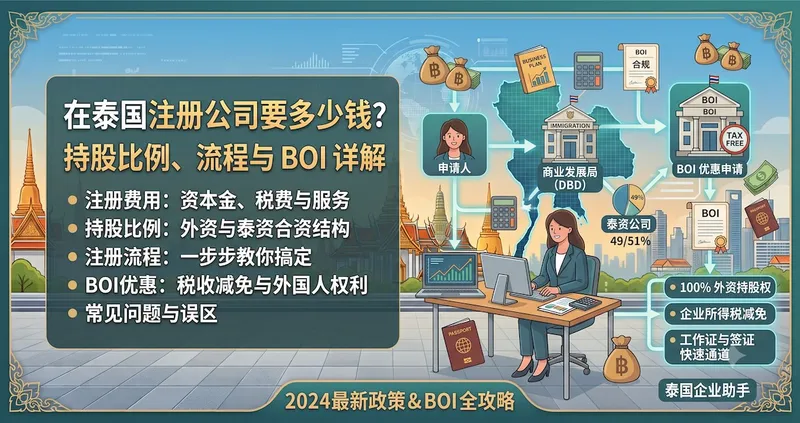
Foreign investors registering a Thai company care about three things: how much they can own, what it costs, and how long it takes. This guide explains limited company rules, fees, and the BOI route to full foreign ownership.
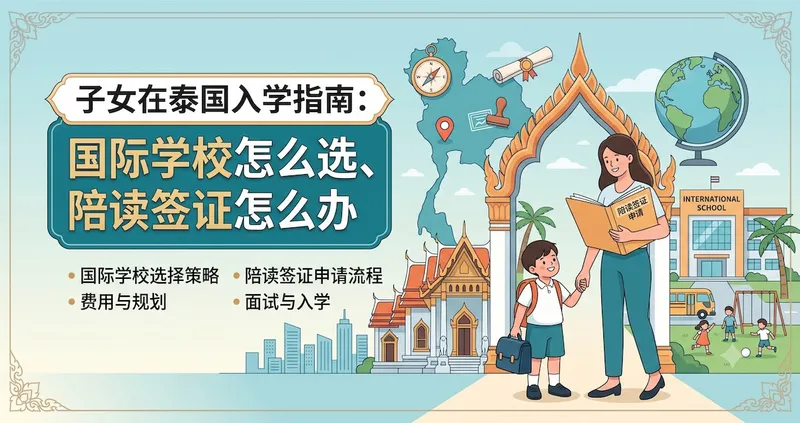
More families are moving their children to international schools in Thailand. This guide covers school types and tuition ranges, admission documents and timelines, and how the child's student visa and the parent's guardian visa work.
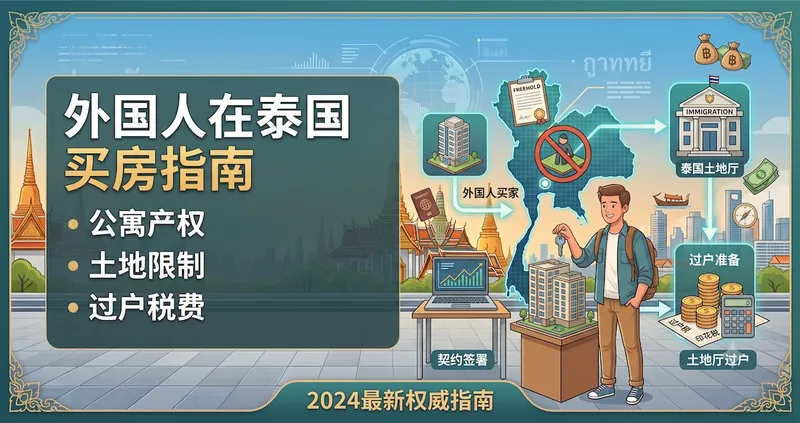
Foreigners can legally own Thai condominiums freehold, but not land. This guide explains the 49% foreign quota, the overseas fund transfer requirement, transfer taxes and fees, and the legal risks to avoid.
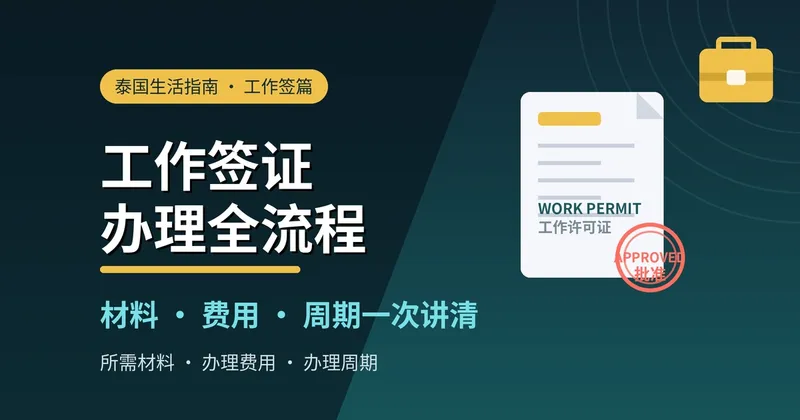
Working legally in Thailand requires two things at once: a Non-Immigrant B visa and a Work Permit. This guide covers employer requirements, the document checklist, the step-by-step process, official fees, and the most common rejection reasons.