 泰互帮
泰互帮Buying a Used Car in Thailand: Inspection Traps, Transfer Steps and Foreigner Paperwork
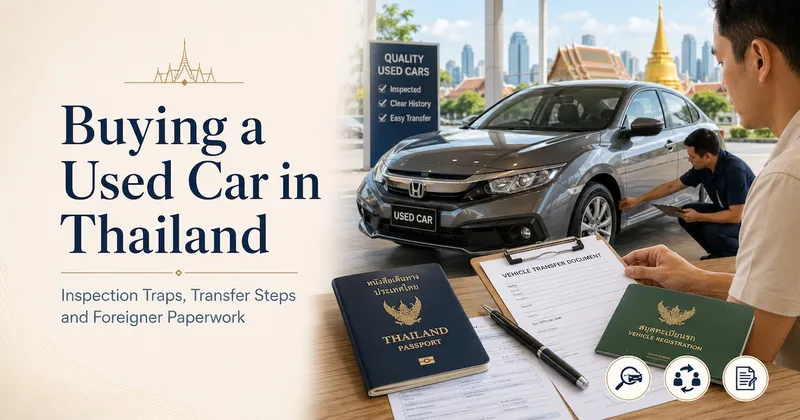
Where to Buy: Three Channels by Risk
- Brand-certified used programs (Toyota Sure, Honda Certified and similar): vetted condition at the highest prices — the low-stress option if budget allows
- Used-car dealers and tent markets: the mainstream channel, wildly uneven — dealer patter and refurbishment skills are professional-grade, and the inspection list below exists for this channel
- Private sales (One2car, Kaidee, Facebook groups, friends): best prices, all due diligence on you. The "urgent sale, flying home" listing in Chinese community groups deserves the full process — familiarity does not replace document checks
- Price intuition: Japanese brands hold value strongly in Thailand, so used prices run higher than mainland instincts expect; the new-car comparison is in our car buying guide
Inspection: Documents Before Metal
Verify paperwork before condition — a clean car with dirty documents is still a no:
- The blue book (Lem Tabian, the registration book): the registered owner must match the seller's ID; for "selling on behalf" arrangements demand the authorization chain, and walk away if it's murky
- Finance status: a car under outstanding finance has its blue book held by the finance company and legally cannot transfer. "Pay me first, I'll clear the loan, then we transfer" is the highest-risk move in the market — insist on a three-party same-day settle-and-transfer
- Mileage and accidents: odometer winding is common enough — cross-check with dealership service records; flood cars show in seat-rail rust and silt in the wiring; major-accident cars show welding at the chassis number area
- Special histories: watch for retired taxis and ride-hailing cars (extreme mileage) and modified cars (which can fail transfer inspection)
- Not a car person? A third-party inspection service costs a few hundred to a couple thousand baht — far cheaper than gambling
The Transfer: Half a Day at the DLT
- Both sides prepare: blue book, sale contract, the owner's ID (for foreigners, passport plus work permit or residence document), and the buyer's equivalents
- The foreigner's key document is proof of address: work permit holders use the permit; others obtain a Residence Certificate from Immigration (issued against your TM30 record) or an embassy address letter — follow the DLT window's current practice
- Drive the car to the DLT for chassis verification, file the transfer, pay fees and duties (typically a few hundred to a bit over a thousand baht in total)
- Collect the updated blue book on the spot or within days — it's done only when the registration page shows your name
- Insurance in parallel: the compulsory Por Ror Bor follows the car through its validity, but voluntary insurance generally needs re-issuing or an insured-party change — don't drive on "the previous owner's policy," it fails at claim time; coverage choices are in our car insurance guide
Payment and Contract Hygiene
- Tie money to the transfer: small deposit, balance paid at the DLT at the moment of transfer is the solid structure; keep transfer slips for any large payment
- The contract should state: chassis number, declared mileage, no-major-accident declaration, finance-cleared declaration, and the handover list — the Thai text governs, so have it checked if you can't read it
- Used-car finance for foreigners is hard (most companies want a work permit and income records, at low ratios and high rates) — cash is the norm. Sort the license first: see our driver's license guide
FAQ
Can I transfer a car on a tourist visa?
Registration law doesn't gate on visa type; the practical gate is proof of address. Immigration's Residence Certificate runs off your TM30 lodging record and is obtainable even on short stays (some offices charge a few hundred baht and take days). Long-stay statuses — work permit, retirement, Elite — process smoothest. Remember buying is the easy half: insurance, annual inspection and road tax all land on your name, so short-stayers should weigh renting instead.
The car is still under finance and priced attractively — workable?
Workable through exactly one structure: a three-party same-day operation — your payment goes directly to the finance company to clear the balance, the company releases the blue book on the spot, and the transfer files immediately. Every variant of "pay me now, I'll settle it soon" hands the other side total control; runaway-seller cases are a large share of used-car fraud. Recourse steps are in our fraud recovery guide.
Can I just drive it without transferring the name?
Strongly no. The car staying in the seller's name means tickets and accident liability notices go to them, you can't properly renew insurance or inspection, their debt disputes can get the car seized — and if they later disappear, you can't even complete the transfer. It costs a few hundred baht and half a day; there is no reason to skip it.
I bought a wound-back or accident car — can I unwind the deal?
It turns on evidence and the contract: with mileage and no-major-accident declarations written in, fraud supports rescission and damages — keep the listing page, chats and inspection report. Without them, proof gets much harder — which is precisely why the declarations belong in the contract. For significant amounts, a lawyer's letter moves things; dealer-channel purchases can also pressure through the consumer protection board (OCPB).
Need Help?
TaiHuBang supports car purchases: used-car contract review, accompanied transfer with interpretation, residence certificate guidance, and dispute assistance. See our legal services, or submit an inquiry — a consultant will reply within 24 hours.
Related Articles

Can a Thai Company Legally Hold Land or Property? Nominee Risks, Compliant Structures & Alternatives
Since foreigners can't directly own Thai land or landed houses, some think of "registering a Thai company to hold the land." That route exists in specific compliant cases, but the most common version on the market — using Thai people as nominee shareholders to make up 51% Thai ownership while a foreigner actually controls the company — is an illegal nominee arrangement: Thai law prohibits using nominees to circumvent the ban on foreign land ownership, and if caught you can face forced disposal of the land, fines and even criminal liability, with the nominee Thais also liable. True compliance depends on whether the company genuinely operates and whether the Thai shareholders genuinely invest and hold rights — not a shell set up purely to hold land. For safer holding, foreigners more commonly buy a freehold condo (which foreigners may own), sign a long-term lease (leasehold, up to about 30 years, renewable), or use BOI/special permits where qualified. This guide covers the red lines of company land-holding, nominee risks and safer alternatives, subject to the Land Code; consult a lawyer for major decisions.
8/4/2026
You Bought Property in Thailand — Now How Do You Stay Legally? A Property Owner's Visa Guide
Buying property in Thailand doesn't let you stay legally — a purchase carries no residency, and you still need a valid visa to live there long-term. Common lawful long-stay routes for owners include: a retirement visa for those 50+ retiring, an Elite visa for easy long stays, the LTR 10-year visa for qualifying high-asset/remote/specialist profiles, a work visa for the employed, a dependant visa if your spouse is Thai, and DTV for remote workers. Which to choose depends on your age, whether you work, your income/assets and your long-stay goal — and has little to do with which property you bought. Owners should also mind obligations like 90-day reporting and TM30 address notification. This guide explains a property owner's visa options by profile and how to pair property with a visa, subject to current Immigration and agency rules.
8/1/2026
Living in Thailand Long-Term: Elite Visa or Buy Property — Which Is Worth It? Budget, Goals & Flexibility
Planning to live in Thailand long-term, many agonise over spending the budget on an Elite visa membership or on property. In fact the two solve different problems and don't replace each other: the Elite (Thailand Privilege) visa solves "what lawful status lets you stay long-term" (long-stay convenience, but no work rights and it expires or must be renewed/repurchased), while buying property solves "where to live and whether to sink assets into Thailand" (own-use/investment, but buying grants no residency). To truly live long-term you usually need both — a visa for status and housing (rented or bought) for a home — not one or the other. If the budget stretches to only one first, it comes down to your core goal: for lawful long stay first, choose the visa; for asset landing or long-term own-use first, consider buying but still arrange a visa. This guide weighs them across the problem solved, cost nature, flexibility and exit difficulty, subject to current Immigration and agency rules.
8/1/2026