 泰互帮
泰互帮Keeping Your Children's Chinese in Thailand: Schools, Textbooks and Exam Paths
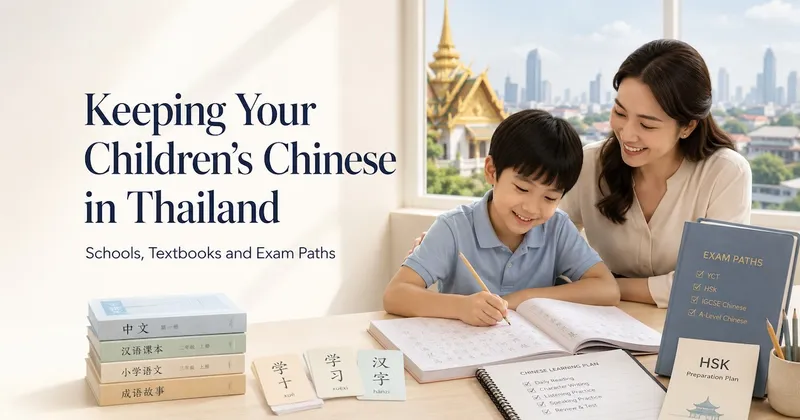
Accept One Reality First: School Won't Hold the Line
At most international schools, Chinese is a foreign-language subject — two or three periods a week on non-native materials. A child's spoken Chinese may stay fluent while reading and writing fall visibly behind mainland peers. A Chinese family's real goals — native-level literacy, the option to re-enter Chinese schools — require a systematic arrangement outside school. That's not a school failure, it's a positioning difference; decide whether your target is "can speak" or "native level," because the investment differs completely. Overall school selection is covered in our international school guide.
The Options Inside the School System
- Native-stream programs at international schools: some schools run first-language Chinese classes or offer IGCSE/IB Chinese (native papers). At tours, ask three questions — is Chinese streamed by native level, what textbooks, how many periods a week — and depth reveals itself immediately
- Trilingual schools (Thai-English-Chinese): Thailand has a tradition of Chinese-heritage schools plus newer trilingual ones, with heavier Chinese timetables at fees below international schools; three languages in parallel suits families planted in Thailand long-term
- Chinese-medium international schools: schools teaching primarily in Chinese and aligned with the mainland curriculum are multiplying in Bangkok — the smoothest re-entry path, but most are young institutions, so inspect curriculum and staffing in person
- Watch the commute radius — the strong-Chinese school may not be in your district; Bangkok area logic is in our neighborhood guide
Outside School: Textbooks and Online Classes That Work
- Pick one textbook spine: the mainland unified curriculum (fully synchronized with schools in China — demanding, needs a parent or tutor driving) or Zhongwen (Jinan University's series designed for overseas Chinese children, friendlier gradient). Start young children on the latter; switch to the former if returning to China is the plan
- Online classes from China: the one-hour time difference makes Thailand one of the best-placed overseas time zones for mainland tutoring; two or three 30–50 minute sessions a week beat one long weekend block
- Weekend Chinese schools: community-run weekend classes in Bangkok carry social value and momentum that self-study can't replicate, but pacing is slow — treat them as a supplement, not the spine
- Home language policy is the cheapest, highest-yield tool: Chinese-only at home, Chinese cartoons and graded readers — speaking and listening hold essentially for free. Literacy is where the money and hours go
Exams: an External Anchor for Progress
YCT (the youth test) and HSK run at established test centers in Thailand (Confucius Institutes and authorized centers in Bangkok and major provinces — check the official Chinese Testing International schedule). For heritage children the point isn't the certificate; it's turning "how's the Chinese going" into verifiable checkpoints: passing YCT 4 or HSK 3–4 in primary years says literacy is on track. Chinese grades also plug into IGCSE/IB — a real academic asset at university time; see our university pathway guide.
Returning to Chinese Schooling: Start the Paperwork a Year Early
- If the child's mainland school registration (xueji) was never deregistered, re-entering is relatively simple; if it was, the child applies as a returning-from-overseas student — policies vary widely by city, so query the target city's rules a year ahead
- Prepare: enrollment certificates and transcripts from Thailand (translation and legalization may be required) and vaccination records; some cities test for grade placement
- The re-entry gap concentrates in Chinese and math progression — exactly what tracking the mainland textbooks abroad is for; English is usually the advantage subject
- A child born in Thailand needs household registration before any xueji exists — see our birth registration guide
FAQ
Will my child's Chinese really slip at an international school?
Speaking holds (if home stays Chinese); literacy almost inevitably falls behind: mainland children learn roughly 3,000 characters across primary school, and a pure international-school environment without extra investment typically delivers less than half. The test is simple — hand the child one page of the same-grade mainland Chinese textbook and listen. The earlier the out-of-school literacy spine starts, the cheaper the catch-up.
Trilingual school or international school?
Anchor on the family's long-term direction: Western university track with budget to match — international school plus an out-of-school Chinese spine; rooted in Thailand or returning to China with tighter budgets — trilingual schools give better value and firmer Chinese foundations. The hybrid (trilingual primary for foundations, international secondary) is common too; reinforce English ahead of the switch.
Where do children take YCT and HSK in Thailand?
Confucius Institutes and authorized centers in Bangkok and major provinces test year-round, paper and online, with registration through the official portal or center channels — seats tighten before holidays, so book early. Younger children start with YCT (friendlier format); secondary students go straight to HSK. For the international-student route into Chinese universities, HSK scores are a hard requirement.
Does a returning child have to drop a grade?
Not necessarily — placement should follow actual Chinese and math levels, not age. Children who tracked the mainland textbooks abroad mostly slot in at grade; those who didn't can usually grind through one semester at grade in the early years, while older students should place by test results honestly — half a grade or a grade down in exchange for keeping up beats struggling for pride. Talk to the target school about placement tests before planning the final six months.
Need Help?
TaiHuBang supports education matters: international and trilingual school selection, guardian visa processing, and translation and legalization of school documents. See our visa services, or submit an inquiry — a consultant will reply within 24 hours.
Related Articles

Can a Thai Company Legally Hold Land or Property? Nominee Risks, Compliant Structures & Alternatives
Since foreigners can't directly own Thai land or landed houses, some think of "registering a Thai company to hold the land." That route exists in specific compliant cases, but the most common version on the market — using Thai people as nominee shareholders to make up 51% Thai ownership while a foreigner actually controls the company — is an illegal nominee arrangement: Thai law prohibits using nominees to circumvent the ban on foreign land ownership, and if caught you can face forced disposal of the land, fines and even criminal liability, with the nominee Thais also liable. True compliance depends on whether the company genuinely operates and whether the Thai shareholders genuinely invest and hold rights — not a shell set up purely to hold land. For safer holding, foreigners more commonly buy a freehold condo (which foreigners may own), sign a long-term lease (leasehold, up to about 30 years, renewable), or use BOI/special permits where qualified. This guide covers the red lines of company land-holding, nominee risks and safer alternatives, subject to the Land Code; consult a lawyer for major decisions.
8/4/2026

You Bought Property in Thailand — Now How Do You Stay Legally? A Property Owner's Visa Guide
Buying property in Thailand doesn't let you stay legally — a purchase carries no residency, and you still need a valid visa to live there long-term. Common lawful long-stay routes for owners include: a retirement visa for those 50+ retiring, an Elite visa for easy long stays, the LTR 10-year visa for qualifying high-asset/remote/specialist profiles, a work visa for the employed, a dependant visa if your spouse is Thai, and DTV for remote workers. Which to choose depends on your age, whether you work, your income/assets and your long-stay goal — and has little to do with which property you bought. Owners should also mind obligations like 90-day reporting and TM30 address notification. This guide explains a property owner's visa options by profile and how to pair property with a visa, subject to current Immigration and agency rules.
8/1/2026

Living in Thailand Long-Term: Elite Visa or Buy Property — Which Is Worth It? Budget, Goals & Flexibility
Planning to live in Thailand long-term, many agonise over spending the budget on an Elite visa membership or on property. In fact the two solve different problems and don't replace each other: the Elite (Thailand Privilege) visa solves "what lawful status lets you stay long-term" (long-stay convenience, but no work rights and it expires or must be renewed/repurchased), while buying property solves "where to live and whether to sink assets into Thailand" (own-use/investment, but buying grants no residency). To truly live long-term you usually need both — a visa for status and housing (rented or bought) for a home — not one or the other. If the budget stretches to only one first, it comes down to your core goal: for lawful long stay first, choose the visa; for asset landing or long-term own-use first, consider buying but still arrange a visa. This guide weighs them across the problem solved, cost nature, flexibility and exit difficulty, subject to current Immigration and agency rules.
8/1/2026