 泰互帮
泰互帮Choosing an International School in Thailand: Curricula, Fees and Admissions

Three Questions Before the School List
Answer three questions before touring schools: where will the child go to university (UK and Commonwealth, North America, or elsewhere), what is the realistic annual budget (add 15%-25% on top of tuition for the extras), and where will you live (a one-way commute over 45 minutes in Bangkok erodes family life). With direction set, the shortlist writes itself. Verify each school's current policies on its official site.
British, American or IB?
| System | Character | Examples |
|---|---|---|
| British | Structured progression, IGCSE + A-Levels, pointing to UK and Commonwealth universities | Shrewsbury, Harrow, Bangkok Patana (largely British) |
| American | Credit system with AP courses, breadth-focused, pointing to North America | ISB, Ruamrudee (RIS) |
| IB | PYP/MYP/DP continuum, globally recognized, heavy workload | NIST, UWC Thailand (Phuket), plus many schools offering IBDP at the top |
Practical note: many schools are hybrids (British lower years with an IBDP sixth form), so look first at what diploma the high school section awards. For university pathways from Thailand, see our university pathway guide.
What Does It Really Cost?
- Top-tier schools (ISB, NIST, Shrewsbury, Harrow): roughly 700,000-1,000,000 THB per year at high school level, 20%-30% less in primary
- Mid-tier international schools: roughly 300,000-600,000 THB per year; the gap with top-tier is mostly teacher turnover and facilities
- Bilingual schools (EP programs): roughly 100,000-300,000 THB per year with substantial Thai-language instruction — suited to families settling long-term
- Beyond tuition: one-time registration and development fees (tens to hundreds of thousands of baht, mostly non-refundable), school bus (40,000-80,000 THB/year), uniforms, lunches and activities
The Admissions Process
- Start 6-12 months ahead: popular schools run waiting lists at popular year levels; the main entry windows are the August new year and January mid-year
- Documents: two years of transcripts (in English or translated), references, passport and visa pages; birth certificate and vaccination records for younger children
- Testing: English and math assessments, plus interviews for older students. Below-threshold English routes into EAL (English support) classes — and limited EAL seats decide admissions outright at some schools
- Offer and deposit: registration fees are due within a deadline to secure the seat, after which it passes to the waitlist
- Timing transfers: avoid joining mid-IGCSE (Years 10-11) in the British system or the second year of the IB Diploma — the highest-friction entry points
Visas for Accompanying Parents
The enrolled child holds a student visa (Non-Immigrant ED), and one parent can hold a guardian visa (Non-Immigrant O) to accompany them legally: school enrollment letter, kinship documents and a bank balance requirement (market practice: 500,000 THB seasoned in a personal account), renewed annually. Key points:
- Typically one guardian visa per enrolled child; the other parent can consider Privilege or DTV options — see our Privilege visa guide
- The guardian visa carries no work permission — employment in Thailand is off the table while on it
- School paperwork and visa paperwork interlock; timelines and details are in our enrollment and guardian visa guide
What to Check on a School Tour
- Teacher turnover: ask directly for average expatriate teacher tenure — high churn is the biggest hidden quality risk
- Student mix: an "international" school dominated by a single nationality dilutes the language environment
- Real results: ask for the distribution of graduate destinations and IBDP averages or A-Level grade profiles, not showcase admits
- Commute test: drive the school run at actual school-run hours — Bangkok rush hour bears no relation to map estimates
FAQ
Can a child with no English enter an international school?
In early years (kindergarten through lower primary), usually yes — young children catch up fast. From upper primary onward most schools require passing the English assessment or entering EAL, and some top schools simply decline zero-English transfers. A common route for older children is a year in a bilingual school or intensive program before switching tracks.
Are there age cutoffs and seat deadlines?
Year placement follows date of birth (September 1 cutoff in the British system; American schools vary), and cross-system transfers may be placed half a year or a year lower. At popular schools, offers give only a week or two to pay the registration fee before the seat moves to the waitlist — have funds ready.
Is a bilingual school a false economy?
It depends on the family plan. For families rooted in Thailand who want strong Thai, bilingual schools are excellent value. For families targeting overseas universities, the high-school diplomas (A-Level/IBDP/AP) and full-English academic training are hard to replicate in bilingual programs — the common pattern is bilingual primary, international secondary, with a year of preparation for the switch.
When should we apply for international school admission in Thailand?
Start 6-12 months before the target entry date. The main intakes are August (new academic year) and January (mid-year), and popular schools run waiting lists at popular year levels, so an early application and early assessment slot matter more than a polished file. Mid-IGCSE (Years 10-11) and the second year of IB are the hardest points to join.
What do international school admissions in Thailand test?
Nearly all schools assess English and math, with interviews for older students. Below-threshold English routes the child into EAL (English support) classes — and because EAL seats are limited, they decide admissions outright at some schools. Prepare two years of transcripts in English, references and passport/visa pages alongside the tests.
Need Help?
TaiHuBang provides end-to-end school support: school selection advice and tour booking, application document preparation and translation, student and guardian visa processing with renewal reminders. See our visa services, or submit an inquiry — a consultant will reply within 24 hours.
Related Articles
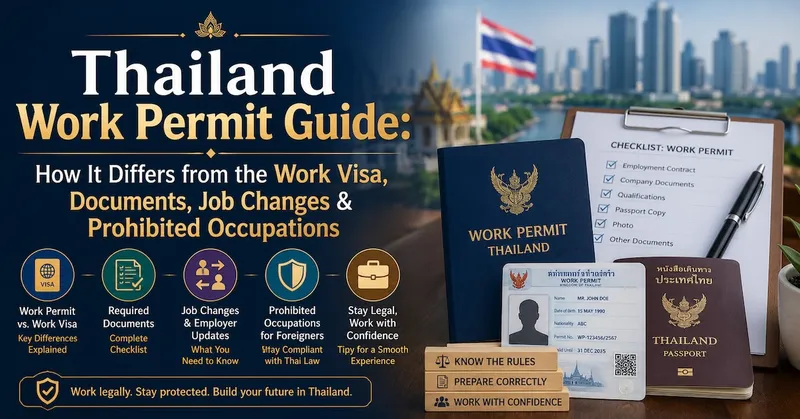
Thailand Work Permit Guide: How It Differs from the Work Visa, Documents, Job Changes & Prohibited Occupations
To work legally in Thailand, a work visa (Non-B) alone isn't enough — you also need a Work Permit, and the two are different: the work visa is permission to enter and stay, while the work permit authorises you to do a specified job for a specified employer. Typically you first hold a Non-B visa, then the company applies for your work permit, and only both together make employment legal. The permit is employer-initiated and tied to a specific company and position, so changing jobs means reapplying or amending it, and the company must meet capital and Thai-to-foreign staff ratio requirements (commonly four Thai employees per foreigner). Thailand also has a list of occupations prohibited or restricted for foreigners; working out of scope or without a permit is illegal and can bring fines, deportation and a blacklist. This guide covers the permit-versus-visa distinction, documents and process, handling job changes, and prohibited occupations, subject to current Ministry of Labour rules.
7/24/2026
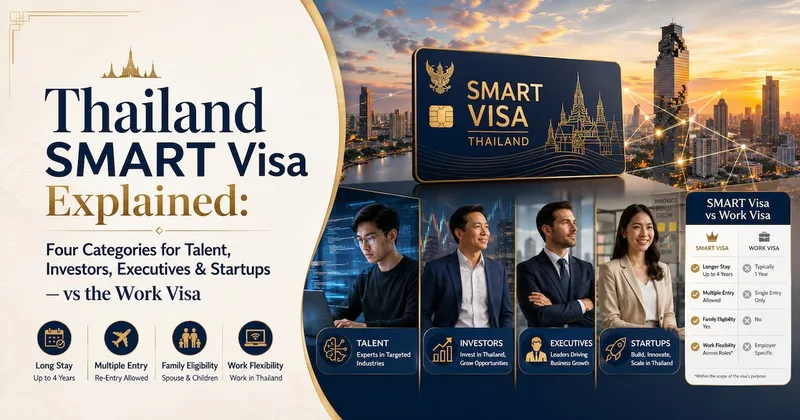
Thailand SMART Visa Explained: Four Categories for Talent, Investors, Executives & Startups — vs the Work Visa
The SMART Visa is Thailand's special visa to attract talent in targeted industries (technology, digital, innovation), in four categories: Highly-Skilled Talent (T), Investor (I), Executive (E) and Startup (S). Its appeal: up to a four-year visa for those who qualify, the ability to work within the approved scope without a separate work permit, 90-day reporting relaxed to once a year, and dependants who can join — with spouses generally allowed to work. But the bar is defined: your role must fall in a BOI-endorsed targeted industry and meet salary or investment thresholds, with certification by the relevant authority, so vetting is stricter than an ordinary work visa. It differs from the standard "work visa + work permit" route, which suits most employed foreigners, whereas SMART targets high-end talent, investors and founders in targeted industries. This guide covers the four categories' requirements, benefits and how to choose between SMART, the work visa and LTR, subject to current BOI and agency rules.
7/22/2026
Thailand LTR Visa Guide: The Four Categories, Requirements, Tax Perks and Ten-Year Residence
The LTR (Long-Term Resident) visa is Thailand's long-stay visa to attract wealthy individuals, affluent retirees, remote-working professionals and highly skilled experts. It offers up to around ten years of residence (typically issued in stages, renewed on continued eligibility), plus perks such as annual reporting instead of 90-day reporting, multiple re-entry, the option of a digital work permit, and preferential personal income tax for some categories. It targets people with higher income, assets or investment, so the bar and paperwork are higher than a tourist visa or DTV — but you get a far more hassle-free long-term status. This guide covers the four LTR categories, their income/asset thresholds, the perks, and how to choose between LTR, the Privilege visa, DTV and retirement visas — subject to the BOI and Immigration's current rules.
7/21/2026