 泰互帮
泰互帮International Schools in Thailand: Choosing a School and Getting the Guardian Visa

Why Families Choose Thailand
Value for money is the main draw of international education in Thailand: tuition for the same curricula (IB, British, American) is generally a third to half of what Europe or the US charges, flights home are short, and a parent can legally stay as a guardian. Bangkok, Chiang Mai and Phuket are the three mainstream choices.
School Types and Tuition Ranges
| Type | Language | Tuition (THB/year) |
|---|---|---|
| Established international schools (IB/British/American) | Full English | approx. 400,000-900,000+ |
| Mid-tier international schools | Full English | approx. 200,000-400,000 |
| Bilingual schools | English-Thai, some with Chinese | approx. 100,000-250,000 |
| Public school English Programs (EP) | Partial English | approx. 50,000-100,000 |
These exclude school bus, meals, uniforms and one-time entrance fees (some schools charge a 50,000-200,000 THB capital fee). Beyond rankings, visit in person and check teacher turnover, nationality mix, and university placement records.
Admission Documents and Timeline
- Passports (child and parents)
- Last two years of school transcripts (in English or certified translation)
- Vaccination records (or translated copies)
- Enrollment certificate or diplomas
- Recommendation letters at some schools
International schools mostly admit year-round, but popular schools and year groups need applications 6-12 months ahead. Most schools run entrance tests in English and math; children with weaker English may be placed in EAL (English support) classes at extra cost.
The Child's Student Visa (Non-ED)
Once admitted, the school issues an acceptance letter and sponsorship documents. The child applies for a Non-ED visa at a Thai embassy or consulate abroad, then the school helps extend it to a one-year stay at Immigration, renewed annually with an enrollment certificate. Many international schools have a visa department that handles the whole process — ask when choosing a school.
The Parent's Guardian Visa (Non-O Guardian)
While the child studies on a student visa, one parent can apply for a Non-O guardian visa. Key points:
- Proof of the parent-child relationship (birth certificate, translated and legalized)
- The child's enrollment certificate and student visa
- Financial proof: at least 500,000 THB in a Thai bank account, held for the required period (per Immigration's current rules)
- Renewed yearly, aligned with the child's visa cycle
Note: the guardian visa is normally granted to one parent only, and it does not permit working in Thailand. The other parent commonly uses a Privilege visa, DTV, or a dependent visa.
FAQ
Can my child cope with transferring mid-way?
Lower primary students adapt fastest; from middle school onward, six months to a year of English preparation is advisable. Most schools allow trial study, and the start of a term is the best entry point.
Can a child with no English start at a bilingual school?
Yes — bilingual schools demand less English than international schools and offer a gentler transition. But if the goal is a Western university, move into a full-English curriculum as early as possible.
Can I work while on a guardian visa?
No. The guardian visa carries no work rights. Employment requires a separate Non-B visa plus work permit, which also means changing visa type.
Need Help?
TaiHuBang provides school placement and guardian visa consulting: school selection advice, application document guidance, and student and guardian visa assistance. See our visa services, or submit an inquiry — a consultant will reply within 24 hours.
Related Articles
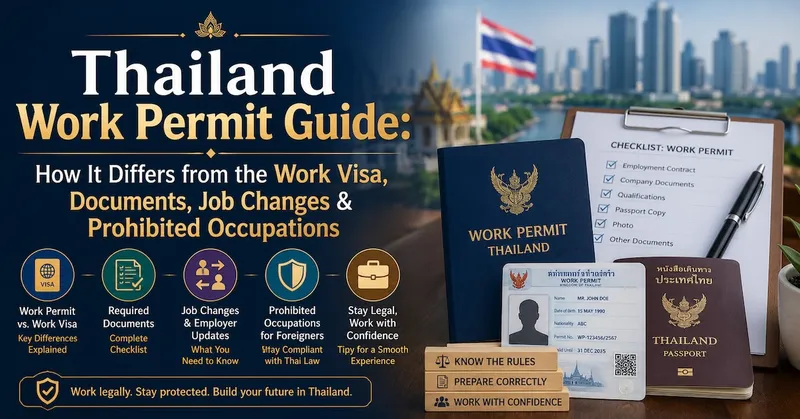
Thailand Work Permit Guide: How It Differs from the Work Visa, Documents, Job Changes & Prohibited Occupations
To work legally in Thailand, a work visa (Non-B) alone isn't enough — you also need a Work Permit, and the two are different: the work visa is permission to enter and stay, while the work permit authorises you to do a specified job for a specified employer. Typically you first hold a Non-B visa, then the company applies for your work permit, and only both together make employment legal. The permit is employer-initiated and tied to a specific company and position, so changing jobs means reapplying or amending it, and the company must meet capital and Thai-to-foreign staff ratio requirements (commonly four Thai employees per foreigner). Thailand also has a list of occupations prohibited or restricted for foreigners; working out of scope or without a permit is illegal and can bring fines, deportation and a blacklist. This guide covers the permit-versus-visa distinction, documents and process, handling job changes, and prohibited occupations, subject to current Ministry of Labour rules.
7/24/2026
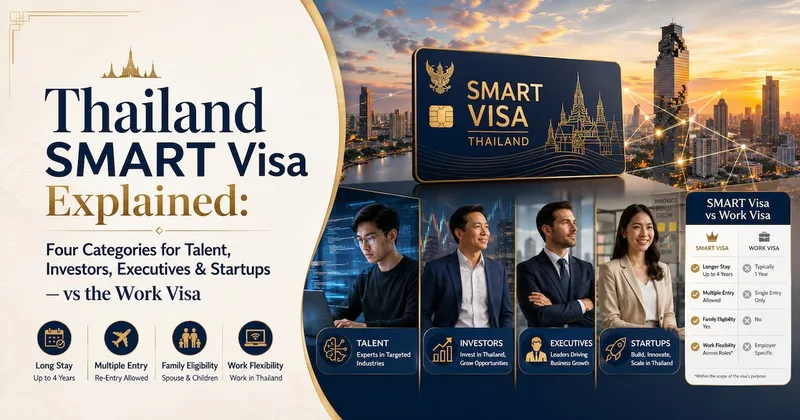
Thailand SMART Visa Explained: Four Categories for Talent, Investors, Executives & Startups — vs the Work Visa
The SMART Visa is Thailand's special visa to attract talent in targeted industries (technology, digital, innovation), in four categories: Highly-Skilled Talent (T), Investor (I), Executive (E) and Startup (S). Its appeal: up to a four-year visa for those who qualify, the ability to work within the approved scope without a separate work permit, 90-day reporting relaxed to once a year, and dependants who can join — with spouses generally allowed to work. But the bar is defined: your role must fall in a BOI-endorsed targeted industry and meet salary or investment thresholds, with certification by the relevant authority, so vetting is stricter than an ordinary work visa. It differs from the standard "work visa + work permit" route, which suits most employed foreigners, whereas SMART targets high-end talent, investors and founders in targeted industries. This guide covers the four categories' requirements, benefits and how to choose between SMART, the work visa and LTR, subject to current BOI and agency rules.
7/22/2026
Thailand LTR Visa Guide: The Four Categories, Requirements, Tax Perks and Ten-Year Residence
The LTR (Long-Term Resident) visa is Thailand's long-stay visa to attract wealthy individuals, affluent retirees, remote-working professionals and highly skilled experts. It offers up to around ten years of residence (typically issued in stages, renewed on continued eligibility), plus perks such as annual reporting instead of 90-day reporting, multiple re-entry, the option of a digital work permit, and preferential personal income tax for some categories. It targets people with higher income, assets or investment, so the bar and paperwork are higher than a tourist visa or DTV — but you get a far more hassle-free long-term status. This guide covers the four LTR categories, their income/asset thresholds, the perks, and how to choose between LTR, the Privilege visa, DTV and retirement visas — subject to the BOI and Immigration's current rules.
7/21/2026