 泰互帮
泰互帮Foreigners Starting a Business in Thailand: Licenses, Foreign-Ownership Limits and a Shopfront Compliance Checklist
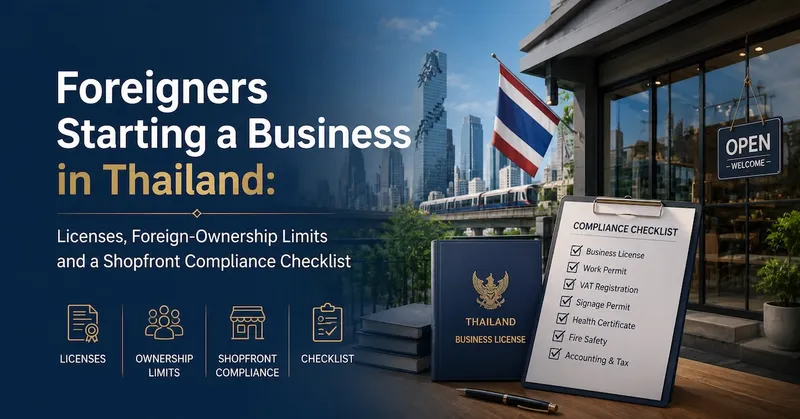
The Red Line First: What Foreigners Can and Can't Wholly Own
The document that decides success or failure is the Foreign Business Act. It sorts industries into three lists, and food service, retail and most services fall under the restricted category — foreigners (including majority foreign-owned companies) can't run them wholly foreign-owned:
- List 1: absolutely closed to foreigners (media, land dealing, traditional agriculture, etc.)
- List 2: national-security and cultural sectors, requiring cabinet approval — a very high bar
- List 3: sectors where Thais aren't yet competitive (much of services, retail and food service sit here); foreign capital needs a Foreign Business License (FBL) to operate
In other words, "opening a bubble-tea shop" isn't legally as simple as renting a unit — you first have to solve the question of how a foreigner may legally operate, with the exact classification per the Department of Business Development (DBD)'s current rules.
Three Legal Routes In
- A limited company with 51% Thai shareholding: the most common structure — Thai shareholders holding a majority sidestep the FBL requirement. But "finding someone to hold shares as a nominee" is clearly illegal — Thailand has stepped up enforcement, and being deemed a nominee arrangement can bring criminal penalties and forced liquidation. Use real, verifiable shareholding and capital, not nominee holdings
- Foreign Business License (FBL): where foreign capital is the majority, apply to the DBD for the restricted activity — long approval, higher paid-up capital, suited to scaled, formal operations
- BOI-promoted projects: activities approved by the Board of Investment can enjoy 100% foreign ownership and relief from the Thai-employee ratio, but only in promoted industries (manufacturing, tech, some services); ordinary food and retail usually don't qualify — see our Thailand BOI application guide
- US–Thai Treaty of Amity: US nationals may operate with rights close to Thai nationals (a few sectors still excluded); it doesn't apply to non-US citizens
Basic Steps and Cost of Registering a Company
- Name reservation → file the articles and shareholder details → DBD registration → obtain the tax ID → VAT registration (on threshold or voluntarily) → social-security registration
- What registered capital really means: for a foreigner to get a work permit, there's an implicit threshold of roughly 2 million baht of registered capital per foreign employee; the figure isn't arbitrary — it drives your later visa and work permit
- For the overall registration cost and professional-fee range, see our Thailand company registration cost guide; registration is only the start — don't underestimate the monthly compliance spend
Your Own Visa and Work Permit as Owner
Being a shareholder doesn't mean you may legally work — working in your own company still needs a work permit:
- The route is a "Non-Immigrant B visa + Work Permit" combination, both required — see our Thailand work visa and work permit guide
- An ordinary company faces a Thai-employee ratio (commonly 4 Thais per 1 foreign work permit) and a registered-capital threshold — build the labor cost into your model before opening
- Long-stay options like the Elite visa or DTV exist, but they are not work authorization — operating a business on them still requires solving work legality separately; see our Thailand Elite visa guide
Extra Licenses and Compliance for a Physical Shop
- Food-hygiene permit: food service and processing apply to the local authority (e.g. the BMA) for a hygiene operating permit, covering premises, ventilation and inspection
- Liquor license: selling alcohol needs a sales license and compliance with legal selling hours and no-sale days
- Signboard tax: shopfront signs are taxed annually by language and area — the ratio of Thai to foreign script affects the rate
- VAT registration and monthly filing: annual revenue over 1.8 million baht requires VAT registration, then monthly VAT, withholding-tax and social-security filings — don't wait to be audited; details in our monthly company tax and social-security guide
- Lease and address: your business address must pass commercial and tax verification — a commercial lease plus a landlord willing to invoice and register the address are both essential
Common Pitfalls
- Nominee shareholding: grabbing random Thais to make up the 51% is an illegal, high-risk move under tightening enforcement — not worth it
- Underestimating monthly compliance cost: accounting, tax filing, social security and work-permit renewals are ongoing — many small shops fail on "easy to register, expensive to maintain"
- Operating before licensing: unlicensed operation risks fines or closure; food, liquor and hygiene permits must be in place before opening
Frequently Asked Questions
Can a foreigner own 100% of a restaurant or bubble-tea shop in Thailand?
Generally no. Food service and retail are restricted under the Foreign Business Act, so wholly foreign ownership needs an FBL (strict, high bar); otherwise the usual route is a limited company with majority Thai shareholding. The key is that the shareholding and capital must be real — using nominees is illegal, enforcement has tightened, and the risk far outweighs the saving. How to structure it is best decided by compliance advice based on your nationality (US citizens can use the Treaty of Amity), industry and scale, per current DBD and BOI rules.
How much registered capital do I need — can I just put any number?
No. Registered capital is both your external credibility and directly tied to the foreign owner's work permit — getting one usually maps to an implicit 2 million baht of capital per foreign employee. Too high and you face paid-up pressure; too low and you can't get the visa and permit. The sensible approach is to work backward from "how many foreign work permits + genuine business need," then align with industry norms — don't guess.
I'm a shareholder — do I still need a work permit to work in my own shop?
Yes. Under Thai law a foreigner needs a work permit for any "work" — serving, managing, doing deals all count, even in your own company. The legal combination is a Non-Immigrant B visa + Work Permit, and the company must meet the Thai-employee ratio and capital requirements. Running a shop on just an Elite visa or DTV without a work permit is illegal employment and risky if inspected.
From registration to legally opening, how long and how much?
Company registration itself usually takes one to several weeks, but "legally open" adds VAT/social-security registration, work-permit processing, and the shop's hygiene permit, liquor license and so on — often one to three months overall. Costs split into registration professional fees, paid-up capital (depending on structure), and monthly accounting/tax/social-security upkeep, and vary widely — be sure to budget the ongoing compliance cost into your startup plan, not just the setup fee.
Need a Hand?
TaiHuBang provides process guidance and document support for starting a business in Thailand: compliant shareholding-structure consulting, company registration, VAT/social-security registration, work visa and work permit processing, and guidance on shopfront licenses. We only do lawful, compliant process support — no nominee arrangements or other illegal setups. See our company registration service, accounting and tax service and legal consulting service, or submit an inquiry and a consultant will reply within 24 hours.
Related Articles

How to Choose a Thai Company Type: Limited Company, Partnership, Representative Office, Branch & BOI Compared
For a foreigner setting up in Thailand, the first step isn't rushing to register — it's choosing the right entity. There are five common ones: the Private Limited Company (the mainstream vehicle that can actually trade, hire and invoice, but with foreign shareholding capped under the Foreign Business Act), the partnership (rarely used), the Representative Office (limited to non-revenue activities like market research and liaison — it cannot earn income), a Branch of a foreign company (an extension of the parent with no liability separation), and a BOI-promoted company (which can lift some foreign-ownership limits and grant tax benefits, but with industry thresholds). Which to pick depends on whether you'll genuinely trade and earn revenue, whether you can accept foreign-shareholding limits, whether you need full foreign ownership, and whether you qualify for BOI. Pick wrong and you can't do business, get stuck on ownership ratios, or overpay tax. This guide compares the five entities' purpose, foreign-ownership limits, liability and tax, subject to current DBD, BOI and agency rules.
8/2/2026
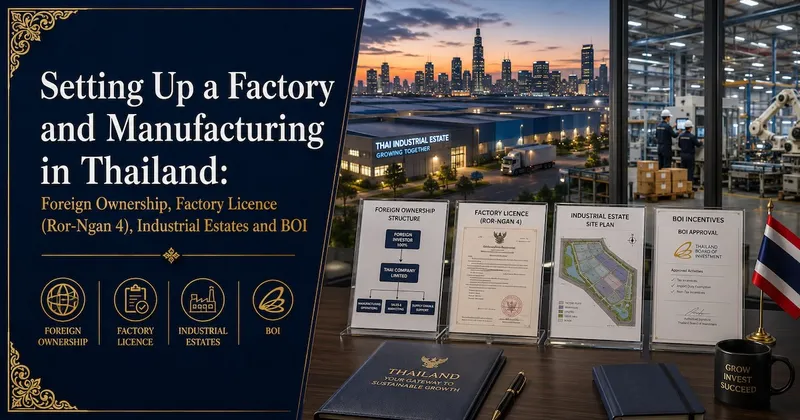
Setting Up a Factory and Manufacturing in Thailand: Foreign Ownership, Factory Licence (Ror-Ngan 4), Industrial Estates and BOI
Thailand is a Southeast Asian manufacturing hub, and many Chinese firms want to set up a factory — but that's far more complex than a trading company: you handle foreign shareholding (manufacturing is relatively open but still needs a compliant structure), obtain a factory licence (Ror-Ngan 4 / รง.4, required for factories above a machinery-power or worker threshold), pick the right site (an IEAT industrial estate vs own land, and whether foreigners can hold it), do an EIA where required, arrange work permits for expat managers and local hiring, and pay duty on imported machinery and materials. A BOI promotion can secure a tax holiday, foreign land holding and expat-employee quotas. This guide covers foreign structure, factory licence, site/land, BOI benefits, and hiring/equipment import, subject to the DIW, BOI and relevant authorities' current rules.
7/12/2026

Import and Export in Thailand: Trader Registration, HS Codes, Duty and VAT, and ASEAN–China FTA Preferences
To trade goods into or out of Thailand, having the goods isn't enough — you must clear three gates: entity, customs clearance, and tax. Importing/exporting usually needs a lawful company registered as an importer/exporter in Customs' e-system; goods are classified by HS code, which sets the rate; imports pay import duty plus 7% import VAT (some goods also excise), and food, cosmetics, electricals etc. need permits and standards. A Form E certificate of origin under the ASEAN–China FTA can secure preferential or zero duty, but wrong classification, under-valuation or missing permits get goods seized with back-tax and fines. This guide covers entity, clearance, duty/VAT, preferential origin and common traps, subject to Thai Customs and relevant authorities' current rules.
7/12/2026