 泰互帮
泰互帮Thailand Work Visa and Work Permit: Requirements, Costs and Timeline
What "Work Visa" Actually Means in Thailand
Many people assume a Thai work visa is a single document. In reality, working legally in Thailand requires two things to be valid at the same time: a Non-Immigrant B visa (Non-B) and a Work Permit. The Non-B covers legal residence; the Work Permit covers legal employment. Working on a tourist visa or visa exemption is illegal and can lead to fines, detention, deportation, and a re-entry ban.
Who Qualifies?
The Work Permit is applied for by the employer, and the employing company must meet hard requirements:
- Registered capital of at least 2 million THB per foreign employee
- Four Thai employees on payroll per foreign employee (BOI-promoted companies are exempt)
- The company must be genuinely operating and filing taxes normally
The applicant must have education or work experience matching the position, no record of violating Thai law, and must not work in occupations reserved for Thai nationals (tour guide, hairdressing, and others on the restricted list).
Document Checklist
Personal Documents
- Passport (valid for at least 6 months)
- Degree certificate with notarized translation
- Medical certificate (Thai-specified checkup items)
- Passport photos on white background
- Previous employment certificate or CV
Company Documents
- Full DBD company registration documents
- Shareholder list, financial statements, tax filing records
- Social security payment records for Thai employees
- Employment contract and job description
Process and Timeline
- The employer files a WP3 pre-approval application with the Ministry of Labour (about 7-15 working days)
- The applicant takes the WP3 to a Thai embassy or consulate outside Thailand to apply for the Non-B visa (about 5-10 working days)
- Enter Thailand on the Non-B and collect the Work Permit from the Ministry of Labour within 30 days
- Extend the 90-day Non-B to a one-year stay at Immigration
- Report to Immigration every 90 days thereafter and renew annually
When everything goes smoothly, the full process takes about 1-2 months. Peak season, document resubmissions, or employer qualification issues will stretch the timeline.
Official Fees
| Item | Official fee (THB) |
|---|---|
| Non-B visa (single entry) | approx. 2,000-3,000 |
| Work Permit (1 year) | approx. 3,100 |
| Visa extension (1 year) | 1,900 |
| Re-entry permit | 1,000 single / 3,800 multiple |
These are government fees only, excluding translation, notarization, medical checkup and agency service fees. Confirm current amounts with the latest announcements from the Ministry of Labour and Immigration.
Common Rejection Reasons
- Company registered capital or Thai employee headcount below the threshold
- Company with no real operations or blank tax records
- Position obviously mismatched with education and experience
- Improperly translated or un-notarized documents
- Previous overstay record
FAQ
Can I get a work permit without an employer?
No. A Work Permit must be initiated by a Thai-registered company as the employer. Freelancers commonly register their own Thai company and apply as its employee, which requires meeting the registered capital and Thai staff requirements.
Can I change employers on a work visa?
The Work Permit is tied to the employer. Changing jobs means cancelling the old permit and having the new employer apply again, with a corresponding visa change. Plan the transition carefully to avoid a gap in legal residence.
What happens if I miss my 90-day report?
Late reporting is fined from 2,000 THB. You can authorize an agent to report on time for you — a small task not worth damaging your renewal record over.
Need Help?
TaiHuBang provides end-to-end work visa consulting and document assistance: employer pre-assessment, document preparation guidance, accompanied submission and progress tracking. See our visa services, or submit an inquiry — a consultant will reply within 24 hours.
Related Articles
Thailand Work Permit Guide: How It Differs from the Work Visa, Documents, Job Changes & Prohibited Occupations
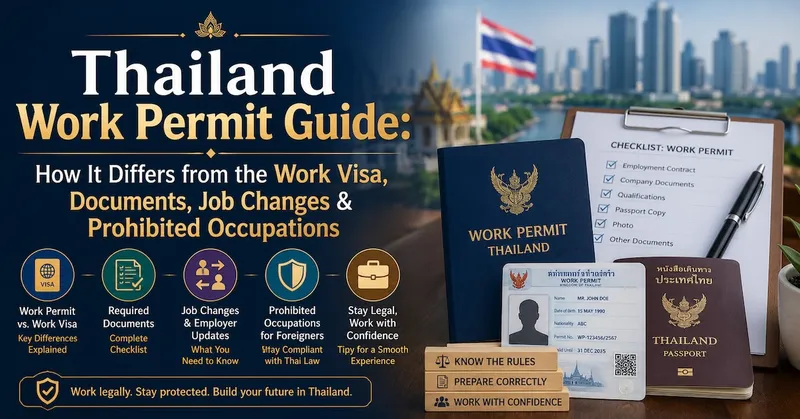
To work legally in Thailand, a work visa (Non-B) alone isn't enough — you also need a Work Permit, and the two are different: the work visa is permission to enter and stay, while the work permit authorises you to do a specified job for a specified employer. Typically you first hold a Non-B visa, then the company applies for your work permit, and only both together make employment legal. The permit is employer-initiated and tied to a specific company and position, so changing jobs means reapplying or amending it, and the company must meet capital and Thai-to-foreign staff ratio requirements (commonly four Thai employees per foreigner). Thailand also has a list of occupations prohibited or restricted for foreigners; working out of scope or without a permit is illegal and can bring fines, deportation and a blacklist. This guide covers the permit-versus-visa distinction, documents and process, handling job changes, and prohibited occupations, subject to current Ministry of Labour rules.
7/24/2026

Thailand SMART Visa Explained: Four Categories for Talent, Investors, Executives & Startups — vs the Work Visa
The SMART Visa is Thailand's special visa to attract talent in targeted industries (technology, digital, innovation), in four categories: Highly-Skilled Talent (T), Investor (I), Executive (E) and Startup (S). Its appeal: up to a four-year visa for those who qualify, the ability to work within the approved scope without a separate work permit, 90-day reporting relaxed to once a year, and dependants who can join — with spouses generally allowed to work. But the bar is defined: your role must fall in a BOI-endorsed targeted industry and meet salary or investment thresholds, with certification by the relevant authority, so vetting is stricter than an ordinary work visa. It differs from the standard "work visa + work permit" route, which suits most employed foreigners, whereas SMART targets high-end talent, investors and founders in targeted industries. This guide covers the four categories' requirements, benefits and how to choose between SMART, the work visa and LTR, subject to current BOI and agency rules.
7/22/2026
Thailand LTR Visa Guide: The Four Categories, Requirements, Tax Perks and Ten-Year Residence
The LTR (Long-Term Resident) visa is Thailand's long-stay visa to attract wealthy individuals, affluent retirees, remote-working professionals and highly skilled experts. It offers up to around ten years of residence (typically issued in stages, renewed on continued eligibility), plus perks such as annual reporting instead of 90-day reporting, multiple re-entry, the option of a digital work permit, and preferential personal income tax for some categories. It targets people with higher income, assets or investment, so the bar and paperwork are higher than a tourist visa or DTV — but you get a far more hassle-free long-term status. This guide covers the four LTR categories, their income/asset thresholds, the perks, and how to choose between LTR, the Privilege visa, DTV and retirement visas — subject to the BOI and Immigration's current rules.
7/21/2026