 泰互帮
泰互帮Divorce in Thailand: Registered Divorce, Court Grounds, Property and Child Custody
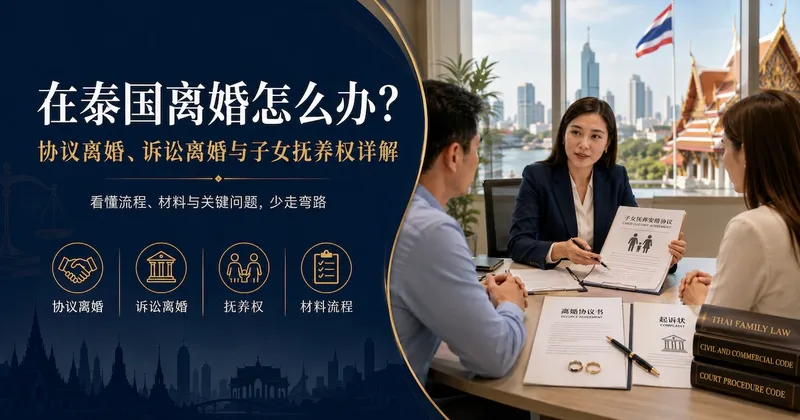
Two Routes to Divorce
Thailand separates divorce into administrative and judicial routes. Where the marriage is registered in Thailand and both spouses agree, divorce is registered at the district office (Amphoe) and takes effect on the spot. Where one side refuses, terms can't be agreed, or the marriage was registered abroad, the route is a court action — months at best, years when fought. The route determines everything about cost and timeline. Specific cases need Thai counsel.
Registered Divorce at the Amphoe
- Conditions: marriage registered (or re-registered) in Thailand, both parties present, agreement on the divorce and its consequences
- Documents: ID (passports for foreigners), the marriage certificate, and translations or legalizations per the office's requirements
- Register the consequences too: property division, custody and child support recorded in the divorce registration are enforceable — put the deal in the registration, never leave it verbal
- Using the divorce abroad: Thai divorce documents need legalization and translation for use in other countries — sort this before remarrying or dealing with property at home
Grounds for Judicial Divorce
The Civil and Commercial Code lists statutory grounds; the ones most used include adultery or cohabiting with another as spouse, serious harm or insult, desertion over one year, disappearance, three years' separation, and failure to maintain. Key points:
- Evidence first: gather proof of fault-based grounds lawfully — illegally obtained evidence can rebound on you
- Jurisdiction: Thai courts take cases where the defendant is domiciled in Thailand or the marriage was registered there; couples married abroad but living in Thailand commonly litigate here, with recognition of the judgment abroad confirmed separately
- Mediation comes first in Thai family cases, and a substantial share settle there
How Property Divides
- Thailand runs a community property regime: assets acquired during marriage (Sin Somros) split equally in principle; premarital assets and personal gifts or inheritances (Sin Suan Tua) stay with their owner
- Land held in the Thai spouse's name: the foreign spouse typically signed a declaration at purchase that the funds were not community property, making a division claim difficult — the biggest structural risk in cross-border marriages
- Condos, deposits and vehicles settle under community rules; concealing or moving assets invites adverse findings at division
- Prenuptial agreements are valid when registered with the marriage — they cannot be added later, which is why this decision belongs at registration; see our marriage registration guide
Custody and Child Support
- A registered divorce can allocate parental power (custody) by agreement; contested cases are decided on the child's best interests — care capacity, stability and the child's wishes
- Children born outside marriage: the father acquires parental power only through legitimation registration or court confirmation — a major issue for unregistered couples
- Support: set by agreement or by the court on incomes and needs, enforceable through execution; enforcement against overseas income is hard, so negotiate lump sums or secured arrangements where possible
- Put visitation in the agreement or judgment; removing a child from Thailand unilaterally can cross into criminal territory — cross-border families take particular care
What Divorce Does to Your Visa
- A spouse on a marriage visa (Non-O) loses the visa basis at divorce and should convert promptly — work, guardian, Privilege or DTV routes — rather than waiting for a refused extension
- Dependent visas and permits attached to the spouse are equally affected
- Plan the children's visas and schooling together; see the enrollment and guardian visa guide
FAQ
We married abroad but both live in Thailand — can we divorce here?
The Amphoe route is unavailable (the marriage isn't registered in Thailand), leaving two options: divorce in the country of registration, or a Thai court action — the practical choice when one side can't travel or won't cooperate. Recognition of the Thai judgment back home follows that country's procedures; plan around where the assets sit.
My spouse refuses to divorce and won't engage — am I stuck?
No. With a statutory ground (three years' separation, desertion over a year), you can sue unilaterally; a non-appearing defendant doesn't stop the case, and default judgment is available. What it takes is patience and a paper trail — start documenting from the date of separation.
How do I enforce child support against an ex who left Thailand?
Assets or income inside Thailand can be executed against with the final judgment; purely offshore assets make enforcement slow and costly. The practical answer is designing protection into the agreement — lump-sum payment, Thai property as security, or a guarantor. For arrears already accrued, have a lawyer trace Thai-side assets before choosing the action.
Need Help?
TaiHuBang connects clients with Thai family lawyers: settlement drafting and registration accompaniment, contested divorce representation, property and custody negotiation, and cross-border document legalization guidance. See our legal consulting service, or submit an inquiry — a consultant will reply within 24 hours.
Related Articles
Can a Thai Company Legally Hold Land or Property? Nominee Risks, Compliant Structures & Alternatives
Since foreigners can't directly own Thai land or landed houses, some think of "registering a Thai company to hold the land." That route exists in specific compliant cases, but the most common version on the market — using Thai people as nominee shareholders to make up 51% Thai ownership while a foreigner actually controls the company — is an illegal nominee arrangement: Thai law prohibits using nominees to circumvent the ban on foreign land ownership, and if caught you can face forced disposal of the land, fines and even criminal liability, with the nominee Thais also liable. True compliance depends on whether the company genuinely operates and whether the Thai shareholders genuinely invest and hold rights — not a shell set up purely to hold land. For safer holding, foreigners more commonly buy a freehold condo (which foreigners may own), sign a long-term lease (leasehold, up to about 30 years, renewable), or use BOI/special permits where qualified. This guide covers the red lines of company land-holding, nominee risks and safer alternatives, subject to the Land Code; consult a lawyer for major decisions.
8/4/2026
You Bought Property in Thailand — Now How Do You Stay Legally? A Property Owner's Visa Guide
Buying property in Thailand doesn't let you stay legally — a purchase carries no residency, and you still need a valid visa to live there long-term. Common lawful long-stay routes for owners include: a retirement visa for those 50+ retiring, an Elite visa for easy long stays, the LTR 10-year visa for qualifying high-asset/remote/specialist profiles, a work visa for the employed, a dependant visa if your spouse is Thai, and DTV for remote workers. Which to choose depends on your age, whether you work, your income/assets and your long-stay goal — and has little to do with which property you bought. Owners should also mind obligations like 90-day reporting and TM30 address notification. This guide explains a property owner's visa options by profile and how to pair property with a visa, subject to current Immigration and agency rules.
8/1/2026
Living in Thailand Long-Term: Elite Visa or Buy Property — Which Is Worth It? Budget, Goals & Flexibility
Planning to live in Thailand long-term, many agonise over spending the budget on an Elite visa membership or on property. In fact the two solve different problems and don't replace each other: the Elite (Thailand Privilege) visa solves "what lawful status lets you stay long-term" (long-stay convenience, but no work rights and it expires or must be renewed/repurchased), while buying property solves "where to live and whether to sink assets into Thailand" (own-use/investment, but buying grants no residency). To truly live long-term you usually need both — a visa for status and housing (rented or bought) for a home — not one or the other. If the budget stretches to only one first, it comes down to your core goal: for lawful long stay first, choose the visa; for asset landing or long-term own-use first, consider buying but still arrange a visa. This guide weighs them across the problem solved, cost nature, flexibility and exit difficulty, subject to current Immigration and agency rules.
8/1/2026