 泰互帮
泰互帮Opening a Restaurant in Thailand: Company and Licenses, Alcohol Permit, Food Hygiene and Location
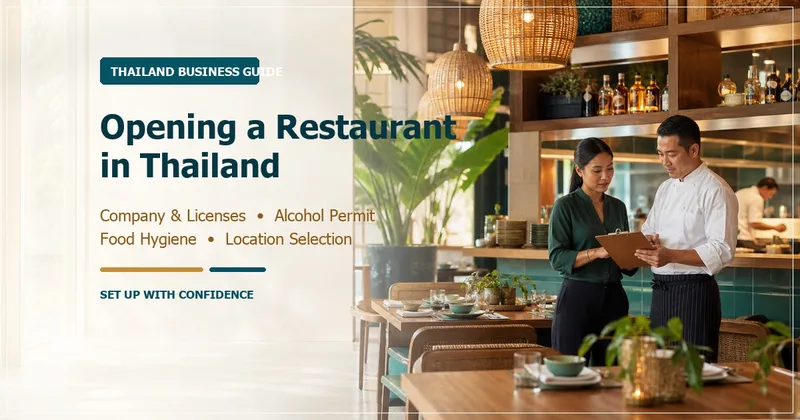
Step One: A Lawful Entity — Don't "Just Open" on a Tourist Visa
- Have a company first: foreigners running a restaurant usually need a registered Thai company as the operating entity, involving registered capital, shareholder structure and foreign-ownership limits (F&B is often a restricted business under the Foreign Business Act)
- You must work lawfully: running and managing the business yourself as owner counts as work — you need a Non-B visa plus a work permit; don't open a shop and man the counter on a tourist visa
- For how to set up and costs see starting a business in Thailand and company registration costs; for work legality see the work visa and work permit guide
Restaurant Licenses and Food-Hygiene Permits
- Premises permit: as a food premises, a restaurant generally needs the relevant operating and hygiene permits from local government (city hall / district office), with requirements varying by scale
- Food hygiene and staff health: covers premises hygiene, kitchen standards and food-handler health certificates, subject to health-department inspection
- Signage and fire safety: shopfront signage and fire safety may need compliance procedures too
- The exact permits, thresholds and offices differ by area — always follow the current rules of the local government where the shop is and check before opening so nothing is missed
Serving Alcohol Needs a Separate License
- Alcohol sales need a dedicated license: to sell beer, spirits and other alcoholic drinks you must separately obtain an alcohol-sales license — distinct from the restaurant license
- Hours and alcohol-free days are restricted: Thailand regulates alcohol sales hours and specific alcohol-free days (some Buddhist holidays, election days); selling in breach is penalized
- For alcohol-free days and public holidays see the holidays and admin calendar
Staff: Lawful Employment and Foreign Ratios
- Thai staff: sign employment contracts, pay social security, and follow minimum wage, working hours and severance rules
- Foreign staff: need the corresponding work permits and quotas (foreign-to-Thai ratio tied to registered capital); chefs and similar roles especially need compliance
- For employment rules see the labour law employer guide; for the cost of one foreign hire see the full cost of hiring a foreigner
Location, Lease and Costs
- Footfall and lease both matter: mall units cost more but have steady traffic; street units are cheaper but rely on your own draw — read the term, deposit, transfer and fit-out clauses
- Foreigners leasing commercial space: sign in the company's name, keep the contract, and don't overlook the landlord's TM30 filing — see the landlord and tenancy guide
- Upfront spend: budget key money, fit-out, equipment, deposit, stock and license fees together — not just monthly rent
After Opening: Tax and Ongoing Compliance
- Monthly filings: the company keeps accounts, withholds tax, registers for VAT above the threshold and files monthly, and pays social security monthly — see what a company must do each month
- Annual audit: every Thai company must produce audited financials and file yearly — see the annual audit and financial statement filing guide
- Brand protection: register your shop name and logo as a trademark to prevent squatting — see the trademark and IP guide
Common Traps and Realistic Expectations
- Don't "use a Thai's name" to open: using a nominee Thai shareholder to skirt foreign-ownership limits is itself a legal risk — if a dispute arises, the shop and money may both be lost
- Don't open first and license later: operating without the right licenses/alcohol permit risks fines or forced closure, and fixing it later is harder
- Build licensing into your timeline: registering the company, obtaining permits and getting a work permit all take time — don't lease a unit and burn rent while the licenses are still pending
FAQ
Can a foreigner open and own a restaurant in Thailand?
Yes, but usually by operating through a registered Thai company and handling foreign-ownership limits — F&B is often restricted under the Foreign Business Act, so shareholding must be arranged lawfully, not via a nominee. Running and managing the business yourself also counts as work, needing a Non-B visa and a work permit. In short, you "can open" but must get both the entity and the visa right — don't open bare on a tourist visa. Exact shareholding and permit requirements follow current rules; plan and consult before leasing.
What licenses does opening a restaurant need?
Roughly three tiers: the company entity (business registration, tax registration, etc.); restaurant and food-hygiene permits (food-premises permit, hygiene conditions, food-handler health certificates, from local government); and a separate alcohol-sales license to serve drinks. There may also be signage and fire-safety procedures, plus staff social security and work permits. Names and thresholds vary by area, so always follow the current rules of the local government and relevant authorities, and check each item before opening.
Does a restaurant need a separate permit to sell alcohol?
Yes. Alcohol sales require a separate alcohol license — distinct from the restaurant operating permit; don't assume "a restaurant can just serve alcohol." Thailand also sets clear rules on sales hours and specific alcohol-free days (some Buddhist holidays, election days), and breaching them is penalized. If drinks or late-night trade are core to your plan, sort out the alcohol license and hours rules first, so you aren't fined after opening. Exact rules follow local regulations.
Can I just use a Thai friend's name to save trouble?
Strongly discouraged. Using a Thai nominee shareholder to skirt foreign-ownership limits may cross a legal line, and the practical risk is huge: shares, accounts and licenses are all in someone else's name, so if the relationship breaks down or they renege, the shop and your investment may be unrecoverable and your position weak. The right approach is to lawfully design the company's shareholding and scope and obtain the proper permits. Saving trouble now can plant serious risk — use a lawful structure.
Need Help?
TaiHuBang offers one-stop assistance for opening a restaurant in Thailand: company registration and compliant shareholding, guidance on restaurant and alcohol permits, owner and staff work permits, and advice on location, leases and employment compliance. We do not arrange nominee holdings or other non-compliant setups, and all permits follow the current rules of government and relevant authorities. See our company registration services or submit an enquiry, and an advisor will reply within 24 hours.
Related Articles

How to Choose a Thai Company Type: Limited Company, Partnership, Representative Office, Branch & BOI Compared
For a foreigner setting up in Thailand, the first step isn't rushing to register — it's choosing the right entity. There are five common ones: the Private Limited Company (the mainstream vehicle that can actually trade, hire and invoice, but with foreign shareholding capped under the Foreign Business Act), the partnership (rarely used), the Representative Office (limited to non-revenue activities like market research and liaison — it cannot earn income), a Branch of a foreign company (an extension of the parent with no liability separation), and a BOI-promoted company (which can lift some foreign-ownership limits and grant tax benefits, but with industry thresholds). Which to pick depends on whether you'll genuinely trade and earn revenue, whether you can accept foreign-shareholding limits, whether you need full foreign ownership, and whether you qualify for BOI. Pick wrong and you can't do business, get stuck on ownership ratios, or overpay tax. This guide compares the five entities' purpose, foreign-ownership limits, liability and tax, subject to current DBD, BOI and agency rules.
8/2/2026
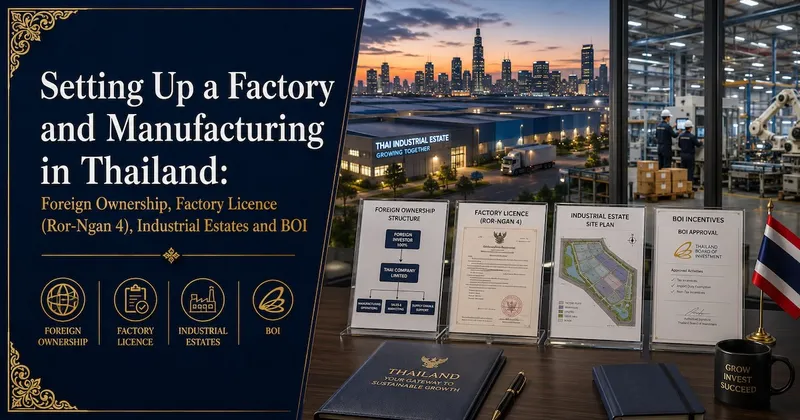
Setting Up a Factory and Manufacturing in Thailand: Foreign Ownership, Factory Licence (Ror-Ngan 4), Industrial Estates and BOI
Thailand is a Southeast Asian manufacturing hub, and many Chinese firms want to set up a factory — but that's far more complex than a trading company: you handle foreign shareholding (manufacturing is relatively open but still needs a compliant structure), obtain a factory licence (Ror-Ngan 4 / รง.4, required for factories above a machinery-power or worker threshold), pick the right site (an IEAT industrial estate vs own land, and whether foreigners can hold it), do an EIA where required, arrange work permits for expat managers and local hiring, and pay duty on imported machinery and materials. A BOI promotion can secure a tax holiday, foreign land holding and expat-employee quotas. This guide covers foreign structure, factory licence, site/land, BOI benefits, and hiring/equipment import, subject to the DIW, BOI and relevant authorities' current rules.
7/12/2026

Import and Export in Thailand: Trader Registration, HS Codes, Duty and VAT, and ASEAN–China FTA Preferences
To trade goods into or out of Thailand, having the goods isn't enough — you must clear three gates: entity, customs clearance, and tax. Importing/exporting usually needs a lawful company registered as an importer/exporter in Customs' e-system; goods are classified by HS code, which sets the rate; imports pay import duty plus 7% import VAT (some goods also excise), and food, cosmetics, electricals etc. need permits and standards. A Form E certificate of origin under the ASEAN–China FTA can secure preferential or zero duty, but wrong classification, under-valuation or missing permits get goods seized with back-tax and fines. This guide covers entity, clearance, duty/VAT, preferential origin and common traps, subject to Thai Customs and relevant authorities' current rules.
7/12/2026