 泰互帮
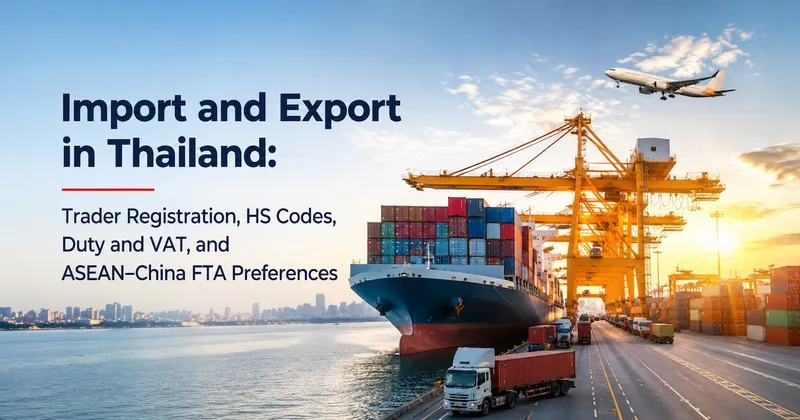
泰互帮Import and Export in Thailand: Trader Registration, HS Codes, Duty and VAT, and ASEAN–China FTA Preferences
First an Entity and Licence: Carrying Goods in Your Bag Isn't Trading
- You need a lawful business entity: ongoing trade usually means registering a Thai company with import/export or trading in its objectives; foreigners face foreign-shareholding limits to arrange compliantly — see the foreigner business set-up guide and company registration cost
- Register as an importer/exporter: Thai Customs runs e-Customs (paperless); a company must register for importer/exporter status and bind a digital certificate to file declarations
- Corporate account and FX: trade receipts and payments need a local corporate account — see the bank account opening guide
- Don't dress commercial imports as personal parcels: bulk goods shipped as "personal use" that are found to be commercial get back-tax and fines; for logistics see the China–Thailand shipping guide
Roughly How Customs Clearance Works
- Determine the HS code: classify goods by Harmonized System code — the code sets the rate and whether a permit is needed, and misclassification is the most common source of trouble
- Gather documents: invoice, packing list, bill of lading/air waybill, certificate of origin (if claiming preference), relevant permits
- Use a broker or self-declare: most firms use a licensed customs broker for efficiency and compliance
- Declare and inspection: after e-filing, Customs releases or inspects by risk; valuation or classification disputes trigger requests for clarification
- Pay and release: after import duty plus import VAT (and excise, if any) are paid, goods are released
Export is similar, but many goods carry zero export duty and may involve refunds; exact documents, permits and inspection follow Thai Customs' current rules, and complex categories are best left to a broker and trade adviser.
Which Taxes Imports Actually Pay
- Import duty: the HS-code rate × the customs value; rates vary hugely by product — some low, some high
- Import VAT (7%): almost all imports pay 7% VAT on (customs value + duty + excise); after VAT registration this input is creditable — for registration and monthly filing see what a company does each month
- Excise: tobacco, alcohol, cars, some beverages carry additional excise — budget it separately
- Value is CIF-based: import valuation is generally on the CIF landed price (incl. freight and insurance), not just the goods value
Use the ASEAN–China FTA: the Form E Certificate of Origin
- China and Thailand are both in the ASEAN–China FTA: Chinese goods meeting the rules of origin can enter Thailand at preferential or even zero duty with a Form E certificate of origin, cutting cost significantly
- Arrange the certificate early: Form E is applied for by the exporter in China, and its details must match the declaration — late or mismatched, and you lose the preference
- Not everything is covered: the benefit follows product category and the reduction schedule — check whether your HS code is in scope first
- Stocking goods for e-commerce? Also see the cross-border e-commerce and online store guide
Common Traps: Classification, Valuation, Permits, Bonded
- Wrong HS classification: affects rate and permits; a Customs re-classification means back-tax and surcharges — don't force a low-rate code to save tax
- Under-declaring value: Customs has a valuation database; getting caught means back-tax plus fines — high risk, don't
- Forcing goods in without permits: food, cosmetics, medicines, supplements (FDA), electricals/industrial goods (TISI standards), agricultural products need the right permits/certification or get held
- Misusing bonded/free zone: bonded warehouses, Free Zones and duty drawback can save tax but the rules are complex — leave them to professionals
- Brand imports should guard against trademark issues — see the trademark and IP protection guide
FAQ
Do I need to register a company to import and export in Thailand?
For ongoing trade, generally yes: register a Thai company with import/export or trading in its objectives, and register as an importer/exporter in Customs' e-system to file declarations. Foreigners also face foreign-shareholding limits to arrange compliantly. Bulk goods brought in as "personal use" that are found to be commercial get back-tax and fines. Small test volumes aside, once you scale, issue invoices and clear formally, an entity, Customs registration and a corporate account are the basics. Exact shareholding and registration requirements follow the relevant authorities' current rules.
How much tax do goods pay to enter Thailand?
There's no single figure — it depends on the HS code. Typically import duty (the code's rate × customs value, varying widely) plus 7% import VAT (on customs value + duty + excise), with additional excise on specific goods like tobacco, alcohol and cars. Value is usually the CIF landed price (incl. freight and insurance). If goods meet the rules of origin and carry a Form E certificate, the ASEAN–China FTA can give lower or zero duty. To estimate accurately, first pin down the HS code and have a broker calculate — exact rates follow Thai Customs' current rules.
Can I get zero duty when importing from China?
Some goods can. China and Thailand are both in the ASEAN–China FTA, so Chinese goods meeting the rules of origin can enter at preferential or even zero duty with a Form E certificate of origin applied for by the exporter in China. Not everything is covered — the benefit follows the HS code and reduction schedule, and the certificate must be arranged in advance with details matching the declaration, or you lose it. To use this, check whether your code is in scope and arrange Form E before importing, subject to the FTA and Customs' current rules.
Can I under-declare value or change the product code to pay less tax?
Not advisable — high risk. Customs has a valuation database and classification rules; under-declaring value or forcing a low-rate wrong HS code, once caught on inspection or audit, means back-tax, surcharges, fines and possibly legal liability — not worth it. The proper way to cut cost is to use legitimate preferences fully — ASEAN–China Form E, bonded warehouses, export refunds — and to classify accurately. To save tax lawfully, plan with a licensed broker and trade adviser rather than gaming the declaration, subject to Thai Customs' current rules.
Need Help?
TaiHuBang offers hands-on support for import/export in Thailand: trading-company registration and compliant shareholding, guidance on Customs importer/exporter registration, broker and logistics matching, HS code and duty estimation, and help with Form E preferential origin and VAT registration. We do no under-declaration or concealment, everything follows Thai Customs and relevant authorities' current rules, and professional conclusions rest on a licensed broker/accountant. See our company registration services or submit an enquiry, and an advisor will reply within 24 hours.
Related Articles

How to Choose a Thai Company Type: Limited Company, Partnership, Representative Office, Branch & BOI Compared
For a foreigner setting up in Thailand, the first step isn't rushing to register — it's choosing the right entity. There are five common ones: the Private Limited Company (the mainstream vehicle that can actually trade, hire and invoice, but with foreign shareholding capped under the Foreign Business Act), the partnership (rarely used), the Representative Office (limited to non-revenue activities like market research and liaison — it cannot earn income), a Branch of a foreign company (an extension of the parent with no liability separation), and a BOI-promoted company (which can lift some foreign-ownership limits and grant tax benefits, but with industry thresholds). Which to pick depends on whether you'll genuinely trade and earn revenue, whether you can accept foreign-shareholding limits, whether you need full foreign ownership, and whether you qualify for BOI. Pick wrong and you can't do business, get stuck on ownership ratios, or overpay tax. This guide compares the five entities' purpose, foreign-ownership limits, liability and tax, subject to current DBD, BOI and agency rules.
8/2/2026
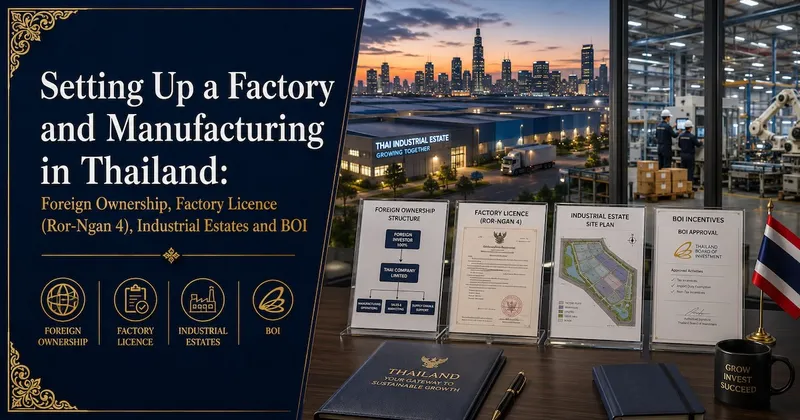
Setting Up a Factory and Manufacturing in Thailand: Foreign Ownership, Factory Licence (Ror-Ngan 4), Industrial Estates and BOI
Thailand is a Southeast Asian manufacturing hub, and many Chinese firms want to set up a factory — but that's far more complex than a trading company: you handle foreign shareholding (manufacturing is relatively open but still needs a compliant structure), obtain a factory licence (Ror-Ngan 4 / รง.4, required for factories above a machinery-power or worker threshold), pick the right site (an IEAT industrial estate vs own land, and whether foreigners can hold it), do an EIA where required, arrange work permits for expat managers and local hiring, and pay duty on imported machinery and materials. A BOI promotion can secure a tax holiday, foreign land holding and expat-employee quotas. This guide covers foreign structure, factory licence, site/land, BOI benefits, and hiring/equipment import, subject to the DIW, BOI and relevant authorities' current rules.
7/12/2026
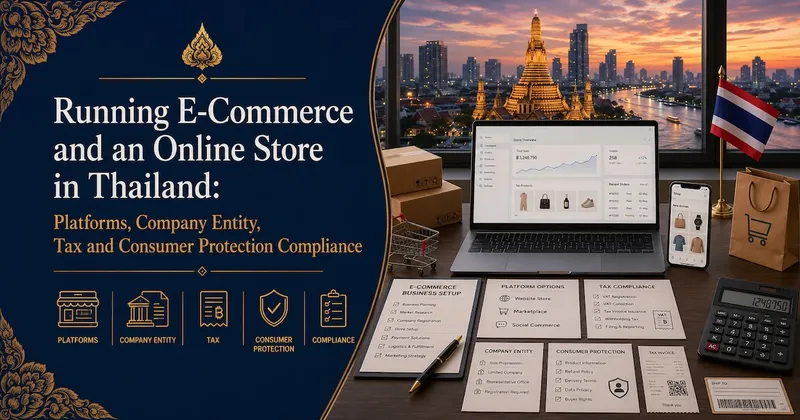
Running E-Commerce and an Online Store in Thailand: Platforms, Company Entity, Tax and Consumer Protection Compliance
Doing e-commerce or opening an online store in Thailand looks low-barrier but has real compliance: selling to Thai consumers usually needs a lawful entity (a registered company, foreign shareholding and business scope), proper bookkeeping and tax (VAT registration above the threshold), and compliance with Thailand's electronic-transaction and consumer-protection laws (returns, truthful advertising, PDPA data protection); platform onboarding (Shopee, Lazada, TikTok Shop, etc.) has its own credentials and settlement rules. Operating without a license, false advertising or misusing customer data can be penalized. This guide covers the compliance essentials across entity, platforms, tax, consumer protection and payment/logistics, subject to the relevant authorities' current rules.
7/12/2026