 泰互帮
泰互帮Shipping Between China and Thailand: Consolidation, Grey Customs Risk and Duty-Free Moves
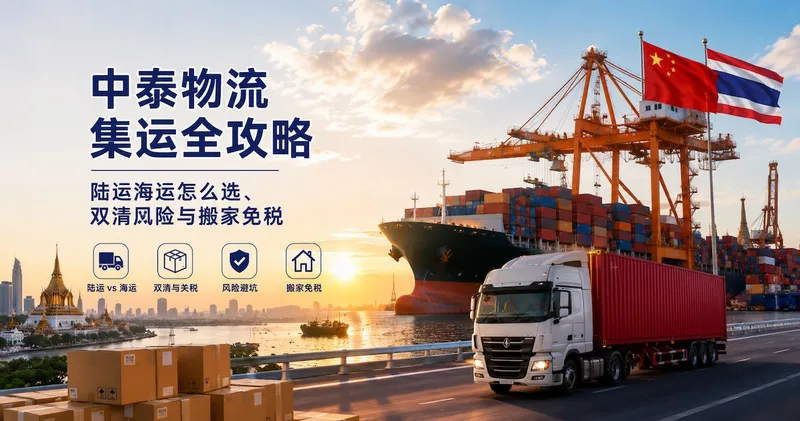
Choosing Between Air, Land and Sea
- Air: 3–5 days, priced per kilogram, most expensive — for documents, urgent and high-value small items; battery goods face aviation restrictions
- Land: via the China–Laos rail/road corridor into Thailand, 5–8 days, mid-priced — currently the mainstream consolidation route with stable transit times
- Sea: 15–25 days, priced per cubic meter, cheapest — for furniture and bulk luggage; full container (FCL) or less-than-container (LCL), with LCL the household-move standard
Small daily goods are best value overland; consider sea freight from about one cubic meter up.
How Consolidation Works and How It's Priced
- Model: the forwarder runs warehouses in Guangzhou, Yiwu and similar hubs; your Taobao and other parcels collect there, get repacked into one shipment to Thailand, then delivered or picked up locally
- Pricing: dense cargo bills by actual weight, light-bulky cargo by volumetric weight (L×W×H in cm ÷ divisor), whichever is greater — ask for the divisor and minimum billable weight before ordering
- Crating and declared value: fragile items need wooden crating (extra charge); insure anything valuable — a verbal "we'll cover losses" means nothing
- Choosing a forwarder: look for real operating history, a self-run Thai-side warehouse and a dispute track record. "Forwarders" that exist only as a WeChat account have run off with goods before; if defrauded, see our fraud recovery guide
What "Double Clearance, Tax Included" Really Means
Double clearance means the forwarder handles both Chinese export and Thai import customs for one flat rate. Genuinely convenient — but understand it often runs on grey channels: goods are declared in the forwarder's name in mixed containers, and you hold no import record naming you as consignee. If Thai customs seizes the container, you can neither prove ownership nor appeal — you wait on whatever the forwarder negotiates. Low-value daily goods on double clearance is market practice; valuables and commercial cargo should clear formally. Importing commercially in company name requires import registration — see our company registration guide.
Prohibited and Restricted Items
- Food, supplements, medicine, cosmetics: importing requires Thai FDA (อย.) approval. Small personal quantities usually ride along in practice — at your own seizure risk; bulk quantities will be held
- Battery electronics: restricted by air, declarable by land and sea; radio equipment (walkie-talkies, some routers) involves NBTC licensing
- Absolute no-gos: counterfeit branded goods (actively prosecuted), e-cigarettes (comprehensively banned in Thailand, including personal import), pirated media, weapons
- Live animals and plants: pets follow a separate quarantine process and cannot travel as consolidated freight — see our pet import guide
Moving to Thailand: the Duty-Free Household Allowance
A policy many new arrivals miss: foreigners holding a one-year non-immigrant visa plus a work permit can apply, within 6 months of first arrival, to import used personal household effects duty-free — with an itemized list, passport/visa and work permit copies. In principle one item per type, and items must be genuinely used. Anything outside scope or new is assessed for duty. Verify current Thai Customs rules; for full-container moves, have a customs broker vet the list before shipping.
Parcels In, Parcels Out
- Low-value import VAT: since 2024 Thailand levies 7% VAT on imported parcels under 1,500 THB (previously exempt), raising direct-shipping costs and strengthening the case for consolidation
- Sending back to China: personal-effects rules apply — value limits and postal tax by category. Latex products and snacks ship fine; meat products, fruit, and religious items like Buddha images need both countries' rules checked first
- Declare values honestly: under-declaring caught at customs means fines and delays; keep receipts for high-value items
FAQ
My goods were seized on a double-clearance channel — can I get them back?
Realistically, rarely. Under grey clearance you hold no formal import record and cannot assert ownership with customs; your only claim runs against the forwarder under your contract — which is why chat records, waybills and insurance receipts must be kept. For large losses with an evasive forwarder, a lawyer's letter or suit is viable, and forwarders with real Thai premises are far more recoverable against.
Can I ship food and cosmetics to Thailand for personal use?
Small personal amounts (a few snack packets, a bottle or two of skincare inside a suitcase-sized parcel) usually arrive in practice — but that is "not caught," not "compliant," and seizures aren't compensated. Case quantities of food or cosmetics need FDA approval or count as unlicensed imports. Infant formula and prescription medicine are better carried in luggage with the prescription.
What's the smartest way to move a full household of furniture?
Sea freight (LCL or FCL) + formal clearance + the used-household duty-free application is the cost-safety balance. The sequence: itemized list (Chinese and English) → confirm your visa and work permit meet the exemption conditions → engage an international mover or customs broker → clear and deliver at port. Never push an entire household through double clearance — high value plus everything you own means one seizure is a catastrophe.
Any restrictions on mailing Buddhist amulets or statues back to China?
Thailand regulates the export of Buddha images: commercial quantities or antiques need an export license from the Fine Arts Department, while small personally-worn amulets are generally unrestricted. On the China side, personal-effects value limits and postal tax apply. Batch shipments for resale are trade on both ends and must be declared as such — verify with both customs authorities.
Need Help?
TaiHuBang supports logistics and customs matters: formal customs broker referral, duty-free household application guidance, seized-cargo dispute assistance and freight contract review. See our legal services, or submit an inquiry — a consultant will reply within 24 hours.
Related Articles

Can a Thai Company Legally Hold Land or Property? Nominee Risks, Compliant Structures & Alternatives
Since foreigners can't directly own Thai land or landed houses, some think of "registering a Thai company to hold the land." That route exists in specific compliant cases, but the most common version on the market — using Thai people as nominee shareholders to make up 51% Thai ownership while a foreigner actually controls the company — is an illegal nominee arrangement: Thai law prohibits using nominees to circumvent the ban on foreign land ownership, and if caught you can face forced disposal of the land, fines and even criminal liability, with the nominee Thais also liable. True compliance depends on whether the company genuinely operates and whether the Thai shareholders genuinely invest and hold rights — not a shell set up purely to hold land. For safer holding, foreigners more commonly buy a freehold condo (which foreigners may own), sign a long-term lease (leasehold, up to about 30 years, renewable), or use BOI/special permits where qualified. This guide covers the red lines of company land-holding, nominee risks and safer alternatives, subject to the Land Code; consult a lawyer for major decisions.
8/4/2026

You Bought Property in Thailand — Now How Do You Stay Legally? A Property Owner's Visa Guide
Buying property in Thailand doesn't let you stay legally — a purchase carries no residency, and you still need a valid visa to live there long-term. Common lawful long-stay routes for owners include: a retirement visa for those 50+ retiring, an Elite visa for easy long stays, the LTR 10-year visa for qualifying high-asset/remote/specialist profiles, a work visa for the employed, a dependant visa if your spouse is Thai, and DTV for remote workers. Which to choose depends on your age, whether you work, your income/assets and your long-stay goal — and has little to do with which property you bought. Owners should also mind obligations like 90-day reporting and TM30 address notification. This guide explains a property owner's visa options by profile and how to pair property with a visa, subject to current Immigration and agency rules.
8/1/2026

Living in Thailand Long-Term: Elite Visa or Buy Property — Which Is Worth It? Budget, Goals & Flexibility
Planning to live in Thailand long-term, many agonise over spending the budget on an Elite visa membership or on property. In fact the two solve different problems and don't replace each other: the Elite (Thailand Privilege) visa solves "what lawful status lets you stay long-term" (long-stay convenience, but no work rights and it expires or must be renewed/repurchased), while buying property solves "where to live and whether to sink assets into Thailand" (own-use/investment, but buying grants no residency). To truly live long-term you usually need both — a visa for status and housing (rented or bought) for a home — not one or the other. If the budget stretches to only one first, it comes down to your core goal: for lawful long stay first, choose the visa; for asset landing or long-term own-use first, consider buying but still arrange a visa. This guide weighs them across the problem solved, cost nature, flexibility and exit difficulty, subject to current Immigration and agency rules.
8/1/2026