 泰互帮
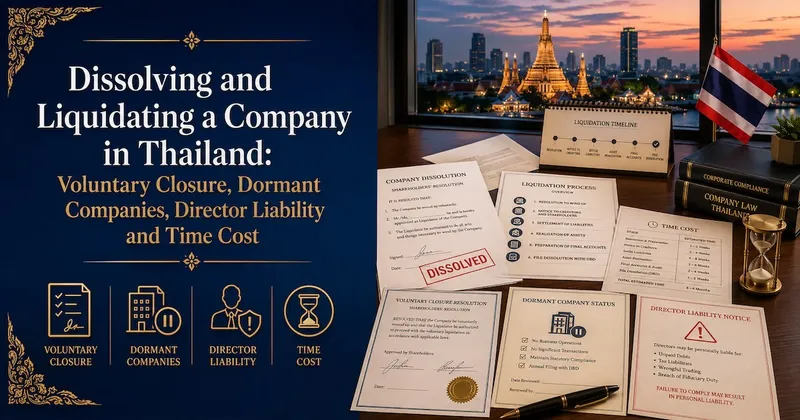
泰互帮Dissolving and Liquidating a Company in Thailand: Voluntary Closure, Dormant Companies, Director Liability and Time Cost
Why You Can't Just "Leave It Alone"
- An existing company has annual duties: until formally dissolved, a company must still produce audited financials, file tax and report to the DBD every year — see the annual audit and financial statement filing guide
- Fines and surcharges accumulate: skip the audit or filing and penalties grow over time — handling it years later costs more
- Directors can be liable: the filing duty sits with the company and directors, so long-term neglect can expose directors personally and affect your other Thai matters (banking, visas)
- Bottom line: if you're sure you won't trade, either dissolve properly or at least stay compliant — don't just walk away
Three Paths: Dissolve vs Maintain vs "Dormant"
- Proper dissolution (liquidation): fully ends the company's legal existence, after which there are no more annual duties — choose this if you won't use it again
- Keep it compliant: to preserve the shell for future use, you must diligently audit and file every year (even a nil filing), at the cost of annual bookkeeping and audit fees
- So-called "dormant": Thailand has no "leave-it-and-it's-exempt" dormant status — a non-trading dormant company still needs annual audit and filing; don't misread it as nothing to do
The Rough Dissolution (Liquidation) Process
- Shareholders' resolution to dissolve: hold a meeting to pass the dissolution resolution and appoint a liquidator
- Register dissolution and give notice: register the dissolution with the DBD and publish/notify creditors as required
- Settle debts and receivables: the liquidator collects receivables, pays debts and disposes of remaining assets
- Tax clearance: apply to the Revenue Department for deregistration and a final liquidation filing — this step is often the most time-consuming and may involve a tax review
- Complete liquidation and deregister: finish liquidation, pass the liquidation report at a shareholders' meeting, and complete deregistration with the DBD — the company's legal existence ends
The whole process has statutory steps and takes months or longer (depending on tax clearance and debts), subject to the DBD and Revenue Department current rules — best handled by a professional accountant/lawyer so no step is missed.
Loose Ends to Clear Before Dissolving
- Catch up on back audits and filings: outstanding annual reports and tax filings usually must be brought current and penalties paid before liquidation can proceed smoothly
- Staff and social security: lawfully settle wages, severance and social security — for employment rules see the labour law employer guide
- Bank account, VAT registration, licenses: deregister VAT, close the corporate account and cancel related operating licenses
- Debts and contracts: settle payables, leases and supplier contracts to avoid disputes lingering after dissolution
Time, Cost and Common Traps
- It takes time: liquidation plus tax deregistration often spans months — don't expect to close on demand
- It costs money: liquidator/accountant/lawyer fees, back audits and back-tax penalties all need budgeting, but it's usually still cheaper than letting fines pile up
- Don't skip tax clearance: only handling the DBD and ignoring the Revenue Department is a common trap — do both properly
- Don't dump it on a nominee: handing the company to a nominee shareholder/director keeps the legal and credit risk with you — proper dissolution is the clean way
FAQ
I don't want my Thai company anymore — can I just ignore it?
Not advisable — the risk is high. Until formally dissolved a company keeps existing and must still audit, file financials and file tax each year; skip it and fines and surcharges keep accumulating, directors can be personally exposed, and it can affect your Thai banking and visa matters. "Leave it and it lapses" doesn't hold in Thailand — a dormant company still has annual duties. If you're sure you won't trade, properly dissolve (liquidate) to fully end it, or at least stay compliant — don't just walk away, subject to current rules.
How long and how much does dissolving a Thai company take?
Usually months or longer, because liquidation and tax clearance have statutory steps and the tax stage may involve a review and be the most time-consuming. Costs include liquidator/accountant/lawyer fees plus catching up on back audits, filings and penalties (if previously missed). This guide gives no absolute figure — it varies with the company's back-log and debt complexity, per a professional's written quote. Though it costs time and money, it's usually still cheaper than leaving it with penalties accumulating yearly, and earlier is cheaper.
Is dissolving a company the same as making it "dormant"?
No. Dissolution (liquidation) fully ends the company's legal existence, after which there are no annual duties; but Thailand has no "leave-it-and-it's-exempt" dormant status — a so-called dormant company (not trading) still audits and files tax yearly, just as a nil filing. To end it completely, dissolve; to keep the shell for later, you must pay to stay compliant each year. Mistaking "dormant" for "ignore" is a common cause of accumulated fines, subject to DBD and Revenue Department rules.
I owe several years of audits and tax filings — can I dissolve directly?
Generally you must catch up first, then dissolve. During liquidation and tax deregistration the Revenue Department usually reviews prior filings, so outstanding annual reports, tax filings and penalties often need to be brought current and paid before liquidation can complete. So "using dissolution to escape what's owed" usually doesn't work. If you owe several years, the right order is to promptly have a professional accountant catch up historical filings and handle penalties, then liquidate and deregister. The longer you wait the more the arrears and fines, and the harder to wrap up — subject to the Revenue Department's current rules.
Need Help?
TaiHuBang offers partner referrals and process support for dissolving and liquidating a Thai company: dissolution feasibility assessment, catching up on back audits and filings, dissolution resolution and liquidator arrangements, tax deregistration and DBD deregistration, and staff/account wrap-up. Everything follows the DBD and Revenue Department current rules, with professional conclusions to be verified by a licensed accountant/lawyer. See our company registration services or submit an enquiry, and an advisor will reply within 24 hours.
Related Articles

How to Choose a Thai Company Type: Limited Company, Partnership, Representative Office, Branch & BOI Compared
For a foreigner setting up in Thailand, the first step isn't rushing to register — it's choosing the right entity. There are five common ones: the Private Limited Company (the mainstream vehicle that can actually trade, hire and invoice, but with foreign shareholding capped under the Foreign Business Act), the partnership (rarely used), the Representative Office (limited to non-revenue activities like market research and liaison — it cannot earn income), a Branch of a foreign company (an extension of the parent with no liability separation), and a BOI-promoted company (which can lift some foreign-ownership limits and grant tax benefits, but with industry thresholds). Which to pick depends on whether you'll genuinely trade and earn revenue, whether you can accept foreign-shareholding limits, whether you need full foreign ownership, and whether you qualify for BOI. Pick wrong and you can't do business, get stuck on ownership ratios, or overpay tax. This guide compares the five entities' purpose, foreign-ownership limits, liability and tax, subject to current DBD, BOI and agency rules.
8/2/2026
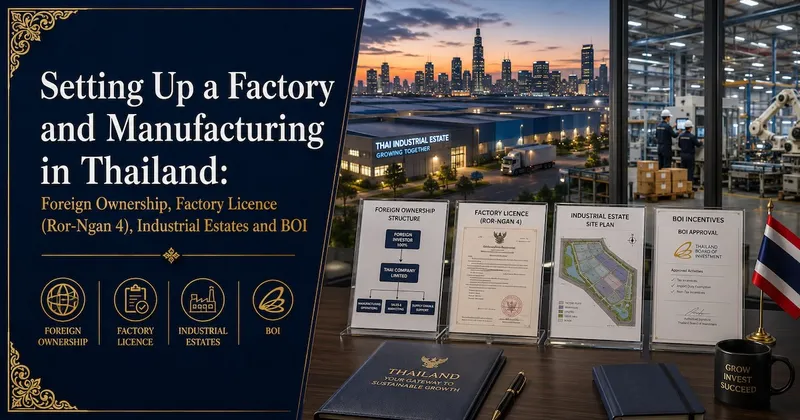
Setting Up a Factory and Manufacturing in Thailand: Foreign Ownership, Factory Licence (Ror-Ngan 4), Industrial Estates and BOI
Thailand is a Southeast Asian manufacturing hub, and many Chinese firms want to set up a factory — but that's far more complex than a trading company: you handle foreign shareholding (manufacturing is relatively open but still needs a compliant structure), obtain a factory licence (Ror-Ngan 4 / รง.4, required for factories above a machinery-power or worker threshold), pick the right site (an IEAT industrial estate vs own land, and whether foreigners can hold it), do an EIA where required, arrange work permits for expat managers and local hiring, and pay duty on imported machinery and materials. A BOI promotion can secure a tax holiday, foreign land holding and expat-employee quotas. This guide covers foreign structure, factory licence, site/land, BOI benefits, and hiring/equipment import, subject to the DIW, BOI and relevant authorities' current rules.
7/12/2026

Import and Export in Thailand: Trader Registration, HS Codes, Duty and VAT, and ASEAN–China FTA Preferences
To trade goods into or out of Thailand, having the goods isn't enough — you must clear three gates: entity, customs clearance, and tax. Importing/exporting usually needs a lawful company registered as an importer/exporter in Customs' e-system; goods are classified by HS code, which sets the rate; imports pay import duty plus 7% import VAT (some goods also excise), and food, cosmetics, electricals etc. need permits and standards. A Form E certificate of origin under the ASEAN–China FTA can secure preferential or zero duty, but wrong classification, under-valuation or missing permits get goods seized with back-tax and fines. This guide covers entity, clearance, duty/VAT, preferential origin and common traps, subject to Thai Customs and relevant authorities' current rules.
7/12/2026