 泰互帮
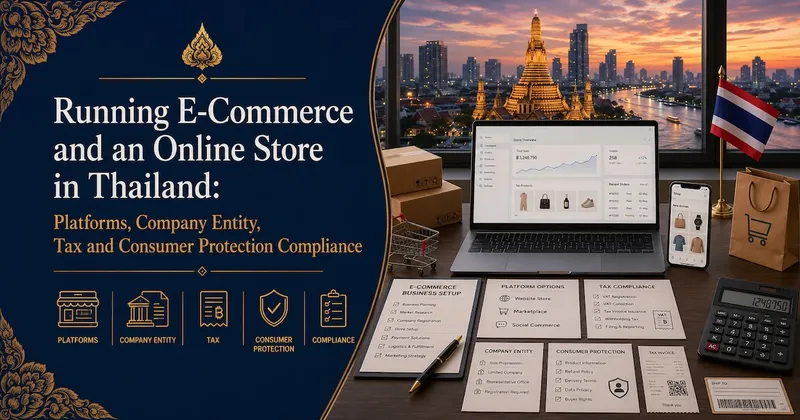
泰互帮Running E-Commerce and an Online Store in Thailand: Platforms, Company Entity, Tax and Consumer Protection Compliance
First, a Lawful Entity: Don't "Sell Bare" as an Individual
- Selling to Thai consumers usually needs a company entity: register a Thai company and handle foreign shareholding and business scope (whether e-commerce/trading is restricted must be assessed case-by-case) — foreigners must arrange shares compliantly
- Operating it yourself means working lawfully: running the store as owner also counts as work, needing a Non-B visa plus work permit
- For how to set up and costs see starting a business in Thailand and company registration costs
- Don't "use a Thai's name" to open: nominee holding to skirt foreign-ownership limits is a legal risk — in a dispute the money and store may both be lost
Platform Onboarding: Shopee, Lazada, TikTok Shop and More
- Each platform has onboarding requirements: business/individual store types, credentials, settlement accounts and deposits differ, and cross-border and local seller policies differ too
- Settlement and withdrawal: check the linked receiving account, settlement cycle and fees — for a corporate account see the bank account opening guide
- Brand protection: register your store name and trademark to prevent squatting — see the trademark and IP guide
- Own standalone site: it must follow the same tax, consumer-protection and data-compliance rules — "my own website" is not exempt
Tax: Bookkeeping, VAT and Filing
- Monthly bookkeeping and filing: the company keeps accounts and withholds; above the turnover threshold you must register for VAT and file monthly — see what a company must do each month
- Annual audit: a Thai company must produce audited financials and file yearly — see the annual audit guide
- Imported goods carry duty and VAT: cross-border stocking and import clearance involve customs duty and import VAT — don't count only product cost
- E-commerce income is transparent and traceable; "no invoice, no filing" tax dodging is high-risk — don't chance it
Consumer Protection and Data Compliance (Most Overlooked)
- Electronic-transaction and consumer-protection law: online sales are subject to Thai law on truthful advertising, price and product information, and returns/after-sales; false or misleading claims draw complaints and penalties
- Personal Data Protection (PDPA): collecting customer names, phones and addresses needs a lawful basis, disclosed purpose and proper protection; misuse or leaks carry liability
- Certain categories need extra licenses: food, cosmetics, supplements, medicines etc. have dedicated regulation — don't sell controlled goods carelessly
- Advertising and content must comply — be especially careful with exaggerated efficacy or comparative claims
Payment, Logistics and After-Sales
- Payment: integrate platform payment or a third-party gateway, minding settlement compliance and fees
- Logistics: local delivery and cross-border consolidation — for cross-border stocking costs see the China-Thailand shipping guide
- After-sales and disputes: a clear returns policy reduces complaints; for fraud or dispute enforcement see the fraud, police report and rights-protection guide
FAQ
Do I need to register a company to do e-commerce in Thailand?
To trade continuously to Thai consumers you generally need a lawful entity — a registered Thai company handling foreign shareholding and business scope, with foreigners arranging shares compliantly, and you also need a Non-B visa and work permit to operate. Small test-scale is different, but once you scale, invoice and run a platform business store, operating without a license becomes risky. Long-term "selling bare" as an individual or using a Thai's name are both unsound. The right approach is to plan the company entity, visa and tax together, subject to the relevant authorities' current rules.
Does an online store have to pay tax and register for VAT?
Yes. The company must do monthly bookkeeping and withholding, and above the registration threshold must register for VAT and file monthly, plus produce audited financials and file tax yearly; cross-border import stocking also carries customs duty and import VAT. E-commerce transaction records are transparent and traceable, so "no invoice, no filing" dodging is high-risk. Get an accounting agent to keep bookkeeping and filing proper from the start and price the tax in — don't wait to be back-taxed and fined once you've grown, subject to the Revenue Department's current rules.
What consumer-protection and data-compliance rules apply to online selling in Thailand?
Mainly two areas: first, electronic-transaction and consumer-protection law, requiring truthful advertising, accurate product and price labeling, and reasonable returns/after-sales, with false or misleading claims drawing complaints and penalties; second, Personal Data Protection (PDPA), where collecting customer names, phones and addresses needs a lawful basis, disclosed purpose and proper protection, with liability for misuse or leaks. Certain categories like food, cosmetics and supplements also have dedicated regulation. Don't assume "online is unregulated" — compliant operation lasts, subject to the relevant law's current rules.
Can I use my personal identity or a friend's Thai account to open a store and save trouble?
Not advisable. Trading at scale long-term as an individual risks having no lawful entity and non-compliant tax and visa; using a Thai friend's identity/account as a nominee may cross the foreign-ownership legal line, and with the money, store and accounts all in someone else's name, you're exposed if the relationship changes or they renege, and enforcement is hard. Saving trouble now can plant serious risk. The right approach is to register a compliant company and sort visa and tax, building the store on a lawful basis you control, subject to the relevant authorities' current rules.
Need Help?
TaiHuBang offers hands-on support for e-commerce ventures in Thailand: company registration and compliant shareholding, operator work permits, bookkeeping, tax filing and VAT registration, and trademark registration and compliance referrals. We do not arrange nominee holdings or other non-compliant setups; everything follows the relevant authorities' current rules, with legal and tax conclusions to be verified by professionals. See our company registration services or submit an enquiry, and an advisor will reply within 24 hours.
Related Articles

How to Choose a Thai Company Type: Limited Company, Partnership, Representative Office, Branch & BOI Compared
For a foreigner setting up in Thailand, the first step isn't rushing to register — it's choosing the right entity. There are five common ones: the Private Limited Company (the mainstream vehicle that can actually trade, hire and invoice, but with foreign shareholding capped under the Foreign Business Act), the partnership (rarely used), the Representative Office (limited to non-revenue activities like market research and liaison — it cannot earn income), a Branch of a foreign company (an extension of the parent with no liability separation), and a BOI-promoted company (which can lift some foreign-ownership limits and grant tax benefits, but with industry thresholds). Which to pick depends on whether you'll genuinely trade and earn revenue, whether you can accept foreign-shareholding limits, whether you need full foreign ownership, and whether you qualify for BOI. Pick wrong and you can't do business, get stuck on ownership ratios, or overpay tax. This guide compares the five entities' purpose, foreign-ownership limits, liability and tax, subject to current DBD, BOI and agency rules.
8/2/2026
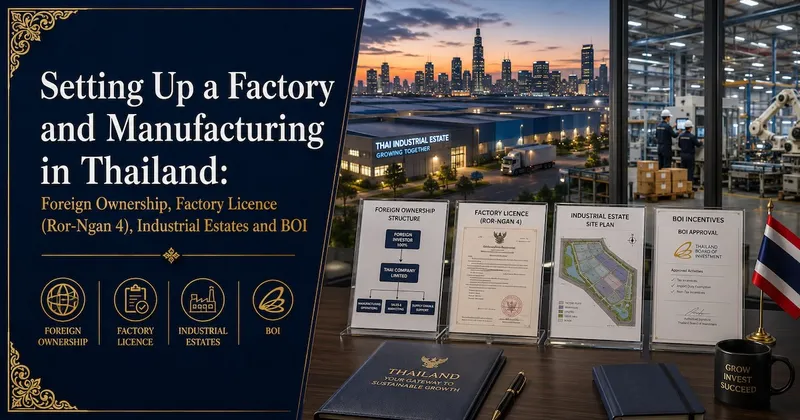
Setting Up a Factory and Manufacturing in Thailand: Foreign Ownership, Factory Licence (Ror-Ngan 4), Industrial Estates and BOI
Thailand is a Southeast Asian manufacturing hub, and many Chinese firms want to set up a factory — but that's far more complex than a trading company: you handle foreign shareholding (manufacturing is relatively open but still needs a compliant structure), obtain a factory licence (Ror-Ngan 4 / รง.4, required for factories above a machinery-power or worker threshold), pick the right site (an IEAT industrial estate vs own land, and whether foreigners can hold it), do an EIA where required, arrange work permits for expat managers and local hiring, and pay duty on imported machinery and materials. A BOI promotion can secure a tax holiday, foreign land holding and expat-employee quotas. This guide covers foreign structure, factory licence, site/land, BOI benefits, and hiring/equipment import, subject to the DIW, BOI and relevant authorities' current rules.
7/12/2026
Import and Export in Thailand: Trader Registration, HS Codes, Duty and VAT, and ASEAN–China FTA Preferences
To trade goods into or out of Thailand, having the goods isn't enough — you must clear three gates: entity, customs clearance, and tax. Importing/exporting usually needs a lawful company registered as an importer/exporter in Customs' e-system; goods are classified by HS code, which sets the rate; imports pay import duty plus 7% import VAT (some goods also excise), and food, cosmetics, electricals etc. need permits and standards. A Form E certificate of origin under the ASEAN–China FTA can secure preferential or zero duty, but wrong classification, under-valuation or missing permits get goods seized with back-tax and fines. This guide covers entity, clearance, duty/VAT, preferential origin and common traps, subject to Thai Customs and relevant authorities' current rules.
7/12/2026