 泰互帮
泰互帮A Map of Chinese Community Resources in Thailand: WeChat Groups, Associations, Chambers and Help Lines
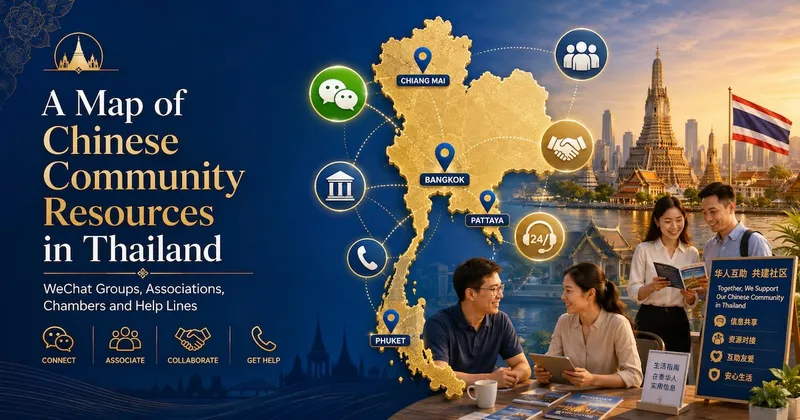
Three Tiers of the Chinese Community
Sort the resources by tier and you'll know who to trust and who to guard against:
- Official tier: the Chinese embassy and consulates, consular-protection hotlines — your ultimate backstop when something serious happens
- Semi-official tier: the chamber of commerce, provincial hometown associations and industry bodies — real-name, with offline organization and traceable information
- Grassroots tier: WeChat groups, forums and public accounts — fast information but mixed truth, the main pitfall zone and the focus of this guide's warnings
Reliable Organizational Resources
- The Chinese Embassy (Bangkok) and Consulates-General in Chiang Mai and Songkhla: the official gateway for visa legalization, document reissue and consular protection — trust the official website and accounts, not middlemen impersonating them with overpriced "agency" services
- The Thai-Chinese Chamber of Commerce and provincial hometown associations: long-established halls (Teochew, Hainan, Guangzhao, Hakka and more) plus active newer provincial associations — good for finding hometown networks and joining offline events
- Industry chambers and associations: for business, connect with the relevant industry body for compliance, supply-chain and policy information — far more reliable than asking around in a WeChat group
Information and Media Resources
- Legitimate Chinese newspapers and public accounts: established Chinese-language media and accounts with a real entity behind them, for policy, life and breaking news
- Real-name life-service platforms: favor Q&A on platforms with an accountable entity over unmanaged mega-groups. TaiHuBang's community Q&A is a place for Chinese speakers in Thailand to ask real-name questions that accumulate over time, with the official team joining in to answer
Official Help Lines: Who to Call When Something Happens
- Tourist Police 1155: offers Chinese-language service — the first call for disputes, scams and safety issues, for tourists and residents alike
- Police 191, ambulance 1669: dial directly in an emergency
- China's consular protection and assistance hotline 12308: for consular help involving personal safety or major interests
- If you've been scammed or need to file a report and pursue redress, see our Thailand scam reporting and redress guide
WeChat-Group Pitfalls: Which Groups and People to Avoid
- Romance/pig-butchering scams and gambling: baited with "friendship," "investment" and "high returns" — if someone in the group flashes profits and draws you in, walk away
- Fake high-paying jobs: "board and lodging, daily pay, tens of thousands a month" overseas recruiting is very likely a scam-compound trap — verify the entity and refuse to hand over your documents
- Disappearing daigou and shady agents: large prepayments, personal transfers and no-contract "acquaintance handling" are the highest risk — for visas, purchasing and rentals, favor formal channels with a real entity
- Rule of thumb: anyone who wants a large transfer up front, holds your documents, insists on off-the-books dealing, or urges you to keep quiet is almost certainly a problem
How to Plug Into a Reliable Circle Fast
- Start from real-name communities and hometown-association events — people you've met offline beat anonymous IDs in a group
- Find niche communities by interest: mothers, entrepreneurs, Buddhist culture and so on; if you're interested in Thai amulets and temple culture, see our guide to temple visits in Thailand
- Use accountable platforms to record experience as searchable answers, rather than letting it scroll away in a mega-group
Frequently Asked Questions
Just arrived — how do I quickly find a reliable Chinese circle?
Start from resources that "have an entity and can be real-name": offline events of hometown associations and chambers, legitimate Chinese media, and life-service platforms with real backing. These are far more reliable than the mega WeChat groups you get pulled into on arrival. Interest communities (mothers, entrepreneurs, religious culture) are good for deeper ties, but for anything involving money, visas or jobs, always take it back to formal channels to verify — don't decide impulsively in a group.
Can I trust the information in WeChat groups? How do I tell?
You can reference it, not fully trust it. Credible information usually has a verifiable entity and a consistent public account; anyone who wants an up-front transfer, holds your documents, insists on off-the-books dealing, promises high returns, or urges secrecy is almost always running a scheme. For anything involving money and documents, cross-check official channels before deciding — better slow than sorry. If you are scammed, report it promptly — see our scam reporting and redress guide.
If I hit a scam or dispute, who do I contact first?
Call the Tourist Police 1155 first (Chinese available); in an emergency dial police 191 or ambulance 1669; for personal safety or major interests, call China's consular protection hotline 12308 or contact the embassy/consulate. Meanwhile keep your evidence — chat logs, transfer records, contracts. For larger sums, engage a lawyer to pursue it. Don't delay out of "not wanting the hassle" or embarrassment — the earlier you report, the stronger your position.
Are those overseas high-paying job offers real?
Treat the vast majority of "board and lodging, daily pay, easy tens of thousands a month" overseas job ads with great suspicion — many are the lure of scam compounds, where you may have your documents seized and your freedom restricted. Legitimate work has a clear employer and a lawful visa and work-permit process, and never asks you to pay first, hand over documents, or enter the country through irregular channels. Refuse and report anything demanding "money up front, don't tell your family, take an irregular route."
Need a Hand?
TaiHuBang helps Chinese speakers in Thailand with settling in and pursuing redress, and runs a real-name community Q&A where the official team joins in on common questions. For visa, legal or daily-life problems, submit an inquiry and a consultant will reply within 24 hours; for scam-redress matters, see also our legal consulting service.
Related Articles

Moving to Thailand: The Complete Checklist — Visa, Housing, Money, Healthcare, Schools & Settling In
Planning to move to Thailand feels overwhelming, but it breaks down into a clear timeline: decide how you'll stay long-term (visa), which city and district to live in (housing), how to bring and spend money (finances), how to handle healthcare and insurance (medical), how children will attend school (education), and the pile of on-the-ground tasks after arrival — SIM, broadband, utilities, driving licence, transport and community (settling in). This is a master checklist and roadmap for moving to Thailand, organised into three stages — before you go, the first month, and once settled — linking each step to the detailed guide that expands on it, so you build your life without missing anything. Specific rules follow current agency regulations; consult on professional matters.
7/24/2026

How Much Does It Cost to Live in Thailand per Month? Bangkok, Chiang Mai & Pattaya Cost Comparison
There's no single answer to how much a month in Thailand costs — it depends mainly on the city, housing tier and lifestyle. The biggest item is rent (central Bangkok condos are priciest; Chiang Mai and Pattaya are cheaper), followed by food (street food is very cheap, while restaurants and imported groceries push it up sharply), transport (BTS/MRT and taxis in Bangkok, motorbikes elsewhere), utilities, health insurance, and visa and sundries. Roughly three tiers: frugal (local food, a small unit outside the core), comfortable (a one-bed in a decent area, eating out often with occasional leisure), and generous (a good unit in the core, restaurants often, a helper, insurance). This guide breaks down each cost by city and spending tier to help you estimate your monthly budget; actual figures fluctuate with exchange rates, location and personal habits.
7/24/2026

Postpartum Care & Confinement Centres in Thailand: Services, Prices, Visas & How to Choose
More Chinese families in and heading to Thailand are choosing postpartum confinement care there. Thai confinement centres typically offer postpartum lodging, confinement meals, mother-and-baby care, lactation support and postnatal recovery, with the environment and care experience as the main selling points. Choosing one comes down to four things: credentials and hygiene (properly registered, professional carers), services (carer ratio, meals, infant care, medical links), price and packages (per day/per package, whether care and meals are included), and location and hospital links (distance to the delivery/paediatric hospital and whether emergencies can reach care quickly). If you're travelling to give birth, also plan the visa, delivery hospital, birth registration and the baby's documents in advance. This guide covers services and pricing, how to choose, and how it connects with delivery and visas, subject to the centre's actual conditions and agency rules.
7/24/2026