 泰互帮
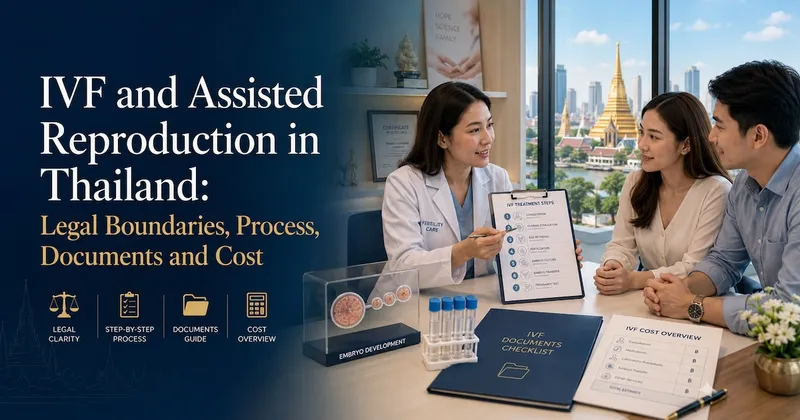
泰互帮IVF and Assisted Reproduction in Thailand: Legal Boundaries, Process, Documents and Cost
First, the Legal Red Lines (Most Important)
- Legally married couples only: Thai assisted-reproduction law requires recipients to be a legally married couple, and most licensed fertility centers require a marriage certificate
- Commercial surrogacy for foreigners is banned: since the 2015 Protection of Children Born Through Assisted Reproductive Technologies Act, Thailand fully prohibits commercial surrogacy for foreigners, with criminal liability for violations — be highly wary of any agent claiming to arrange surrogacy for foreigners in Thailand
- Non-medical sex selection is prohibited: choosing an embryo's sex for non-medical reasons is banned in Thailand
- Egg/sperm donation is tightly regulated: with qualification and compliance requirements — not something done on demand
- Bottom line: what's legally available is routine assisted-reproduction treatment for married couples; for anything involving surrogacy, sex selection, or eligibility for single/same-sex applicants, consult a licensed medical provider and a legal professional first — don't take an agent's word
What's Legally Available
- IVF / ICSI (intracytoplasmic sperm injection): routine IVF techniques, the mainstream approach for infertility
- Egg/sperm/embryo freezing: fertility preservation, with rules per medical providers and current law
- Embryo testing (with a medical indication): such as screening for specific genetic-disease risk, requiring a medical reason and never for non-medical sex selection
- Whether these apply to your case is per the fertility doctor's assessment and current regulations
Treatment Process and Timeline
- Initial assessment: examinations of both partners, fertility assessment and a treatment plan
- Ovarian stimulation: a period of medication and monitoring
- Egg retrieval and fertilization: retrieval, then lab fertilization and embryo culture
- Embryo transfer: transfer at the chosen time, then a pregnancy test
- A full cycle needs multiple visits over weeks to months, often coming in stages or arranging follow-up per the doctor after the first visit — don't over-pack your itinerary
Documents, Cost and Choosing a Clinic
- Documents: passport, marriage certificate (possibly needing notarization/legalization), prior tests and records (translation recommended)
- Cost: a single IVF cycle varies widely by hospital, protocol, medication and any added testing — this guide gives no absolute figures; go by a licensed fertility center's written quote, with stimulation drugs and freezing usually extra
- Insist on a licensed fertility center and compliant doctor: don't be drawn by rock-bottom prices or "guaranteed success" pitches — credentials and compliance come first
Visa and Logistics
- Arrange a short stay per entry rules for short treatment, and mind overstay for long cycles — for entry see our tourist visa and entry guide
- For obtaining and legalizing a marriage certificate, if registering in Thailand see our marriage registration guide; for long-stay married couples our marriage visa guide
- When you don't speak the language, use a professional interpreter for your condition and plan; for choosing a hospital see our hospital guide and for cover our health insurance guide
- If you give birth in Thailand, for birth registration and household registration back home see our childbirth in Thailand guide
Risks and Realistic Expectations
- There is no "guaranteed success": success rates relate closely to age, ovarian function, sperm quality and more — distrust any 100% promise
- Treatment involves medication and a physical toll, needing mental and physical preparation and realistic expectations, sometimes across multiple attempts
- Plan medical, legal, visa and financial matters as a whole — don't decide hastily just because the price is low
Frequently Asked Questions
Can singles or same-sex couples do IVF in Thailand?
It's restricted by law. Thai assisted-reproduction law is oriented to legally married couples, and licensed centers mostly require a marriage certificate, so eligibility for singles and same-sex couples is limited and the rules may change. Never trust an agent claiming "no marriage certificate needed" or "we'll sort out your status" — such arrangements may be non-compliant or illegal. Go by licensed medical providers and Thai legal professionals for the real picture, and don't bet in a grey area.
Can I choose the baby's sex with IVF in Thailand?
No. Thailand prohibits non-medical embryo sex selection; embryo testing is only possible with a clear medical indication (such as avoiding a specific genetic disease) and per a doctor's judgment under the regulations. Marketing that promises "guaranteed sex selection in Thailand" is largely non-compliant or a scam — don't believe it. Lawful assisted reproduction aims to treat infertility, per medical providers and current regulations.
Can foreigners arrange surrogacy in Thailand?
No. Since Thailand's 2015 Protection of Children Born Through Assisted Reproductive Technologies Act, commercial surrogacy for foreigners is fully banned, with possible criminal liability for violations. Any agent claiming to arrange surrogacy for foreigners in Thailand is running a high-risk, non-compliant operation that can leave you and the child in serious legal and status trouble. For surrogacy-related needs, first consult a legal professional on the lawful boundaries — don't be led into a trap by "all-in-one" pitches.
How many trips to Thailand and how long for one IVF cycle?
Usually not done in one go: initial assessment, stimulation monitoring, retrieval and transfer span weeks to months, so it's common to come in stages or arrange follow-up per the doctor after the first visit. When planning, factor in your visa stay, and mind overstay especially for long cycles. The exact number of visits and timeline is per the fertility doctor's plan — clarify before you go, and don't over-pack your itinerary.
Need a Hand?
TaiHuBang helps families coming to Thailand for treatment settle in: accompanied medical interpretation, airport and hospital transfers, accommodation and itinerary arrangements, and guidance on documents like marriage certificates. We provide no medical opinions and are involved in no illegal arrangements such as surrogacy — all diagnosis and treatment are per licensed providers and doctors, and legal matters per professionals. Submit an inquiry for medical transfers and accompaniment, or browse our community Q&A; a consultant will reply within 24 hours.
Related Articles

Moving to Thailand: The Complete Checklist — Visa, Housing, Money, Healthcare, Schools & Settling In
Planning to move to Thailand feels overwhelming, but it breaks down into a clear timeline: decide how you'll stay long-term (visa), which city and district to live in (housing), how to bring and spend money (finances), how to handle healthcare and insurance (medical), how children will attend school (education), and the pile of on-the-ground tasks after arrival — SIM, broadband, utilities, driving licence, transport and community (settling in). This is a master checklist and roadmap for moving to Thailand, organised into three stages — before you go, the first month, and once settled — linking each step to the detailed guide that expands on it, so you build your life without missing anything. Specific rules follow current agency regulations; consult on professional matters.
7/24/2026

How Much Does It Cost to Live in Thailand per Month? Bangkok, Chiang Mai & Pattaya Cost Comparison
There's no single answer to how much a month in Thailand costs — it depends mainly on the city, housing tier and lifestyle. The biggest item is rent (central Bangkok condos are priciest; Chiang Mai and Pattaya are cheaper), followed by food (street food is very cheap, while restaurants and imported groceries push it up sharply), transport (BTS/MRT and taxis in Bangkok, motorbikes elsewhere), utilities, health insurance, and visa and sundries. Roughly three tiers: frugal (local food, a small unit outside the core), comfortable (a one-bed in a decent area, eating out often with occasional leisure), and generous (a good unit in the core, restaurants often, a helper, insurance). This guide breaks down each cost by city and spending tier to help you estimate your monthly budget; actual figures fluctuate with exchange rates, location and personal habits.
7/24/2026
Postpartum Care & Confinement Centres in Thailand: Services, Prices, Visas & How to Choose
More Chinese families in and heading to Thailand are choosing postpartum confinement care there. Thai confinement centres typically offer postpartum lodging, confinement meals, mother-and-baby care, lactation support and postnatal recovery, with the environment and care experience as the main selling points. Choosing one comes down to four things: credentials and hygiene (properly registered, professional carers), services (carer ratio, meals, infant care, medical links), price and packages (per day/per package, whether care and meals are included), and location and hospital links (distance to the delivery/paediatric hospital and whether emergencies can reach care quickly). If you're travelling to give birth, also plan the visa, delivery hospital, birth registration and the baby's documents in advance. This guide covers services and pricing, how to choose, and how it connects with delivery and visas, subject to the centre's actual conditions and agency rules.
7/24/2026