 泰互帮
泰互帮Thailand Marriage Visa (Non-O) Guide: Requirements, Documents, Renewal and the Right to Work
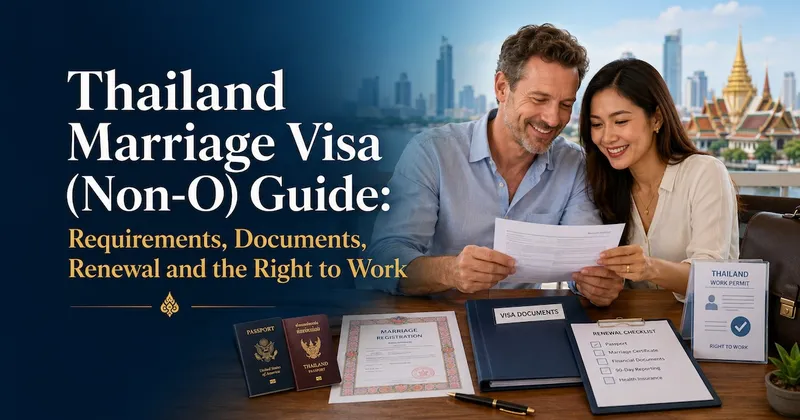
What the Marriage Visa Is and Who Can Get It
- Who it's for: a foreign spouse lawfully married to a Thai citizen can apply for the dependent Non-Immigrant O visa (based on marriage), commonly called the "marriage visa"
- It requires a lawful marriage registration first: complete a Thailand-recognized marriage registration; for the process for Chinese nationals registering in Thailand (single-status certificate, legalization) see our marriage registration guide
- A different "dependent visa" follows a work-permit holder (accompanying spouse/children) — distinct from the marriage-based visa, so don't confuse them
Proof of Funds: The Most Common Sticking Point
- Common standard: around 400,000 baht in the applicant's Thai bank account (held for the required months), or qualifying monthly income, or a combination — exact figures and holding months per Immigration's current rules
- The funds requirement is lower than the retirement visa, but the review is strict about how long the funds have been held — don't scrape together a lump sum right before applying; plan to hold it for the required months
- For compliant entry and exchange of larger funds, see our currency exchange and remittance guide
Documents and the Genuineness Check
- Basic documents: passport, marriage certificate, the spouse's Thai ID and house registration, proof of address, proof of funds, photos together and evidence of shared life
- Genuineness verification: Immigration verifies the marriage is real, which may include a home visit, photos together and address checks — a sham marriage is illegal and extremely risky, so it must be a genuine marriage
- Document lists vary slightly between Immigration offices — confirm each item against your local office's current requirements before applying
Renewal and the 90-Day Report
- Yearly renewal: the marriage visa usually grants a shorter entry permit first, then you extend it to a year at Immigration after arrival, renewing annually thereafter
- 90-day report: like all long stays — don't confuse it with renewal; see our 90-day report and re-entry permit guide
- Re-entry permit: if you leave during a valid extension, get a re-entry permit first, or the visa is voided
Can You Work on a Marriage Visa? The Link to the Work Permit
- You can work lawfully, but still need a work permit: a foreign spouse on a marriage visa may apply for a work permit to be employed or run a business — an important advantage over a tourist visa
- The Thai-employee ratio and registered-capital thresholds for a work permit via a marriage visa are usually more relaxed than an ordinary work visa, per the Ministry of Labour's current rules
- To start a business, for company and license compliance see our foreigner business guide; for employment see our work visa and work permit guide
Change in the Marriage: How Divorce Affects the Visa
The marriage visa depends on the marriage, so once you divorce, its basis disappears — you must promptly convert to another lawful visa or arrange departure, not let it drift into overstay. For matters involving child custody and asset division, see our Thailand divorce and custody guide.
Frequently Asked Questions
Does marrying a Thai automatically give me long-stay status?
Not automatically. After a lawful marriage registration you separately apply for the dependent Non-O marriage visa, meeting proof of funds (commonly about 400,000 baht on deposit or qualifying income) and passing a genuineness check, renewed yearly with a 90-day report. Marriage isn't permanent residence, nor automatic work rights (work still needs a permit). Exact conditions and figures are per Immigration's current rules — verify against local requirements before applying.
How much money do I need for the marriage visa — can I scrape it together?
Commonly around 400,000 baht on deposit in a Thai bank or qualifying monthly income — lower than the retirement visa. But Immigration reviews the holding period strictly, so scraping a lump sum together right before applying usually won't do — deposit and hold it for the required months. Figures and holding periods are per current rules. Move larger funds in via compliant exchange routes and keep records — don't use funds of unclear origin, which can affect the review.
Can I work or start a company on a marriage visa?
Yes, but you still need a work permit — precisely the marriage visa's advantage over a tourist visa. The thresholds for a work permit via a marriage visa (Thai-employee ratio, registered capital) are usually more relaxed than an ordinary work visa, for employment or self-employment, per the Ministry of Labour's current rules. To start a business you'll also handle company registration and shopfront license compliance. So "having the right to work" isn't "no work permit needed" — don't conflate them.
If I divorce, is the marriage visa still valid?
The marriage visa is based on the marriage, so after divorce its basis disappears — convert promptly to another lawful visa (work, Elite, etc.) or arrange departure, and don't let it drift into overstay, which has serious consequences (see the overstay guide). Handle child custody and asset division lawfully in parallel. When the marriage changes, the earlier you plan the visa transition the better — consult a professional if needed.
Need a Hand?
TaiHuBang provides marriage-visa process guidance and document support: guidance on marriage registration and the dependent visa, funds and document preparation advice, renewal and 90-day report reminders, and referral for the spouse's work permit. All per Immigration and Ministry of Labour current rules, with no "guaranteed visa" or sham-marriage arrangements. See our visa service and legal consulting service, or submit an inquiry and a consultant will reply within 24 hours.
Related Articles
Thailand Work Permit Guide: How It Differs from the Work Visa, Documents, Job Changes & Prohibited Occupations
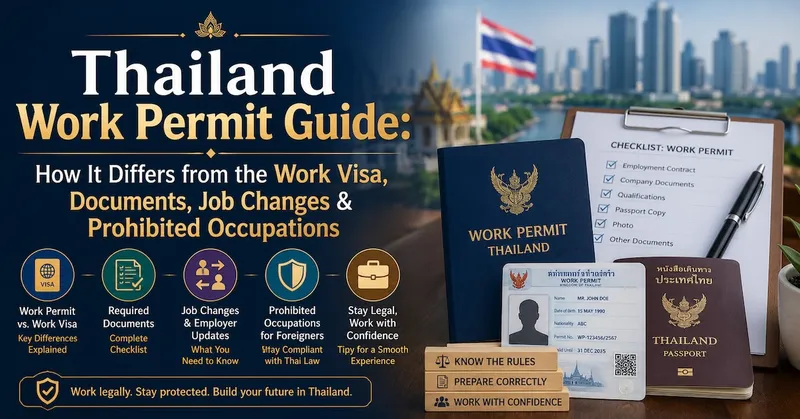
To work legally in Thailand, a work visa (Non-B) alone isn't enough — you also need a Work Permit, and the two are different: the work visa is permission to enter and stay, while the work permit authorises you to do a specified job for a specified employer. Typically you first hold a Non-B visa, then the company applies for your work permit, and only both together make employment legal. The permit is employer-initiated and tied to a specific company and position, so changing jobs means reapplying or amending it, and the company must meet capital and Thai-to-foreign staff ratio requirements (commonly four Thai employees per foreigner). Thailand also has a list of occupations prohibited or restricted for foreigners; working out of scope or without a permit is illegal and can bring fines, deportation and a blacklist. This guide covers the permit-versus-visa distinction, documents and process, handling job changes, and prohibited occupations, subject to current Ministry of Labour rules.
7/24/2026
Thailand SMART Visa Explained: Four Categories for Talent, Investors, Executives & Startups — vs the Work Visa
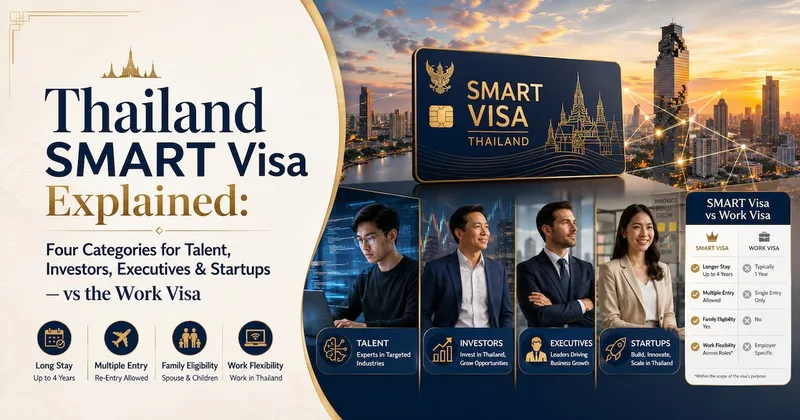
The SMART Visa is Thailand's special visa to attract talent in targeted industries (technology, digital, innovation), in four categories: Highly-Skilled Talent (T), Investor (I), Executive (E) and Startup (S). Its appeal: up to a four-year visa for those who qualify, the ability to work within the approved scope without a separate work permit, 90-day reporting relaxed to once a year, and dependants who can join — with spouses generally allowed to work. But the bar is defined: your role must fall in a BOI-endorsed targeted industry and meet salary or investment thresholds, with certification by the relevant authority, so vetting is stricter than an ordinary work visa. It differs from the standard "work visa + work permit" route, which suits most employed foreigners, whereas SMART targets high-end talent, investors and founders in targeted industries. This guide covers the four categories' requirements, benefits and how to choose between SMART, the work visa and LTR, subject to current BOI and agency rules.
7/22/2026
Thailand LTR Visa Guide: The Four Categories, Requirements, Tax Perks and Ten-Year Residence
The LTR (Long-Term Resident) visa is Thailand's long-stay visa to attract wealthy individuals, affluent retirees, remote-working professionals and highly skilled experts. It offers up to around ten years of residence (typically issued in stages, renewed on continued eligibility), plus perks such as annual reporting instead of 90-day reporting, multiple re-entry, the option of a digital work permit, and preferential personal income tax for some categories. It targets people with higher income, assets or investment, so the bar and paperwork are higher than a tourist visa or DTV — but you get a far more hassle-free long-term status. This guide covers the four LTR categories, their income/asset thresholds, the perks, and how to choose between LTR, the Privilege visa, DTV and retirement visas — subject to the BOI and Immigration's current rules.
7/21/2026