 泰互帮
泰互帮Money and Thailand: Currency Exchange, International Transfers and the FET Paper Trail
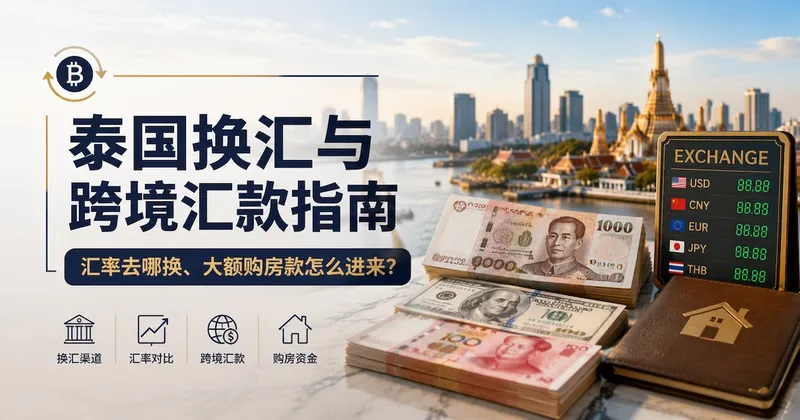
Three Scenarios, Three Playbooks
The right channel depends on what the money is for: pocket cash, regular living expenses, or a property purchase. Choosing wrong costs you spread on small amounts — and can block a condo transfer on large ones. This guide works through each scenario; policy details follow current Bank of Thailand rules and your home country's exchange controls.
Everyday Exchange: Where Are the Best Rates?
| Channel | Rate quality | Notes |
|---|---|---|
| Exchange specialists (Superrich and peers) | Best | Branches across central Bangkok and BTS stations; passport required; large amounts can be rate-locked by phone |
| Bank counters / airport booths | Below average | Airport rates are the worst — change only what you need for day one |
| ATM withdrawals | Fair rate, heavy fees | Thai ATMs charge foreign cards 220 THB per withdrawal plus issuer fees; frequent small withdrawals are the most expensive pattern |
| Card / mobile payment | Near mid-market | Visa/Mastercard and UnionPay rates are transparent; QR wallets are widely accepted at real-time rates |
Cash declaration lines: carrying over USD 20,000 equivalent into or out of Thailand requires declaration. Move serious money through banks, not luggage.
Sending Living Expenses Into Thailand
- Bank wire (SWIFT): 1-3 business days, with combined sending and receiving fees typically USD 30-100; check your home country's annual remittance allowances and purpose declarations
- Licensed transfer services (Wise and similar): better rates and faster arrival where supported — coverage varies by sending country
- Receiving side: Thai banks convert incoming foreign currency to baht at the day's rate automatically; large credits may trigger a purpose-verification call — answer factually
- No Thai account yet? See our bank account opening guide
Property Money: The FET Document Is the Lifeline
Foreigners buying a Thai condo must bring the purchase funds in as foreign currency, converted to baht inside Thailand. For inbound conversions above USD 50,000 the bank issues a Foreign Exchange Transaction form (FET, formerly Thor Tor 3) — the statutory evidence of foreign funds that the Land Office requires at transfer, and later the basis for repatriating the sale proceeds. Getting it right:
- State the purpose in the transfer memo (e.g., "purchase of condominium unit X") with the recipient name matching the buyer
- Splitting into multiple transfers? Collect documentation for every tranche; for amounts under USD 50,000 ask the bank for a credit advice letter of equivalent effect
- Keep the FET originals — needed at transfer and again when funds leave
- Structure the sending-country side within your own exchange-control rules; never borrow other people's remittance quotas
The full purchase process is in our property buying guide.
Getting Money Out of Thailand
- Outbound transfers are evidence-based: sale proceeds need the FET and transfer documents, salary needs the work permit and tax records, dividends need financial statements and tax filings — with documents in order, banks process routinely
- Large baht amounts without provable lawful origin are very hard to move through banks — this is why the FET must be done properly at purchase
- Modest surpluses move via bank remittance or licensed services; keep your Thai income tax records
Is Remitting Foreign Income Into Thailand Taxable?
A significant recent change: from 2024 Thailand tightened taxation of foreign-source income remitted by Thai tax residents (183+ days in a calendar year). Remitted foreign income is now in principle assessable in the year of remittance — the old "remit the following year tax-free" reading no longer applies. This matters most to long-stay digital nomads, retirees and anyone with offshore investment income. Exemptions, treaty credits and subsequent policy adjustments follow the Revenue Department's latest guidance — get a tax assessment before large remittances; see our tax filing guide.
FAQ
Are QR wallets and cards good enough to skip cash entirely?
Almost. Malls, convenience stores and chains take cards and QR payments at near mid-market rates. Street vendors, taxis and small shops still run on cash and Thai PromptPay QR, so keep one or two thousand baht on hand.
What do I need at an exchange booth, and is it safe?
Your passport. Licensed booths are regulated by the Bank of Thailand, post their rates and count out in front of you — entirely safe. What to avoid is unlicensed street changers and private "premium rate" deals, which frequently connect to laundering flows; receiving tainted funds can freeze your Thai account.
Why not use informal underground exchange networks with better rates?
Because both ends are illegal and the practical risks land on you: no recourse when a counterparty vanishes, and Thai accounts frozen by police after receiving flagged funds — a recurring pattern in recent cases involving foreign residents. The spread saved never covers a frozen account. Use regulated channels.
Need Help?
TaiHuBang provides funds compliance support: FET process guidance for property purchases, bank liaison for large transfers, tax assessment for foreign income remittance and legal referral for frozen account cases. See our accounting and tax service, or submit an inquiry — a consultant will reply within 24 hours.
Related Articles
Personal Income Tax for Foreigners in Thailand: Who Pays, Tax Residency, Rates, Deductions & the PND.91 Return
Foreigners working in or earning Thai-source income generally owe personal income tax. It has three layers: who pays — employment/service/business income earned in Thailand is in principle taxable there, regardless of tax residency; residency — staying 183 days in a tax year makes you a tax resident, and residents may also be taxed on foreign income remitted into Thailand (rules have tightened recently); and how to compute and file — tax is on a 0%–35% progressive scale after allowances and deductions, employees commonly file the annual PND.91 while employers withhold monthly (PND.1). Overpayments can be refunded. This guide covers a foreigner's tax liability, residency, rates and common deductions, and the filing and refund process, subject to current Revenue Department rules on rates, thresholds and foreign income; consult an accountant for your case.
8/4/2026

Outsourcing Thai Company Accounting & Tax: Choosing a Firm, Fees, Monthly/Annual Process & Pitfalls
Once you register a Thai company, you must keep books and file taxes monthly and annually — even with no revenue — and most foreigners outsource this to a local accounting firm. Outsourcing covers monthly bookkeeping, VAT filing (PP.30), withholding-tax filing (PND.3/53) and social-security filing, plus annual financial statements, an audit (Thai companies generally require a licensed auditor) and the annual income-tax return (PND.50). Fees are usually a monthly bookkeeping fee plus a separate annual audit/filing fee, tiered by company size, transaction volume, VAT registration and whether you need service in your language. Choosing a firm means checking credentials, communication, whether the quote includes the audit and annual return, and whether they proactively flag deadlines. Key pitfalls: don't assume zero revenue means no filing (missed filings incur penalties), don't pick the cheapest that can't produce compliant statements, and keep invoices in order. This guide covers scope, fees, the monthly/annual process and how to choose a firm, subject to Revenue Department rules.
8/4/2026
Do You Pay Tax on Cryptocurrency in Thailand? Digital Asset Trading, Remittance and Compliant Reporting
Holding and trading cryptocurrency in Thailand is legal, but it must be compliant: Thailand regulates and taxes digital assets (crypto and tokens), exchanges must be licensed, and gains from personal trading are taxable income. Selling for profit, crypto-to-crypto swaps, mining, airdrops and staking rewards can all trigger personal income tax, and funds repatriated from overseas exchanges also engage the tax-residency and overseas-income remittance rules. Recent adjustments (such as VAT relief on some trades via licensed local exchanges) aim to support the sector, but the personal income tax obligation hasn't disappeared. This guide covers who pays, which actions may be taxed, how overseas trading and remittance are treated, and how to keep records and report compliantly — subject to the Revenue Department and SEC's current rules.
7/21/2026