 泰互帮
泰互帮Buying Property in Thailand as a Foreigner: Condo Ownership, Land Rules and Taxes
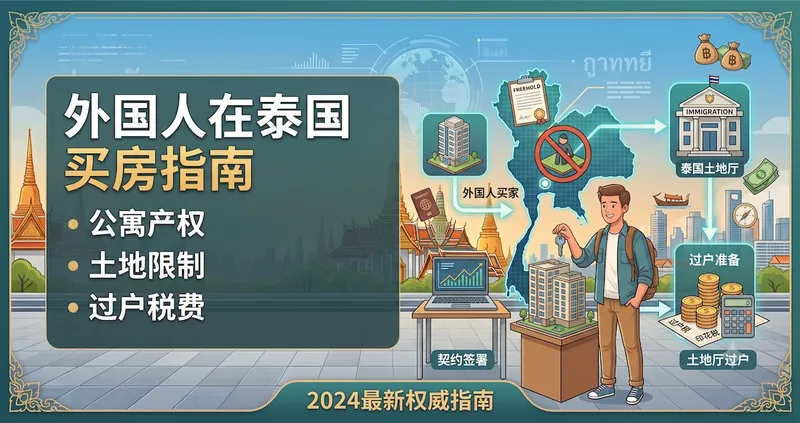
What Can Foreigners Actually Buy?
Thai law on foreign property ownership is clear: foreigners can own condominium units freehold, but cannot directly own land. That means villas, townhouses and any property with land cannot be registered freehold in a foreigner's personal name.
Condos: The 49% Foreign Quota
Under the Thai Condominium Act, foreign owners may hold no more than 49% of the total sellable area in any condominium building. In popular projects the foreign quota can sell out, leaving only Thai-quota units available on long leasehold. Before buying, always have the developer or seller confirm in writing how much foreign quota remains.
Land and Villas: Lease or Company Only
- Long lease: land leases run up to 30 years per term with renewal clauses possible; the lease must be registered at the Land Office to bind third parties
- Thai company ownership: buying land through a 51% Thai-owned company is common but using Thai nominee shareholders is illegal, and Land Office scrutiny has tightened — a high-risk structure
- Land purchases under BOI or IEAT (industrial estate) schemes are specific investment scenarios, unrelated to personal home buying
Purchase Funds Must Come from Abroad
To register a condo freehold, the purchase money must be remitted into Thailand in foreign currency, with the Thai bank issuing a Foreign Exchange Transaction form (FET, for amounts of USD 50,000+) or a credit advice letter. The Land Office requires this document at transfer; without it, the unit cannot be registered under foreign ownership. Note the property name and unit number in the remittance purpose field.
Transfer Taxes and Fees
| Item | Rate | Usually paid by |
|---|---|---|
| Transfer fee | 2% of appraised value | negotiable, commonly split 50/50 |
| Specific Business Tax | 3.3% (if seller owned less than 5 years) | seller |
| Stamp duty | 0.5% (instead of SBT) | seller |
| Withholding tax | 1% for company sellers; progressive for individuals | seller |
These are the statutory charges collected at the Land Office; actual allocation follows the sale contract. New projects may also charge a sinking fund and prepaid management fees. Confirm current rates with the Land Department.
The Buying Process
- Choose the unit and verify title: have a lawyer pull the title deed (Chanote) to confirm no mortgage, no seizure, and sufficient foreign quota
- Sign the reservation agreement and pay the booking deposit
- Sign the sale and purchase agreement — review default clauses, handover standards and late-delivery compensation
- Remit the funds from abroad and obtain the FET form
- Both parties attend the Land Office for transfer, pay the taxes, and receive the title deed
Common Risks
- Unfinished off-plan projects: check the developer's delivery track record and EIA approval; tie payments to construction milestones
- Guaranteed rental returns: high guaranteed yields are rarely sustainable — vet the operator before signing
- Nominee land purchases: nominee agreements are unenforceable in Thai courts; you can lose both money and property
- Thai-only contracts: request an English version; if the Thai text prevails, review it clause by clause
FAQ
Does buying a condo get me a Thai visa?
Not directly. Some developers bundle a Thailand Privilege membership with the purchase — effectively the visa fee is built into the price, so calculate whether the package is actually worthwhile.
Can my children inherit the condo?
Yes, foreign-owned condos can be inherited, but heirs are subject to the same foreign quota and must complete inheritance registration within the legal timeframe. Make a will and take legal advice in advance.
Can I buy remotely without coming to Thailand?
Yes, via a notarized power of attorney (POA) authorizing an agent to handle the transfer. Limit the POA to the specific property and actions — avoid open-ended authorizations.
Need Help?
TaiHuBang provides property legal support: title due diligence, contract review, accompanied transfer, and POA guidance. See our legal consulting service, or submit an inquiry — a consultant will reply within 24 hours.
Related Articles
Can a Thai Company Legally Hold Land or Property? Nominee Risks, Compliant Structures & Alternatives
Since foreigners can't directly own Thai land or landed houses, some think of "registering a Thai company to hold the land." That route exists in specific compliant cases, but the most common version on the market — using Thai people as nominee shareholders to make up 51% Thai ownership while a foreigner actually controls the company — is an illegal nominee arrangement: Thai law prohibits using nominees to circumvent the ban on foreign land ownership, and if caught you can face forced disposal of the land, fines and even criminal liability, with the nominee Thais also liable. True compliance depends on whether the company genuinely operates and whether the Thai shareholders genuinely invest and hold rights — not a shell set up purely to hold land. For safer holding, foreigners more commonly buy a freehold condo (which foreigners may own), sign a long-term lease (leasehold, up to about 30 years, renewable), or use BOI/special permits where qualified. This guide covers the red lines of company land-holding, nominee risks and safer alternatives, subject to the Land Code; consult a lawyer for major decisions.
8/4/2026
You Bought Property in Thailand — Now How Do You Stay Legally? A Property Owner's Visa Guide
Buying property in Thailand doesn't let you stay legally — a purchase carries no residency, and you still need a valid visa to live there long-term. Common lawful long-stay routes for owners include: a retirement visa for those 50+ retiring, an Elite visa for easy long stays, the LTR 10-year visa for qualifying high-asset/remote/specialist profiles, a work visa for the employed, a dependant visa if your spouse is Thai, and DTV for remote workers. Which to choose depends on your age, whether you work, your income/assets and your long-stay goal — and has little to do with which property you bought. Owners should also mind obligations like 90-day reporting and TM30 address notification. This guide explains a property owner's visa options by profile and how to pair property with a visa, subject to current Immigration and agency rules.
8/1/2026
Living in Thailand Long-Term: Elite Visa or Buy Property — Which Is Worth It? Budget, Goals & Flexibility
Planning to live in Thailand long-term, many agonise over spending the budget on an Elite visa membership or on property. In fact the two solve different problems and don't replace each other: the Elite (Thailand Privilege) visa solves "what lawful status lets you stay long-term" (long-stay convenience, but no work rights and it expires or must be renewed/repurchased), while buying property solves "where to live and whether to sink assets into Thailand" (own-use/investment, but buying grants no residency). To truly live long-term you usually need both — a visa for status and housing (rented or bought) for a home — not one or the other. If the budget stretches to only one first, it comes down to your core goal: for lawful long stay first, choose the visa; for asset landing or long-term own-use first, consider buying but still arrange a visa. This guide weighs them across the problem solved, cost nature, flexibility and exit difficulty, subject to current Immigration and agency rules.
8/1/2026