 泰互帮
泰互帮Thai Company Tax Filing Guide: VAT and Corporate Income Tax Deadlines
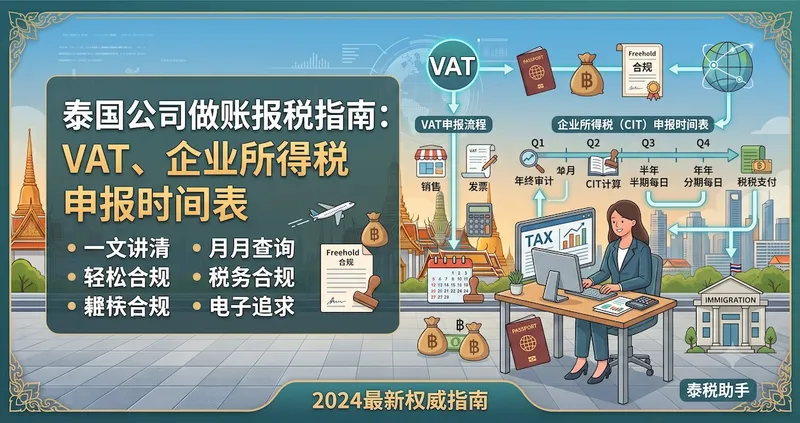
Which Taxes Does a Thai Company Pay?
Operating a Thai limited company involves four main tax types:
- Value Added Tax (VAT): standard rate 7%; registration is mandatory above 1.8 million THB annual revenue
- Withholding Tax: deducted when paying service fees, rent, salaries and more, at rates from 1% to 5%
- Corporate Income Tax (CIT): standard rate 20%; SMEs with registered capital up to 5 million THB and revenue up to 30 million THB get progressive relief (profit under 300,000 THB is exempt)
- Personal Income Tax (PIT): employee salaries taxed progressively 0%-35%, withheld monthly by the company
Monthly Filings
| Form | Content | Deadline |
|---|---|---|
| PP30 | VAT return | 15th of the following month |
| PND1 | Withholding tax on salaries | 7th of the following month |
| PND3 / PND53 | Withholding tax on payments to individuals / companies | 7th of the following month |
| SSO | Social security (5% employer + 5% employee) | 15th of the following month |
E-filing via the Revenue Department system usually extends deadlines by 8 days. Note: once VAT-registered, PP30 must be filed every month even with zero revenue — missed filings accumulate fines.
Annual Filings
- PND51: mid-year CIT prepayment, due within 2 months after the first half of the accounting year
- PND50: annual CIT return, due within 150 days after the accounting year ends
- Annual audit: every registered Thai company, regardless of size, must submit financial statements audited by a licensed auditor to the DBD
- Annual employee tax summary (PND1 Kor): by end of February
Consequences of Late or Missed Filing
- Late filing fines: 100-2,000 THB per form
- Tax surcharge: 1.5% interest per month on unpaid tax
- Prolonged non-filing: the Revenue Department can assess tax by estimate and flag the company
- Knock-on effects: directors' work visa renewals, corporate bank accounts and BOI status can all be affected
Traps Foreign Owners Commonly Fall Into
- Assuming no business means no filing — then facing two years of accumulated VAT and blank-account fines
- Mixing personal and company accounts, leaving fund flows unexplainable at audit
- Forgetting to withhold tax on rent and service payments, making costs non-deductible
- Keeping books only in the home country with no Thai ledgers, then paying double for a rushed catch-up before audit
- Negotiating salaries "net in hand" while overlooking social security and PIT costs
FAQ
Can a company with zero revenue skip the audit?
No. Thai law requires all limited companies to submit audited financial statements annually, zero revenue included — the audit fee is simply lower.
Do the books have to be in Thai?
Official ledgers and filings are in Thai; day-to-day documents can be organized bilingually. This is why most foreign-owned SMEs outsource to a local accounting firm.
Do I personally need to file Thai income tax?
Staying in Thailand 180 days or more in a calendar year makes you a Thai tax resident. Thai-sourced income is always taxable, and since 2024 foreign income remitted into Thailand also falls within scope — check the Revenue Department's latest rules and plan ahead.
Need Help?
TaiHuBang works with licensed Thai accounting firms offering monthly bookkeeping and filing, annual audit, tax health checks and catch-up bookkeeping. See our accounting and tax service, or submit an inquiry describing your company for a quote and compliance advice.
Related Articles
Personal Income Tax for Foreigners in Thailand: Who Pays, Tax Residency, Rates, Deductions & the PND.91 Return
Foreigners working in or earning Thai-source income generally owe personal income tax. It has three layers: who pays — employment/service/business income earned in Thailand is in principle taxable there, regardless of tax residency; residency — staying 183 days in a tax year makes you a tax resident, and residents may also be taxed on foreign income remitted into Thailand (rules have tightened recently); and how to compute and file — tax is on a 0%–35% progressive scale after allowances and deductions, employees commonly file the annual PND.91 while employers withhold monthly (PND.1). Overpayments can be refunded. This guide covers a foreigner's tax liability, residency, rates and common deductions, and the filing and refund process, subject to current Revenue Department rules on rates, thresholds and foreign income; consult an accountant for your case.
8/4/2026

Outsourcing Thai Company Accounting & Tax: Choosing a Firm, Fees, Monthly/Annual Process & Pitfalls
Once you register a Thai company, you must keep books and file taxes monthly and annually — even with no revenue — and most foreigners outsource this to a local accounting firm. Outsourcing covers monthly bookkeeping, VAT filing (PP.30), withholding-tax filing (PND.3/53) and social-security filing, plus annual financial statements, an audit (Thai companies generally require a licensed auditor) and the annual income-tax return (PND.50). Fees are usually a monthly bookkeeping fee plus a separate annual audit/filing fee, tiered by company size, transaction volume, VAT registration and whether you need service in your language. Choosing a firm means checking credentials, communication, whether the quote includes the audit and annual return, and whether they proactively flag deadlines. Key pitfalls: don't assume zero revenue means no filing (missed filings incur penalties), don't pick the cheapest that can't produce compliant statements, and keep invoices in order. This guide covers scope, fees, the monthly/annual process and how to choose a firm, subject to Revenue Department rules.
8/4/2026

Do You Pay Tax on Cryptocurrency in Thailand? Digital Asset Trading, Remittance and Compliant Reporting
Holding and trading cryptocurrency in Thailand is legal, but it must be compliant: Thailand regulates and taxes digital assets (crypto and tokens), exchanges must be licensed, and gains from personal trading are taxable income. Selling for profit, crypto-to-crypto swaps, mining, airdrops and staking rewards can all trigger personal income tax, and funds repatriated from overseas exchanges also engage the tax-residency and overseas-income remittance rules. Recent adjustments (such as VAT relief on some trades via licensed local exchanges) aim to support the sector, but the personal income tax obligation hasn't disappeared. This guide covers who pays, which actions may be taxed, how overseas trading and remittance are treated, and how to keep records and report compliantly — subject to the Revenue Department and SEC's current rules.
7/21/2026