 泰互帮
泰互帮Is Thai Property a Good Investment? Rental Yields, Guaranteed-Rent Traps and Real Costs

First Separate Gross from Net Return
- Gross rental yield = annual rent ÷ price — the figure ads use, attractive but with no costs deducted
- Net yield = (annual rent − management fee − sinking fund − property tax − management cost − vacancy loss) ÷ (price + purchase taxes) — what you actually keep
- The gap can be large: a stack of holding costs sits between gross and net; looking at gross alone overstates returns — cost details in the taxes and fees guide
What Drives Returns: Location and Rental Certainty
- Metro-adjacent resists vacancy: BTS/MRT-line homes within a short walk rent faster with shorter voids — location in the Bangkok area guide
- Tenant sources must be stable: expats, Japanese/Korean communities, students and tourists have different seasons — know who you're renting to
- Cities differ: Bangkok has steady long-let demand, Pattaya and Phuket lean holiday short-let, Chiang Mai slow retirement lets — different logic
- Vacancy is the hidden killer: two empty months a year cuts returns sharply — don't budget on full occupancy
Beware the "Guaranteed Rent-Back" Trap
- High rent-back is often a price-inflation tool: a "guaranteed X% for X years" often bakes the rent-back cost into a higher price — you're paid with your own money
- Honouring depends on the developer operating: whether you get the rent-back hinges on the developer or operator's long-term operation; if they underperform or vanish, the promise fails
- Read the party and liability in the contract: who pays the rent-back, for how long, what happens at term end, and default remedies must be nailed down
- "Guaranteed return" itself is a flag: investment is never a sure thing — the more "guaranteed" is the selling point, the more you should recompute coolly
Can Short-Let (Airbnb) Boost Returns?
- Higher but less stable: peak-season short-let in holiday cities can beat long-let, but swings with season, platforms and competition
- Compliance first: Thailand restricts daily short-let, and many condo by-laws ban it — non-compliant letting is risky
- High management cost: short-let needs cleaning, turnover and platform work — deduct these from net returns
How to Judge if a Property Is Worth Investing In
- Compute net return first: strip out holding costs, vacancy and taxes for the real annualised figure
- Then the exit cost: future sale transfer taxes and withholding tax; holding 5+ years saves more
- Include currency: baht swings against your home currency erode or boost returns
- Don't ignore loan costs: if borrowing, count interest — see the mortgage guide
FAQ
What rental yield does Thai property give?
There's no single figure, and you must separate gross from net. Gross yield (annual rent ÷ price) on core-city metro lines has a reference range, but the ads' "guaranteed 6%–8%" are mostly gross or rent-back-padded figures. Real net return deducts management fees, sinking fund, property tax, management costs and vacancy, then factors in purchase and exit taxes and currency swings — often clearly below the advertised number. Returns mainly hinge on location and rental certainty — metro-adjacent homes with stable tenant sources have less vacancy and truer returns. To know a property's real return, compute net yourself rather than trusting the gross ad figure. The market moves with timing, subject to live data; not investment advice.
Are developers' "guaranteed rent-back" promises trustworthy?
Be very cautious. A "guaranteed X% for X years" sounds tempting but has two problems: first, high rent-back is often baked into a higher price, so you're paid with your own money; second, whether it's honoured depends entirely on the developer or operator's long-term operation — if they underperform, occupancy misses targets, or the operator vanishes, the promise fails. Before signing such a contract, read who pays the rent-back, for how long, what happens at term end and default remedies, and have a lawyer review it. Projects leaning on "guaranteed return" as a selling point especially warrant a cool recomputation of real net yield — don't be dazzled by the number. Not investment advice; subject to the contract.
Is short-let (Airbnb) worthwhile for Thai property?
Possibly higher returns, but unstable and with compliance risk. In holiday cities (Pattaya, Phuket) peak-season short-let can beat long-let, but it swings with season, platform policy and competition, and off-season can sit vacant for long stretches. More importantly, there's the compliance issue: Thailand restricts daily short-let, and many condos' by-laws explicitly ban it, so non-compliant letting can draw complaints and fines. Short-let also carries management costs — cleaning, turnover, platform operation — which reduce net returns. If considering a short-let strategy, first confirm the project allows it and what local rules say, rather than eyeing only peak-season highs. Subject to local law and by-laws; not investment advice.
Need Help?
TaiHuBang offers consulting and estimation support for Thai property investment: location and rental-demand analysis, net-return estimates, rent-back contract and developer background checks, tax and exit-cost estimates, and lawyer and accountant referral. We only provide consulting and process support and promise no returns; this article is not investment advice, with professional conclusions verified against a lawyer, an accountant and live market data. See legal consulting and tax services, or submit an enquiry and an advisor will reply within 24 hours.
Related Articles
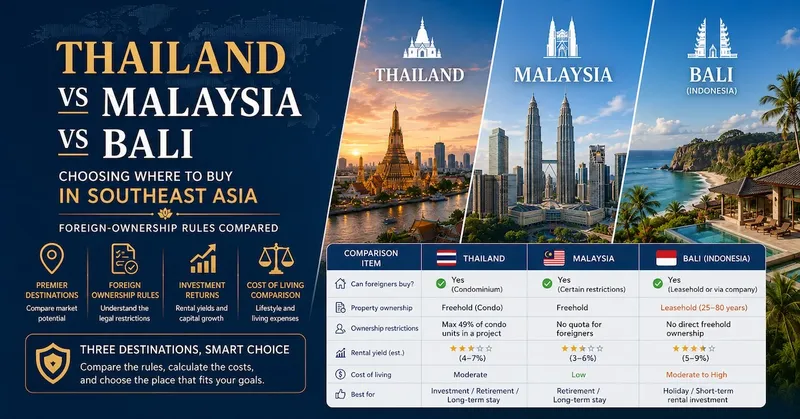
Thailand vs Malaysia vs Bali: Choosing Where to Buy in Southeast Asia and Foreign-Ownership Rules Compared
For buying in Southeast Asia, Thailand, Malaysia and Indonesia's Bali are three popular choices, but foreign-ownership rules, costs and suitability differ greatly. Thailand: foreigners can buy condo freehold (49% foreign quota), can't hold land individually, and villas use leasehold or a company; mature living, strong tourism, good value. Malaysia: foreigners can buy property above a local minimum price threshold (including landed property, rules by state), with the MM2H long-stay programme, widespread English and an English-style legal system. Bali (Indonesia): foreigners can't hold land title directly, commonly using Hak Pakai (right of use) or leasehold, with a strong holiday character and relatively complex rules. This guide compares the three on ownership, residency, cost and who they suit; each country's rules are subject to its official current rules, and this is not investment or legal advice.
7/16/2026
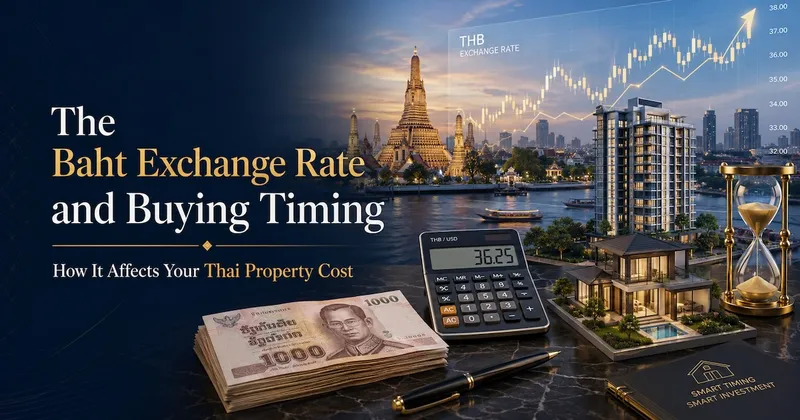
The Baht Exchange Rate and Buying Timing: How It Affects Your Thai Property Cost
Thai property is priced in baht, but your funds are mostly in another currency, so the baht exchange rate directly affects your real purchase cost and your take-home proceeds when you later sell. Put simply: the stronger your currency against the baht (the more baht it buys), the cheaper the purchase; weaker, and it costs more. The rate also affects off-plan instalments (long span, big swings), the amount you repatriate on sale, and your return in your home currency. But be clear-eyed: rates are hard to predict, don't rush to buy chasing a rate, and don't count on the rate to make money — the home's location, title and price are what matter. The rational approach is to treat the rate as a cost variable in the budget, use tools to compute, and convert in tranches to spread risk. This guide explains how the rate affects buying and how to treat timing rationally; rates are live, not investment or financial advice.
7/16/2026
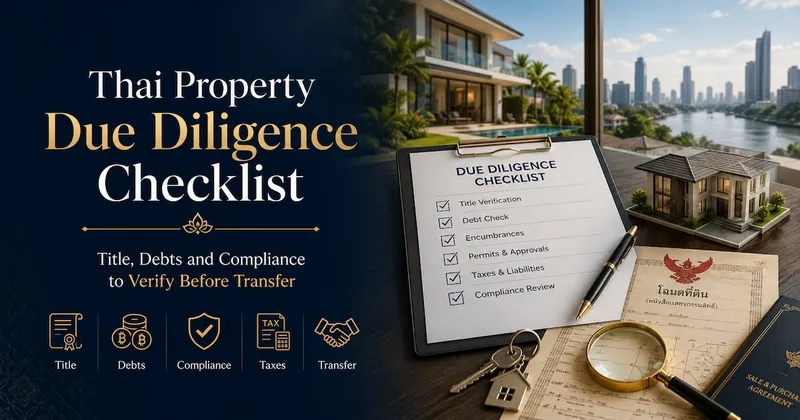
Thai Property Due Diligence Checklist: Title, Debts and Compliance to Verify Before Transfer
In Thailand, due diligence before transfer is the most important, most pitfall-blocking step. Five core areas to check: first, title — verify the deed type (whether Chanote), that the owner is the seller, and that area and boundaries match; second, debts and encumbrances — any mortgage, seizure, or unpaid management fees and utilities; third, the foreign quota (condos) and land limits (villas) — whether a foreigner can lawfully hold it; fourth, the developer and project (off-plan) — delivery record, EIA and construction permits; fifth, the contract and funds — review the sale contract and confirm funds can be remitted compliantly for the FET. Most of this needs a lawyer verifying originals at the Land Office. This guide gives a checklist to work against, subject to the Land Department's current rules and a lawyer.
7/16/2026