 泰互帮
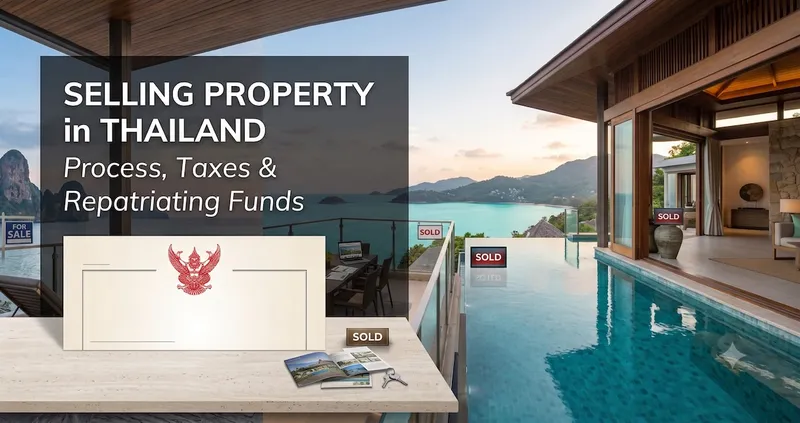
泰互帮Selling Property in Thailand: Process, Taxes and Repatriating Funds
The Typical Selling Flow
- Price and find a buyer: price against same-area comparables, find a buyer via an agent or channel
- Negotiate, sign the contract, take a deposit: agree the price, sign, take a deposit, set the transfer date and tax split
- Support the buyer's due diligence: the buyer (especially foreign) checks title and quota — have the title deed and documents ready
- Land Office transfer, pay taxes: both parties transfer at the Land Office, paying the seller's share of taxes
- Receive funds, repatriate: receive the proceeds; a foreign seller repatriates funds compliantly
What Taxes You Pay Selling
- Transfer fee: typically 2% of appraised value, split by contract
- Stamp duty 0.5% or SBT about 3.3%: one or the other — reselling having held under 5 years (or not meeting the registered-residence condition) charges about 3.3% SBT with no stamp duty; at 5 years stamp duty applies, cheaper
- Withholding tax: an individual seller on a progressive basis, a company at a fixed rate, withheld by the Land Office
- Tax details against buying in the taxes and fees guide
Holding 5+ Years Saves Tax
- 5 years is the key line: reselling after 5 years (or meeting the registered-residence condition) applies 0.5% stamp duty instead of about 3.3% SBT — clearly lower cost
- Timing can be planned: if near 5 years, weigh whether holding to 5 years before selling is more worthwhile
- Don't look at the margin alone: include taxes and holding costs for the real return — see the investment breakdown
How to Repatriate Funds Compliantly
- By the FET and transaction documents: a foreign seller's proceeds leaving Thailand need proof of source, and the original purchase FET is the key basis — see funds and the FET
- Keep complete records: the purchase FET, sale contract, and transfer and tax-payment documents, to ease the bank's outflow processing
- Confirm with the bank early: check the required documents and process before the outflow, to avoid getting stuck at repatriation
FAQ
What taxes does a foreigner pay selling property in Thailand?
Selling taxes fall mainly on transfer day at the Land Office: the transfer fee (typically 2% of appraised value), stamp duty 0.5% or SBT about 3.3% (one or the other — about 3.3% SBT if the seller held under 5 years, with no stamp duty then; at 5 years the cheaper 0.5% stamp duty applies), and the seller's withholding tax (individual progressive, company fixed rate, withheld by the Land Office). How these split between buyer and seller is by contract, and in practice SBT and withholding tax usually fall on the seller. To work out net proceeds, deduct these taxes and holding costs. Rates are subject to the Land Department's and Revenue Department's current rules.
Why is it more worthwhile to sell Thai property after holding 5 years?
Because 5 years is the key line for specific business tax. A seller reselling having held under 5 years (or not meeting the registered-residence condition) pays about 3.3% SBT; reselling after 5 years (or meeting the condition) instead applies 0.5% stamp duty rather than SBT, one or the other, at clearly lower cost. So if your home is near 5 years, before selling weigh whether holding to 5 years saves enough tax to be worth it versus selling early. Of course tax is only one dimension — also weigh the market, your fund needs and holding costs, rather than dragging it out just to save tax. Rates and conditions are subject to the Revenue Department's current rules; this article is not investment advice.
How can I repatriate the sale proceeds compliantly?
For a foreign seller repatriating proceeds from Thailand, the key is proving a compliant source of funds. The most important basis is the Foreign Exchange Transaction (FET) certificate issued when you originally remitted from abroad to buy — it shows the property money came in compliantly from overseas, making repatriation after sale straightforward. So keep complete records: the purchase FET, sale contract, and Land Office transfer and tax-payment documents. Before the outflow, confirm the required documents and process with the bank. If the FET wasn't correctly obtained when buying, repatriation is harder — which is why the FET matters at the buying stage. Repatriation requirements are subject to Thai banks' and foreign-exchange rules.
Need Help?
TaiHuBang offers consulting and support for selling Thai property and repatriating funds: selling-process guidance, seller tax estimation and split consultation, transfer document preparation, compliant repatriation and FET/document checks, and lawyer and accountant referral. We only provide consulting and process support and don't handle your funds, with professional tax and outflow conclusions verified against the Land Department, Revenue Department, banks' current rules and licensed institutions; this article is not investment or tax advice. See tax services and legal consulting, or submit an enquiry and an advisor will reply within 24 hours.
Related Articles
Thailand vs Malaysia vs Bali: Choosing Where to Buy in Southeast Asia and Foreign-Ownership Rules Compared
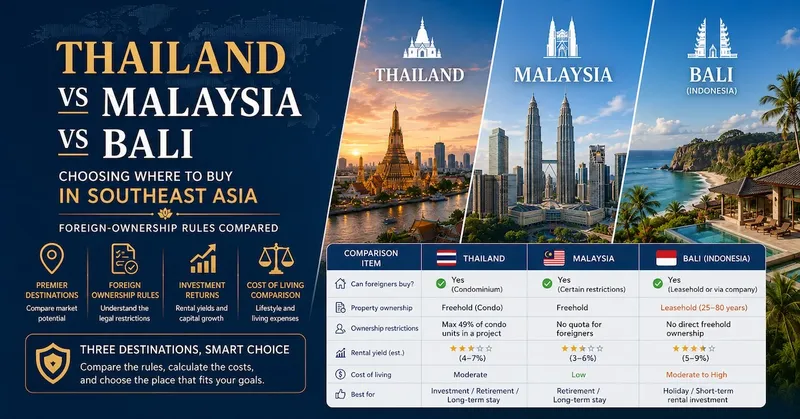
For buying in Southeast Asia, Thailand, Malaysia and Indonesia's Bali are three popular choices, but foreign-ownership rules, costs and suitability differ greatly. Thailand: foreigners can buy condo freehold (49% foreign quota), can't hold land individually, and villas use leasehold or a company; mature living, strong tourism, good value. Malaysia: foreigners can buy property above a local minimum price threshold (including landed property, rules by state), with the MM2H long-stay programme, widespread English and an English-style legal system. Bali (Indonesia): foreigners can't hold land title directly, commonly using Hak Pakai (right of use) or leasehold, with a strong holiday character and relatively complex rules. This guide compares the three on ownership, residency, cost and who they suit; each country's rules are subject to its official current rules, and this is not investment or legal advice.
7/16/2026
The Baht Exchange Rate and Buying Timing: How It Affects Your Thai Property Cost
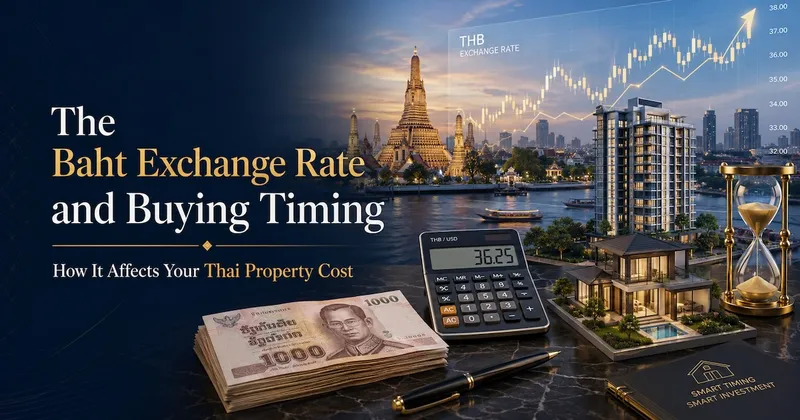
Thai property is priced in baht, but your funds are mostly in another currency, so the baht exchange rate directly affects your real purchase cost and your take-home proceeds when you later sell. Put simply: the stronger your currency against the baht (the more baht it buys), the cheaper the purchase; weaker, and it costs more. The rate also affects off-plan instalments (long span, big swings), the amount you repatriate on sale, and your return in your home currency. But be clear-eyed: rates are hard to predict, don't rush to buy chasing a rate, and don't count on the rate to make money — the home's location, title and price are what matter. The rational approach is to treat the rate as a cost variable in the budget, use tools to compute, and convert in tranches to spread risk. This guide explains how the rate affects buying and how to treat timing rationally; rates are live, not investment or financial advice.
7/16/2026
Thai Property Due Diligence Checklist: Title, Debts and Compliance to Verify Before Transfer
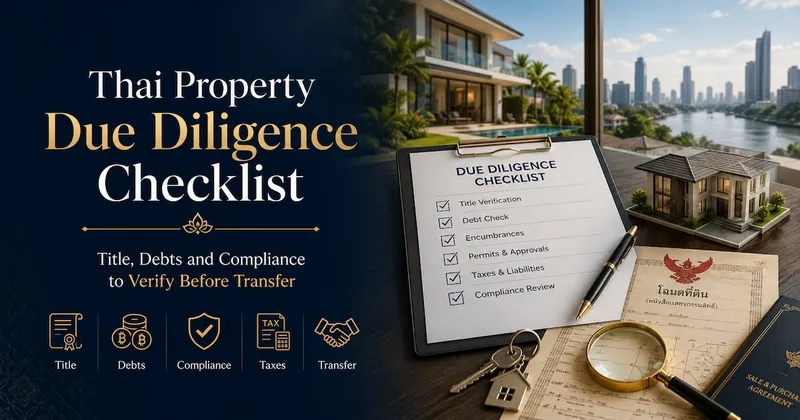
In Thailand, due diligence before transfer is the most important, most pitfall-blocking step. Five core areas to check: first, title — verify the deed type (whether Chanote), that the owner is the seller, and that area and boundaries match; second, debts and encumbrances — any mortgage, seizure, or unpaid management fees and utilities; third, the foreign quota (condos) and land limits (villas) — whether a foreigner can lawfully hold it; fourth, the developer and project (off-plan) — delivery record, EIA and construction permits; fifth, the contract and funds — review the sale contract and confirm funds can be remitted compliantly for the FET. Most of this needs a lawyer verifying originals at the Land Office. This guide gives a checklist to work against, subject to the Land Department's current rules and a lawyer.
7/16/2026