 泰互帮
泰互帮Buying Off-Plan Property in Thailand: Payment Milestones, Handover and Contract Resale

What Off-Plan Is, and How It Differs from Completed Homes
- Off-plan: you buy before completion, judging by show units and renders, pay by construction progress, and transfer at handover
- Completed / resale: you see the real thing and can move in now — see the resale process
- Off-plan's appeal: a lower launch price, staged payments, and more choice of floor, aspect and layout — good for buyers who can wait and value price and choice
The Typical Off-Plan Buying Process
- Sign a reservation, pay a deposit: locks the unit, with unit, price and the payment plan stated
- Sign the sale contract, pay the down payment: sets the down payment (commonly 20%–30%), handover date, and default and refund terms
- Pay by milestones during construction: pay by construction stages or monthly up to the agreed proportion before handover
- Inspect at handover: once built, inspect against the delivery standard, finishes and equipment
- Pay the balance, transfer at the Land Office: at handover pay the balance, transfer, pay taxes and receive the title
Foreign buyers must also arrange compliant remittance from abroad and an FET certificate — see the full buying process.
Four Things to Check Before Buying Off-Plan
- Developer reputation and delivery record: whether past projects were delivered on time and their quality — weak developers carry high delay and stall risk
- EIA and construction permits: large projects need an Environmental Impact Assessment and permits; projects with incomplete approvals are risky
- Foreign quota: confirm your unit is within the 49% foreign quota with room left — see the foreigner buying guide
- Key contract terms: handover date, late-delivery penalties, refund conditions and delivery standards must be spelled out — don't trust verbal promises
What "Contract Resale" (Flipping) Means
- Selling the off-plan contract before handover: transfer your purchase-contract interest to a new buyer before completion, to take a margin or exit
- Check if the developer allows it and the transfer fee: whether transfer is permitted and its fee is set by the developer — ask before signing
- Market-dependent: whether and at what price you can flip depends on the market and the project's demand — no guaranteed profit
Off-Plan's Main Risks
- Delayed handover: slow progress or cash-flow strain can push handover back repeatedly — the contract needs late-delivery penalties
- Stalled projects: if the developer fails and construction stops, recovering paid sums is hard — choosing a strong developer is the key defence
- Reality gap: the delivered home may differ from renders and show units — inspect strictly against the delivery standard
- Currency and funds: the long payment span means baht swings affect your total cost — plan funds ahead
FAQ
How much down payment does off-plan property in Thailand require?
There's no fixed standard — the developer's contract sets it — but the down payment is commonly around 20%–30% of the price, paid when you sign the sale contract. You then enter the construction period, paying by milestones or monthly up to the agreed proportion, with the remaining balance paid at handover and transfer. Compared with resale, which needs a large lump sum, off-plan's appeal is exactly the spread-out payments and lower upfront pressure. Note the payment span can run one to several years, so baht swings affect your real total outlay — plan funds ahead. Exact down payment and milestones are subject to the developer's contract.
Can Thai off-plan projects stall, and how do I reduce the risk?
Yes, there's a stall risk, especially with weak, cash-strained developers. Key ways to reduce it: first, choose a reputable developer with a stable delivery record — the most important defence; second, check the project has passed EIA and obtained construction permits, as fully-approved projects are safer; third, spell out the handover date, late-delivery penalties and refund conditions in the contract to preserve recourse; fourth, tie payments to actual construction progress. Even so, off-plan inherently carries the "pay first, receive later" time risk, so have a lawyer review the contract and don't be swayed by low prices and renders alone. Subject to the developer's contract and the relevant authorities' rules.
Can I resell off-plan before handover?
Some projects allow it, called contract resale (flipping) — before handover and transfer you assign your purchase-contract interest to a new buyer, to take a margin or exit early. But whether you can transfer and the transfer fee are set by the developer's rules; not all projects permit it, so ask and read the contract before signing. Also, whether you can actually flip and at what price depends entirely on the market and the project's demand at the time — in a weak market you may struggle to sell or have to cut the price, with no guaranteed profit. Treating contract resale as a sure exit is unrealistic. This article is not investment advice; subject to the developer's contract.
Need Help?
TaiHuBang offers consulting and process support for buying off-plan in Thailand: developer and project background checks, foreign-quota confirmation, sale contract and delivery-term review, remittance and FET guidance, handover inspection and Land Office transfer support, and lawyer referral. We only provide consulting, process guidance and document assistance; this article is not investment advice, with professional conclusions verified against a lawyer and the Land Department's current rules. See legal consulting or submit an enquiry and an advisor will reply within 24 hours.
Related Articles
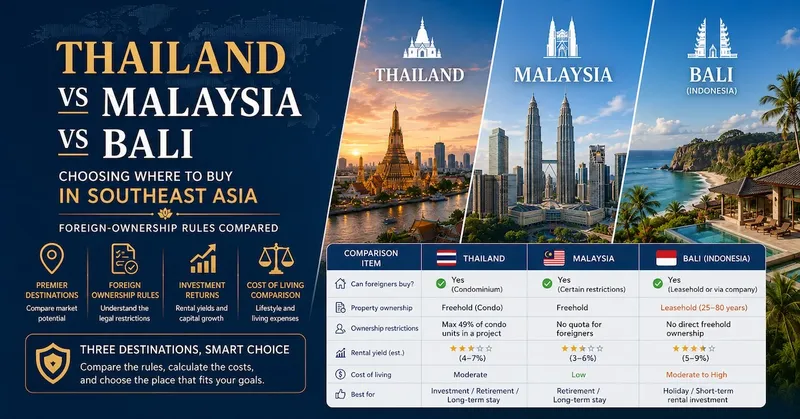
Thailand vs Malaysia vs Bali: Choosing Where to Buy in Southeast Asia and Foreign-Ownership Rules Compared
For buying in Southeast Asia, Thailand, Malaysia and Indonesia's Bali are three popular choices, but foreign-ownership rules, costs and suitability differ greatly. Thailand: foreigners can buy condo freehold (49% foreign quota), can't hold land individually, and villas use leasehold or a company; mature living, strong tourism, good value. Malaysia: foreigners can buy property above a local minimum price threshold (including landed property, rules by state), with the MM2H long-stay programme, widespread English and an English-style legal system. Bali (Indonesia): foreigners can't hold land title directly, commonly using Hak Pakai (right of use) or leasehold, with a strong holiday character and relatively complex rules. This guide compares the three on ownership, residency, cost and who they suit; each country's rules are subject to its official current rules, and this is not investment or legal advice.
7/16/2026

The Baht Exchange Rate and Buying Timing: How It Affects Your Thai Property Cost
Thai property is priced in baht, but your funds are mostly in another currency, so the baht exchange rate directly affects your real purchase cost and your take-home proceeds when you later sell. Put simply: the stronger your currency against the baht (the more baht it buys), the cheaper the purchase; weaker, and it costs more. The rate also affects off-plan instalments (long span, big swings), the amount you repatriate on sale, and your return in your home currency. But be clear-eyed: rates are hard to predict, don't rush to buy chasing a rate, and don't count on the rate to make money — the home's location, title and price are what matter. The rational approach is to treat the rate as a cost variable in the budget, use tools to compute, and convert in tranches to spread risk. This guide explains how the rate affects buying and how to treat timing rationally; rates are live, not investment or financial advice.
7/16/2026
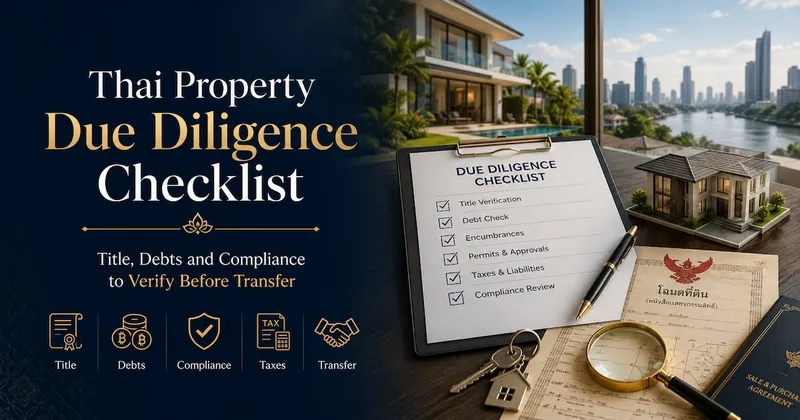
Thai Property Due Diligence Checklist: Title, Debts and Compliance to Verify Before Transfer
In Thailand, due diligence before transfer is the most important, most pitfall-blocking step. Five core areas to check: first, title — verify the deed type (whether Chanote), that the owner is the seller, and that area and boundaries match; second, debts and encumbrances — any mortgage, seizure, or unpaid management fees and utilities; third, the foreign quota (condos) and land limits (villas) — whether a foreigner can lawfully hold it; fourth, the developer and project (off-plan) — delivery record, EIA and construction permits; fifth, the contract and funds — review the sale contract and confirm funds can be remitted compliantly for the FET. Most of this needs a lawyer verifying originals at the Land Office. This guide gives a checklist to work against, subject to the Land Department's current rules and a lawyer.
7/16/2026