 泰互帮
泰互帮How to Choose a Thai Company Type: Limited Company, Partnership, Representative Office, Branch & BOI Compared

First: what you actually want to do decides the entity
- To genuinely trade, earn, hire and invoice: almost always a Private Limited Company, Thailand's mainstream vehicle
- Only market research/liaison, no revenue: a Representative Office — but it cannot earn income
- A parent extending directly into Thailand: a Branch, but liability isn't separated from the parent
- To lift foreign limits and get tax benefits: qualifying industries can go via BOI — see the BOI application guide
- For the overall foreign-business framework, see the foreigner's business guide
Five entities at a glance
| Type | Can it earn revenue? | Foreign shareholding | Liability | Best for |
|---|---|---|---|---|
| Private Limited | Yes, most versatile | Capped under the FBA — usually ≤49% (unless BOI/licence) | Limited | Most who genuinely trade |
| Partnership | Yes, rarely used | Also foreign-capped | Unlimited/partly limited | Specific partnership cases |
| Representative Office | No revenue | Can be 100% foreign | Parent liable | Research/liaison/sourcing only |
| Branch | Yes (within approval) | Foreign entity | Parent jointly liable | Parent extension, specific projects |
| BOI company | Yes, with benefits | Can lift some limits | Limited | Qualifying targeted industries |
Figures and scope change — follow current DBD and BOI rules.
Why most end up with a Private Limited Company
- It can genuinely do business: sign contracts, invoice, hire and get work permits — a Rep Office or liaison entity can't; on hiring see the work permit guide
- Limited liability: shareholders are liable up to their capital, more protective than a branch/general partnership
- But you face foreign limits: most sectors cap foreign shareholding at 49%, so arrange compliant Thai shareholders or go via BOI/a Foreign Business Licence — don't use illegal nominees; risks below and in the nominee/property risks guide
- Monthly/annual obligations: bookkeeping, VAT, social security and audit — see the monthly compliance guide and annual audit guide
When a Rep Office, Branch or BOI fits
- Representative Office: a parent doing market research, liaison, sourcing QC, reporting — can be 100% foreign but strictly no revenue; trading beyond scope gets flagged
- Branch: a parent extending business and trading within approval, but with no liability separation and possible scope/licence limits
- BOI company: targeted industries (tech, manufacturing) that meet thresholds can lift foreign limits, get tax breaks and hiring ease, subject to BOI approval — see the BOI guide
- Specific sectors have their own licences — see restaurants, e-commerce, import/export, manufacturing
Frequently asked questions
Which entity do foreigners usually use to open a company in Thailand?
Most use a Private Limited Company, because it can genuinely operate — sign contracts, invoice, hire and obtain work permits — with limited shareholder liability. A Representative Office can't earn revenue and a Branch has no liability separation, so neither suits normal trading. The core issue with a limited company is the foreign-shareholding limit: most sectors cap foreign ownership at 49%, so you'll need compliant Thai shareholders, or go via BOI promotion or a Foreign Business Licence (FBL) to lift it. Qualifying targeted industries should assess BOI first — it can lift limits and add tax benefits. Entity choice and foreign rules follow current DBD and BOI regulations.
What's the difference between a Representative Office and a limited company?
The core difference is whether it can earn money. A Representative Office is limited to non-revenue activities — market research, liaison, sourcing QC, reporting to the parent — and cannot generate income in Thailand; the upside is it can be 100% foreign-owned with a simple structure, but you can't invoice or collect through it. A Private Limited Company is the real operating vehicle — it can contract, invoice, hire and obtain work permits — at the cost of foreign-shareholding limits in most sectors and full bookkeeping/tax/audit duties. In short: a Rep Office for a liaison/research base; a limited company (or BOI if you qualify) to genuinely trade, subject to current rules.
When should I consider a BOI company?
When you're in a BOI targeted industry (tech, manufacturing, innovation, certain services) and can meet the investment or qualification thresholds, assess BOI first. The benefits are tangible: it can lift some foreign-shareholding limits (even 100% foreign), grant corporate income-tax breaks, and ease hiring and land holding. The trade-off is passing BOI approval, meeting conditions and staying compliant. If your business is ordinary trading or local services outside a targeted industry, a plain limited company plus (if needed) a Foreign Business Licence is usually more realistic. Get an eligibility assessment first, subject to current BOI rules.
Need help?
Taihubang helps choose and register a Thai entity: assessing whether a Private Limited Company, Representative Office, Branch or BOI route fits your goals, structuring compliant foreign shareholding, business scope, capital and ongoing bookkeeping/tax duties, and connecting you with accountants and lawyers. We don't arrange illegal nominees; everything follows current DBD, BOI and agency rules, verified with licensed accountants/lawyers. See our company registration service or submit an enquiry; an adviser replies within 24 hours.
Related Articles
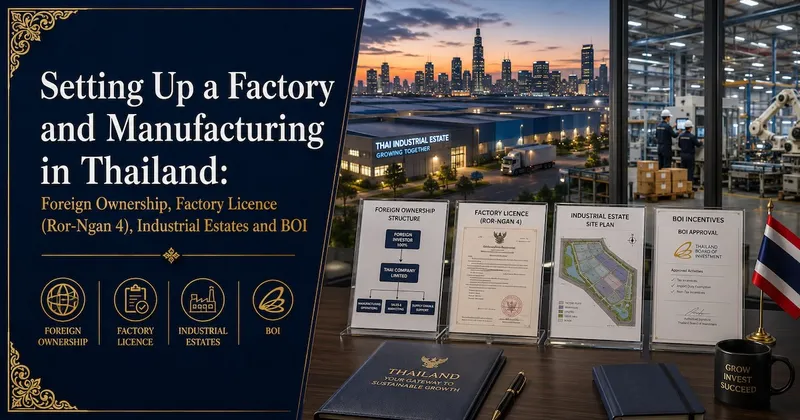
Setting Up a Factory and Manufacturing in Thailand: Foreign Ownership, Factory Licence (Ror-Ngan 4), Industrial Estates and BOI
Thailand is a Southeast Asian manufacturing hub, and many Chinese firms want to set up a factory — but that's far more complex than a trading company: you handle foreign shareholding (manufacturing is relatively open but still needs a compliant structure), obtain a factory licence (Ror-Ngan 4 / รง.4, required for factories above a machinery-power or worker threshold), pick the right site (an IEAT industrial estate vs own land, and whether foreigners can hold it), do an EIA where required, arrange work permits for expat managers and local hiring, and pay duty on imported machinery and materials. A BOI promotion can secure a tax holiday, foreign land holding and expat-employee quotas. This guide covers foreign structure, factory licence, site/land, BOI benefits, and hiring/equipment import, subject to the DIW, BOI and relevant authorities' current rules.
7/12/2026
Import and Export in Thailand: Trader Registration, HS Codes, Duty and VAT, and ASEAN–China FTA Preferences
To trade goods into or out of Thailand, having the goods isn't enough — you must clear three gates: entity, customs clearance, and tax. Importing/exporting usually needs a lawful company registered as an importer/exporter in Customs' e-system; goods are classified by HS code, which sets the rate; imports pay import duty plus 7% import VAT (some goods also excise), and food, cosmetics, electricals etc. need permits and standards. A Form E certificate of origin under the ASEAN–China FTA can secure preferential or zero duty, but wrong classification, under-valuation or missing permits get goods seized with back-tax and fines. This guide covers entity, clearance, duty/VAT, preferential origin and common traps, subject to Thai Customs and relevant authorities' current rules.
7/12/2026
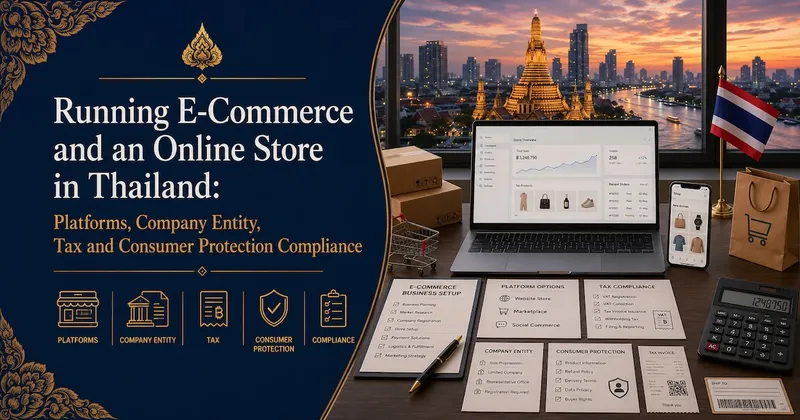
Running E-Commerce and an Online Store in Thailand: Platforms, Company Entity, Tax and Consumer Protection Compliance
Doing e-commerce or opening an online store in Thailand looks low-barrier but has real compliance: selling to Thai consumers usually needs a lawful entity (a registered company, foreign shareholding and business scope), proper bookkeeping and tax (VAT registration above the threshold), and compliance with Thailand's electronic-transaction and consumer-protection laws (returns, truthful advertising, PDPA data protection); platform onboarding (Shopee, Lazada, TikTok Shop, etc.) has its own credentials and settlement rules. Operating without a license, false advertising or misusing customer data can be penalized. This guide covers the compliance essentials across entity, platforms, tax, consumer protection and payment/logistics, subject to the relevant authorities' current rules.
7/12/2026