 泰互帮
泰互帮Buying Property in Phuket: Holiday Villas, Sea-View Condos and Short-Let Returns
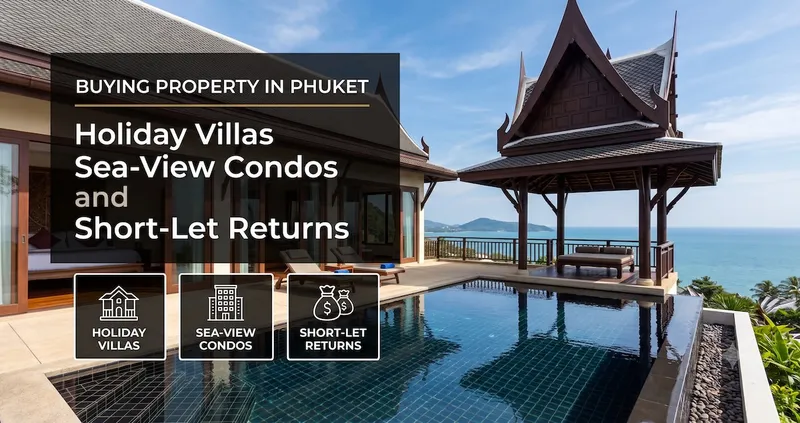
Phuket's Position: Upscale Island Resort
- Thailand's largest island, an international resort: led by holiday villas and sea-view condos, higher in tier and price than Pattaya
- Diverse buyers: upscale investment, holiday second homes, and southern retirement long-stay all feature
- Holiday-market driven: short-let and resale depend on tourism and holiday demand, with clear peaks and troughs
- Long stays need a visa — see buying and residency
Choosing an Area in Phuket: Beach and Airport
- Patong: the liveliest, with concentrated nightlife and tourists — short-let aimed at tourists, but noisy
- Kamala / Surin / Bang Tao: upscale, quiet west-coast areas with dense villas and premium condos and mature amenities
- Rawai / Nai Harn: the south, with a strong retirement and long-stay feel and relatively friendly living costs
- Airport area (north): Bang Tao and around are close to the airport, convenient for short-let
Property Types and Ownership
- Sea-view condos: foreigners can buy freehold — Phuket's most hassle-free choice
- Holiday villas: Phuket's villa market is developed, but foreigners can't hold land directly — mostly long-lease or company-held, with risks and structure in the foreigner buying guide
- Lots of off-plan: Phuket has many new off-plan projects — check developer reputation to avoid stalls, see the off-plan guide
What to Watch When Investing in Phuket
- Strong short-let potential but season- and compliance-bound: peak-season holiday short-let returns well, but Thailand restricts daily short-let and many condos ban it, so non-compliant letting is risky — see the investment breakdown
- High villa management costs: pool, garden, maintenance and a manager are ongoing outgoings to deduct from net returns
- High prices, high barrier: Phuket's upscale property has high totals — plan funds and currency ahead, remittance in the funds and FET guide
- Beware "guaranteed rent-back": common in holiday projects, mostly a price-inflation tool — compute the real net return coolly
FAQ
Who does buying in Phuket suit?
Phuket suits upscale holiday buyers, those wanting an island second home, and southern retirement long-stayers. As Thailand's largest island and an international resort, its property is led by upscale villas and sea-view condos, higher in tier and price than Pattaya, with first-class environment and holiday experience. On investment, Phuket's holiday short-let has strong potential, but returns clearly swing with season and short-let compliance, and villa management costs are high, so pure-investment returns need rational computation. In short: those with ample budget valuing island holiday quality or wanting a holiday second home suit Phuket; for steady long-let returns, Bangkok fits better. Subject to your needs and live market data; this article is not investment advice.
What should I watch buying a holiday villa in Phuket?
Key points: first, ownership structure — Phuket's developed villa market is tempting, but foreigners can't hold land directly, so villas are mostly long-lease (Leasehold) or company-held, and nominee arrangements to dodge the rule are non-compliant, so have a lawyer clarify the structure and renewal terms first; second, off-plan risk — Phuket has many new off-plan projects, so check developer reputation and delivery record to avoid stalls; third, management cost — a villa's pool, garden, maintenance and manager are ongoing outgoings to deduct from returns; fourth, short-let compliance and rent-back traps — if counting on short-let income, confirm compliance first, and beware "guaranteed rent-back" price-inflation talk. The island villa is beautiful, but clear the ownership and cost gates. Subject to the contract and law, with major decisions verified by a lawyer.
How do I choose between Phuket, Pattaya and Bangkok?
The three differ clearly. Bangkok is a metropolis on the metro, with steady long-let demand and good investment liquidity, for those valuing steady returns and city life; Pattaya is close to Bangkok (about two hours) with accessible sea-view condo prices, for budget-conscious sea-view holiday buyers; Phuket is an upscale international island with the highest-tier and priciest villas and sea-view condos, for well-budgeted buyers chasing holiday quality or a holiday second home. Holiday-type Phuket and Pattaya both have season-bound rentals and short-let restrictions, so steadier than Bangkok they are not. In short: Bangkok for stability, Pattaya for sea views on a budget, Phuket for upscale island holiday. Ownership rules and the buying flow are the same across all three. Subject to live market data; not investment advice.
Need Help?
TaiHuBang offers area consulting and support for buying in Phuket and other cities: area-to-need matching, villa ownership-structure and condo quota checks, off-plan developer background checks, purchase contract and transfer support, remittance guidance, and lawyer referral. We only provide consulting and process support; this article is not investment advice, prices are subject to live market data, and professional conclusions are verified against a lawyer and the Land Department's current rules. See legal consulting or submit an enquiry and an advisor will reply within 24 hours.
Related Articles
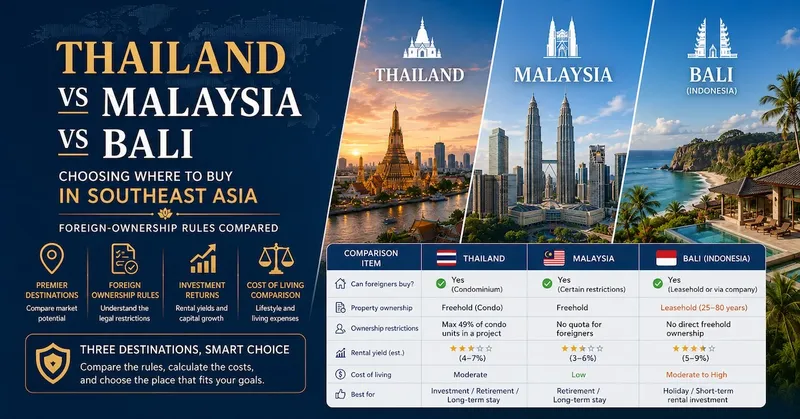
Thailand vs Malaysia vs Bali: Choosing Where to Buy in Southeast Asia and Foreign-Ownership Rules Compared
For buying in Southeast Asia, Thailand, Malaysia and Indonesia's Bali are three popular choices, but foreign-ownership rules, costs and suitability differ greatly. Thailand: foreigners can buy condo freehold (49% foreign quota), can't hold land individually, and villas use leasehold or a company; mature living, strong tourism, good value. Malaysia: foreigners can buy property above a local minimum price threshold (including landed property, rules by state), with the MM2H long-stay programme, widespread English and an English-style legal system. Bali (Indonesia): foreigners can't hold land title directly, commonly using Hak Pakai (right of use) or leasehold, with a strong holiday character and relatively complex rules. This guide compares the three on ownership, residency, cost and who they suit; each country's rules are subject to its official current rules, and this is not investment or legal advice.
7/16/2026
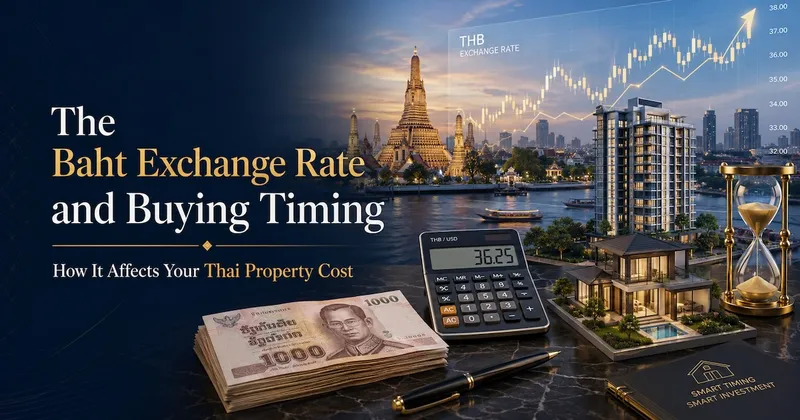
The Baht Exchange Rate and Buying Timing: How It Affects Your Thai Property Cost
Thai property is priced in baht, but your funds are mostly in another currency, so the baht exchange rate directly affects your real purchase cost and your take-home proceeds when you later sell. Put simply: the stronger your currency against the baht (the more baht it buys), the cheaper the purchase; weaker, and it costs more. The rate also affects off-plan instalments (long span, big swings), the amount you repatriate on sale, and your return in your home currency. But be clear-eyed: rates are hard to predict, don't rush to buy chasing a rate, and don't count on the rate to make money — the home's location, title and price are what matter. The rational approach is to treat the rate as a cost variable in the budget, use tools to compute, and convert in tranches to spread risk. This guide explains how the rate affects buying and how to treat timing rationally; rates are live, not investment or financial advice.
7/16/2026
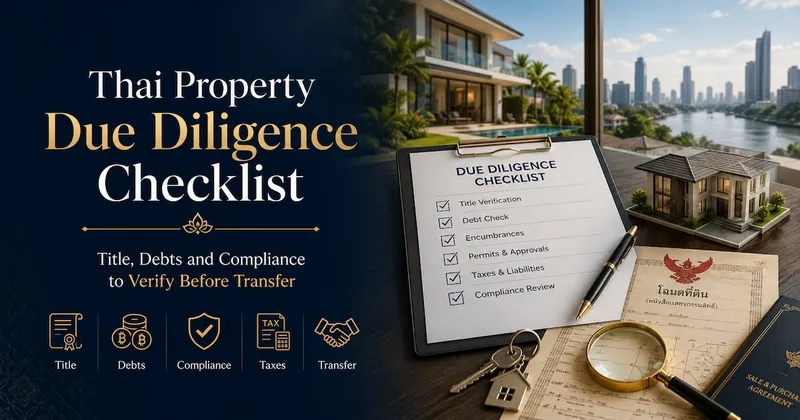
Thai Property Due Diligence Checklist: Title, Debts and Compliance to Verify Before Transfer
In Thailand, due diligence before transfer is the most important, most pitfall-blocking step. Five core areas to check: first, title — verify the deed type (whether Chanote), that the owner is the seller, and that area and boundaries match; second, debts and encumbrances — any mortgage, seizure, or unpaid management fees and utilities; third, the foreign quota (condos) and land limits (villas) — whether a foreigner can lawfully hold it; fourth, the developer and project (off-plan) — delivery record, EIA and construction permits; fifth, the contract and funds — review the sale contract and confirm funds can be remitted compliantly for the FET. Most of this needs a lawyer verifying originals at the Land Office. This guide gives a checklist to work against, subject to the Land Department's current rules and a lawyer.
7/16/2026