 泰互帮
泰互帮Wills and Inheritance in Thailand: Passing On Property and Bank Accounts as a Foreigner
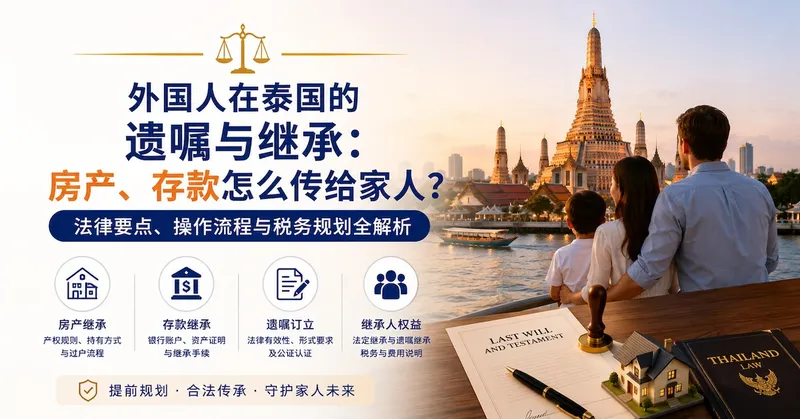
Why Thai Assets Need Their Own Plan
A common misconception among foreigners with property or accounts in Thailand: arrangements made back home automatically cover Thai assets. In reality, succession to immovable property in Thailand follows Thai law, banks freeze accounts on a depositor's death, and the family must obtain a Thai court order appointing an estate administrator (ผู้จัดการมรดก) before any asset can be dealt with. Without a Thai will, that process is slower and more contentious. Specific cases should be reviewed by a Thai lawyer.
No Will? How Thai Law Divides an Estate
The Thai Civil and Commercial Code recognizes six classes of statutory heirs, with the spouse counted separately:
- Descendants
- Parents
- Full brothers and sisters
- Half brothers and sisters
- Grandparents
- Uncles and aunts
The spouse always inherits, with a share that depends on which class survives: equal per-head division alongside children; a larger share where only remoter classes survive; everything where no class survives. Note that children and parents can inherit together — different from many home-country rules.
Can Foreign Heirs Inherit Thai Property?
- Condominiums: a foreign heir can inherit, but must qualify for foreign ownership (within the building's foreign quota with compliant funds); an unqualified heir is required to sell within the statutory period (generally one year), keeping the proceeds
- Land and houses on land: foreigners cannot in practice hold inherited land long-term — even a statutory heir must dispose of it within the prescribed period, typically by sale with the heir taking the proceeds
- Land held by a Thai spouse: no foreign-ownership issue arises on the land itself, but the marital property settlement when the foreign spouse dies still warrants legal advice
Structuring for succession at the time of purchase costs far less than untangling it afterwards — see our guide to buying property in Thailand.
Ways to Make a Will in Thailand
| Form | Key requirements | Best for |
|---|---|---|
| Ordinary written will | In writing, signed before two witnesses | The standard choice; law firms prepare bilingual versions |
| Holographic will | Entirely handwritten, signed and dated; no witnesses | Simple estates, interim arrangements |
| Public document will | Made and recorded by an official at the district office (Amphoe) | Official safekeeping, loss prevention |
| Secret document will | Sealed and registered at the district office | Confidential contents |
Good practice: limit the Thai will to assets in Thailand and state that it does not revoke wills made elsewhere; name an executor (who can also be proposed as estate administrator); and specify which language prevails in a bilingual text.
What the Family Must Do After a Death
- Obtain the death certificate (hospital and police documents for a death in Thailand, plus embassy paperwork in cross-border cases)
- Petition the court to appoint an estate administrator: the person named in the will, or one agreed among heirs where there is none; the court rules after a hearing, typically taking months
- Use the court order to process everything: bank releases, condo transfer, vehicle transfer, share transfers
- Heirs abroad should start early on identity and kinship documents — notarization, legalization and Thai translation of foreign documents is the slowest step
Does Thailand Have Inheritance Tax?
Yes, with a high threshold: only the portion of an inheritance above 100 million THB per heir is taxed, at 5% for direct ascendants and descendants and 10% for others (spouses exempt). Most families never reach the threshold — the real costs are transfer fees, legal fees and cross-border document legalization. Rates and thresholds follow current Revenue Department rules.
FAQ
I have a will from my home country — does it cover my Thai condo?
Not directly. A foreign will can be used in Thailand only after translation, legalization and recognition through the Thai court, a materially longer process than probating a local will. Once your Thai assets are significant, a separate Thai will is the highest-value piece of paperwork you can sign.
How are joint accounts and marital property handled when one spouse dies?
The marital property settlement comes first — half of the community property already belongs to the surviving spouse, and only the other half enters the estate. Where the marriage was registered and any prenuptial terms affect the analysis; cross-border couples should pair legal advice with our Thailand marriage registration guide.
The heirs live abroad and speak no Thai — can the estate still be administered?
Yes. The administrator proceedings can be handled by a Thai lawyer under power of attorney, heirs rarely need to appear in person, and individual steps can be handled by video or notarized authorization. The bulk of the work is notarizing, legalizing and translating the foreign-side documents — start early.
Need Help?
TaiHuBang connects clients with licensed Thai lawyers for succession matters: Thai will drafting and registration, estate administrator court proceedings, cross-border document guidance and property transfer support. See our legal consulting service, or submit an inquiry — a consultant will reply within 24 hours.
Related Articles
Can a Thai Company Legally Hold Land or Property? Nominee Risks, Compliant Structures & Alternatives
Since foreigners can't directly own Thai land or landed houses, some think of "registering a Thai company to hold the land." That route exists in specific compliant cases, but the most common version on the market — using Thai people as nominee shareholders to make up 51% Thai ownership while a foreigner actually controls the company — is an illegal nominee arrangement: Thai law prohibits using nominees to circumvent the ban on foreign land ownership, and if caught you can face forced disposal of the land, fines and even criminal liability, with the nominee Thais also liable. True compliance depends on whether the company genuinely operates and whether the Thai shareholders genuinely invest and hold rights — not a shell set up purely to hold land. For safer holding, foreigners more commonly buy a freehold condo (which foreigners may own), sign a long-term lease (leasehold, up to about 30 years, renewable), or use BOI/special permits where qualified. This guide covers the red lines of company land-holding, nominee risks and safer alternatives, subject to the Land Code; consult a lawyer for major decisions.
8/4/2026
You Bought Property in Thailand — Now How Do You Stay Legally? A Property Owner's Visa Guide
Buying property in Thailand doesn't let you stay legally — a purchase carries no residency, and you still need a valid visa to live there long-term. Common lawful long-stay routes for owners include: a retirement visa for those 50+ retiring, an Elite visa for easy long stays, the LTR 10-year visa for qualifying high-asset/remote/specialist profiles, a work visa for the employed, a dependant visa if your spouse is Thai, and DTV for remote workers. Which to choose depends on your age, whether you work, your income/assets and your long-stay goal — and has little to do with which property you bought. Owners should also mind obligations like 90-day reporting and TM30 address notification. This guide explains a property owner's visa options by profile and how to pair property with a visa, subject to current Immigration and agency rules.
8/1/2026
Living in Thailand Long-Term: Elite Visa or Buy Property — Which Is Worth It? Budget, Goals & Flexibility
Planning to live in Thailand long-term, many agonise over spending the budget on an Elite visa membership or on property. In fact the two solve different problems and don't replace each other: the Elite (Thailand Privilege) visa solves "what lawful status lets you stay long-term" (long-stay convenience, but no work rights and it expires or must be renewed/repurchased), while buying property solves "where to live and whether to sink assets into Thailand" (own-use/investment, but buying grants no residency). To truly live long-term you usually need both — a visa for status and housing (rented or bought) for a home — not one or the other. If the budget stretches to only one first, it comes down to your core goal: for lawful long stay first, choose the visa; for asset landing or long-term own-use first, consider buying but still arrange a visa. This guide weighs them across the problem solved, cost nature, flexibility and exit difficulty, subject to current Immigration and agency rules.
8/1/2026