 泰互帮
泰互帮Thailand vs Malaysia vs Bali: Choosing Where to Buy in Southeast Asia and Foreign-Ownership Rules Compared
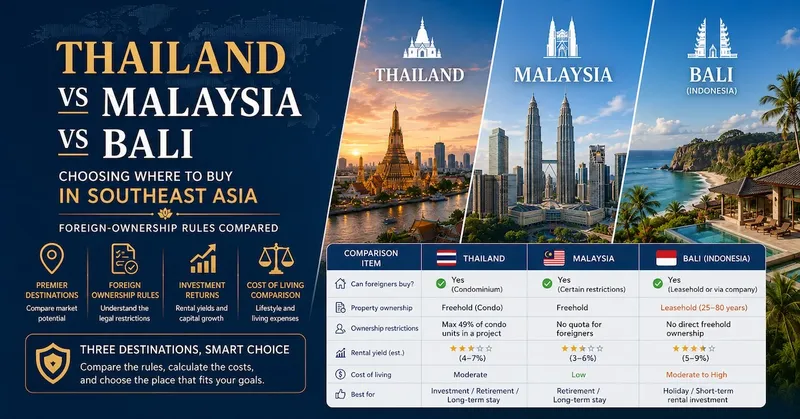
Foreign-Ownership Rules at a Glance
- Thailand: condos can be bought freehold (within the 49% foreign quota); land can't be held individually; villas use a long lease or company — see the foreigner buying guide
- Malaysia: foreigners can buy property above a local minimum price threshold (including some landed property; the threshold and rules vary by state), with relatively open ownership forms
- Bali (Indonesia): foreigners can't hold land title directly, commonly using Hak Pakai (right of use) or Leasehold, with relatively complex rules needing professional oversight
Residency / Visa
- Thailand: buying doesn't equal a visa — you need an Elite, retirement, LTR etc. separately — see buying and residency
- Malaysia: has the MM2H (Malaysia My Second Home) long-stay programme (conditions change from time to time), valued by many buyers
- Bali: Indonesia has its own long-stay visa/residence paths — conditions and policy per official rules
Cost, Language and Living
- Thailand: moderate living costs, strong tourism and healthcare, a large Chinese community, rich Bangkok-city-plus-island-holiday choice, good value
- Malaysia: widespread English, a high Chinese share, an English-style legal system, and a mature Kuala Lumpur — many value the language and education
- Bali: the strongest holiday-island character, a villa and guesthouse vibe, good for holiday/digital nomads, but infrastructure and rules are less stable than the big cities
Who Each Suits
- Value, holiday-plus-city, a Chinese community: Thailand is the balanced all-rounder
- English environment, landed property, MM2H long-stay, English-style schooling: Malaysia
- Pure holiday island, villas and guesthouses, digital nomads: Bali, accepting complex ownership and policy variables
- For all three, first settle your core purpose — own-use/investment/retirement/holiday — then match
Common Cautions
- Ownership limits differ: what foreigners can buy and how they hold it differ greatly across the three — verify country by country
- Use a local lawyer everywhere: cross-border ownership, tax and contracts are complex — a local professional lawyer is essential
- Don't buy on a holiday impulse: assess rental return, liquidity and policy stability rationally
- Policy changes: each country's foreign-buying and visa rules change from time to time — go by official current rules
FAQ
For Southeast Asia, how do I choose between Thailand, Malaysia and Bali?
It depends on your core purpose and preferences. Thailand is the balanced all-rounder: foreigners can buy condo freehold, with moderate living costs, strong tourism and healthcare, a large Chinese community, and both Bangkok city and island holidays, at good value — good for those valuing overall experience and a Chinese community. Malaysia has widespread English, a high Chinese share and an English-style legal system, lets foreigners buy above-threshold property (including some landed, by state) and has the MM2H long-stay programme — good for those valuing an English environment, landed property and children's education. Bali (Indonesia) has the strongest holiday-island character and a villa/guesthouse vibe, good for holiday and digital nomads, but foreigners can't hold land directly and rules are relatively complex. In short: Thailand for balanced value, Malaysia for English and landed long-stay, Bali for a pure holiday island. Each country's rules are per its official current rules; not investment advice.
Which country has the most relaxed foreign-ownership limits?
Relatively, Malaysia is more open to foreign ownership — foreigners can buy property above a local minimum price threshold, including some landed property (thresholds and rules vary by state), which is uncommon in Southeast Asia. Thailand is next: foreigners can buy condo freehold (within the 49% quota), but land can't be held individually, so villas only via lease or company. Bali (Indonesia) is the most restricted: foreigners can't hold land title directly, mostly using right of use (Hak Pakai) or leasehold, with relatively complex rules. So purely on "can you buy landed property, is title direct," Malaysia is relatively relaxed, Thailand is in the middle, and Bali needs the most workaround. But ownership openness is only one dimension — also weigh cost, residency, language and living. Each country's rules are per its official current rules, with major decisions verified by a local lawyer.
What common pitfalls should cross-border buyers watch?
A few common ones: first, ownership limits differ by country — what foreigners can buy and how they hold it (freehold/right of use/lease/company) differ greatly across the three, so verify country by country and don't apply Thailand's experience elsewhere; second, always use a local professional lawyer — cross-border ownership, tax and contracts are complex and local due diligence is essential; third, don't be led by a holiday impulse — assess rental return, liquidity and policy stability rationally, especially for holiday islands; fourth, policy changes — each country's foreign-buying and residency-visa rules change from time to time, so go by official current rules. The core principle of cross-border buying is "settle your purpose, verify rules country by country, have a local lawyer oversee it." Subject to each country's official rules and a local lawyer's opinion; not investment or legal advice.
Need Help?
TaiHuBang focuses on consulting and on-the-ground support for buying in Thailand: Thai foreign-buying rule explanation, condo/villa ownership-structure checks, buying-process and transfer support, living plans aligned with a visa, and lawyer referral. For Malaysia, Bali and other countries, the specific rules are per their official authorities and local lawyers. We only provide consulting and process support; this article is not investment or legal advice, and each country's rules are per its official current rules. See legal consulting or submit an enquiry and an advisor will reply within 24 hours.
Related Articles
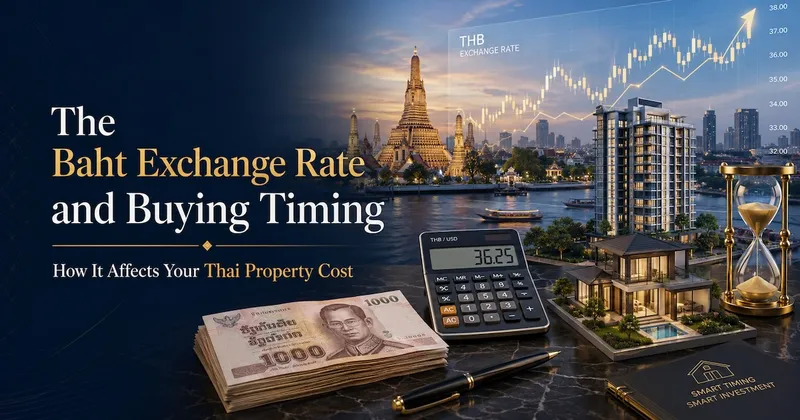
The Baht Exchange Rate and Buying Timing: How It Affects Your Thai Property Cost
Thai property is priced in baht, but your funds are mostly in another currency, so the baht exchange rate directly affects your real purchase cost and your take-home proceeds when you later sell. Put simply: the stronger your currency against the baht (the more baht it buys), the cheaper the purchase; weaker, and it costs more. The rate also affects off-plan instalments (long span, big swings), the amount you repatriate on sale, and your return in your home currency. But be clear-eyed: rates are hard to predict, don't rush to buy chasing a rate, and don't count on the rate to make money — the home's location, title and price are what matter. The rational approach is to treat the rate as a cost variable in the budget, use tools to compute, and convert in tranches to spread risk. This guide explains how the rate affects buying and how to treat timing rationally; rates are live, not investment or financial advice.
7/16/2026
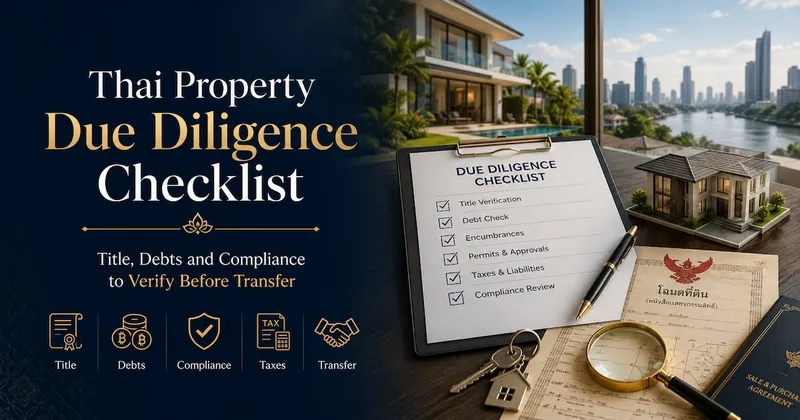
Thai Property Due Diligence Checklist: Title, Debts and Compliance to Verify Before Transfer
In Thailand, due diligence before transfer is the most important, most pitfall-blocking step. Five core areas to check: first, title — verify the deed type (whether Chanote), that the owner is the seller, and that area and boundaries match; second, debts and encumbrances — any mortgage, seizure, or unpaid management fees and utilities; third, the foreign quota (condos) and land limits (villas) — whether a foreigner can lawfully hold it; fourth, the developer and project (off-plan) — delivery record, EIA and construction permits; fifth, the contract and funds — review the sale contract and confirm funds can be remitted compliantly for the FET. Most of this needs a lawyer verifying originals at the Land Office. This guide gives a checklist to work against, subject to the Land Department's current rules and a lawyer.
7/16/2026

Guaranteed Rental Schemes in Thai Property: Why You Should Be Extra Careful
Buying Thai property, you'll often see developers promise 'guaranteed X% for X years' or 'hassle-free rent-back' — it sounds like sure money, but be extra careful. Three core problems: first, high rent-back is often baked into a higher price, so you're paid with your own money; second, whether it's honoured depends entirely on the developer or operator's long-term operation — if occupancy misses targets, they underperform, or the operator vanishes, the rent-back fails; third, the paying party, term, end-of-term arrangement and default remedies in the contract are often vague. Rent-back isn't untouchable, but review it as a 'conditional, risky operating arrangement,' not a 'guaranteed fixed return.' This guide breaks down how rent-back works, common tricks and review points, subject to the contract; not investment advice.
7/16/2026