 泰互帮
泰互帮Thai Property Due Diligence Checklist: Title, Debts and Compliance to Verify Before Transfer
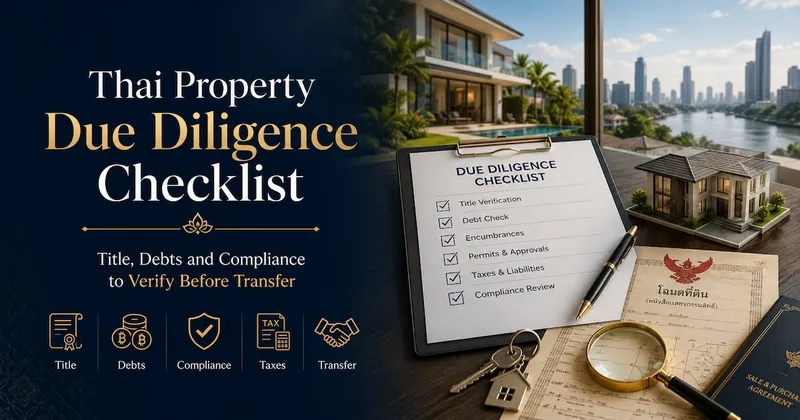
Why Due Diligence Is the Most Important Step
- Blocks the costliest pitfalls: unclear title, a mortgage, a full quota, a stalling developer — all can be caught at due diligence, avoiding paying then hitting problems
- Tiny cost against the price: a due-diligence fee is a fraction of a multi-million-baht price yet the best value
- Most needs original verification at the Land Office: a seller's or agent's copy isn't enough — professional verification is reliable; background in the buying process
Checklist 1: Title
- Deed type: confirm whether it's a Chanote (highest and clearest) — see Thai title deeds (Chanote)
- Owner: whether the name on the deed matches the seller, guarding against proxy/forgery
- Area and boundaries: whether the actual area and boundaries match the record
- Freehold or leasehold: whether you get freehold or a lease, and the renewal terms
Checklist 2: Debts and Encumbrances
- Mortgage / seizure: any bank mortgage or judicial seizure — mortgaged property must be discharged before transfer
- Arrears: any unpaid management fees, sinking fund or utilities — settle before transfer or put on the seller
- Co-ownership / disputes: any co-ownership interests, leases, or boundary/title disputes
Checklist 3: Foreign-Ownership Eligibility
- Condo foreign quota: confirm the unit is within the 49% foreign quota with room — see the foreigner buying guide
- Villa land limits: foreigners can't hold landed property individually — verify the lease or company structure is compliant
Checklist 4: Developer and Project (Off-Plan)
- Developer reputation: past delivery record, reputation, financial strength
- Permits and EIA: whether it has construction permits and passed the EIA
- Handover standard: what the contract handover includes — see handover and inspection; off-plan risk in the off-plan guide
Checklist 5: Contract and Funds
- Sale contract: whether price, payment, delivery, default, tax split and refund terms are clear and fair
- Tax split: who bears the transfer fee, stamp duty/SBT and withholding tax — see the taxes and fees guide
- Fund compliance: whether the price can be remitted compliantly from abroad for the FET — see funds and the FET
FAQ
What exactly does Thai property due diligence check?
Mainly five areas. Title: deed type (whether Chanote), whether the owner is the seller, whether area and boundaries match, and freehold vs lease. Debts and encumbrances: any mortgage or seizure, any unpaid management fees or utilities, any co-ownership or disputes. Foreign-ownership eligibility: for condos, within the 49% foreign quota; for villas, whether the land lease/company structure is compliant. Developer and project (off-plan): delivery record, construction permits, EIA. Contract and funds: whether the sale contract is clear and fair, how taxes split, and whether funds can be remitted compliantly for the FET. Most needs a lawyer verifying originals at the Land Office — a copy isn't enough. Done thoroughly, this catches the vast majority of pitfalls in advance. Subject to Land Department rules and a lawyer.
Do I have to use a lawyer for due diligence, or can I do it myself?
Strongly use a lawyer — it's hard to check fully and accurately yourself. Verifying title authenticity, encumbrances (mortgage/seizure), the foreign quota, contract traps and villa ownership structures is technical and often needs original verification and registry records at the Land Office, which ordinary buyers lack the access and experience for. A due-diligence fee is a fraction of the price yet blocks the costliest title and fund pitfalls — the cases that go badly wrong are often exactly those done alone to save this fee. You can do a preliminary self-check (condition, basic questions, the contract), but formal title and compliance due diligence should go to a lawyer. Engage a vetted lawyer via legal consulting, subject to the lawyer's professional opinion.
Is due diligence the same for resale and off-plan?
The broad shape is the same, but the emphasis differs. Resale focuses on existing title and condition: verify the owner, check mortgages, arrears and disputes, the foreign quota, and build quality — see the resale process. Off-plan, since the home isn't built, focuses on the developer and project: delivery record and financial strength, construction permits and EIA, the contract's handover standard and late-delivery terms, and enough foreign quota, to avoid delays and stalls. Common to both are contract review and compliant fund remittance (FET). In short: resale checks "is this specific home clean," off-plan checks "can this developer deliver as agreed." Both are best done by a lawyer. Subject to the lawyer's opinion and the relevant rules.
How much does property due diligence cost in Thailand?
Law firms usually quote a flat fee running in the tens of thousands of THB, with a straightforward condo at the lower end and land, villas or company-structure purchases higher. Against a multi-million-baht purchase it is a small fraction of the price — get a written quote, as scope and rates vary by firm.
How long does due diligence take in Thailand?
A typical condo check takes about 1-2 weeks once the lawyer has the deed copy and documents; land, villas and off-plan projects take longer because of Land Office searches, developer background checks and EIA verification. Build the window into your reservation agreement so the deposit is not at risk while checks are still running.
Need Help?
TaiHuBang offers consulting and support for Thai property due diligence: title and deed checks, mortgage/arrears and dispute screening, foreign-quota and land-compliance confirmation, developer and project background checks, contract review and fund-compliance guidance, and lawyer referral. We only provide consulting and process support, with professional conclusions verified against a lawyer and the Land Department's current rules; this article is not investment or legal advice. See legal consulting or submit an enquiry and an advisor will reply within 24 hours.
Related Articles
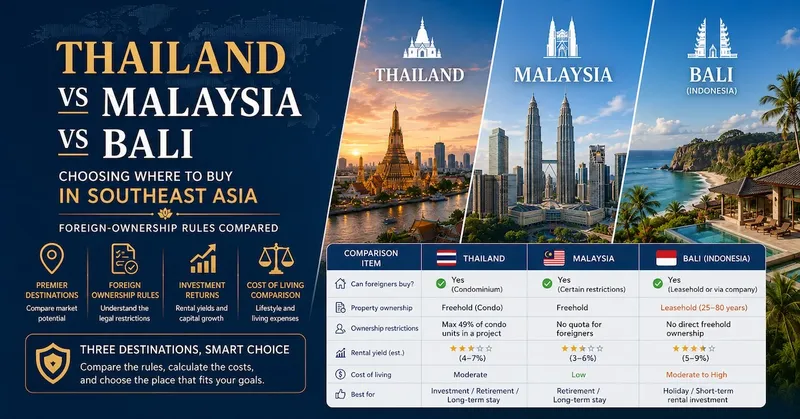
Thailand vs Malaysia vs Bali: Choosing Where to Buy in Southeast Asia and Foreign-Ownership Rules Compared
For buying in Southeast Asia, Thailand, Malaysia and Indonesia's Bali are three popular choices, but foreign-ownership rules, costs and suitability differ greatly. Thailand: foreigners can buy condo freehold (49% foreign quota), can't hold land individually, and villas use leasehold or a company; mature living, strong tourism, good value. Malaysia: foreigners can buy property above a local minimum price threshold (including landed property, rules by state), with the MM2H long-stay programme, widespread English and an English-style legal system. Bali (Indonesia): foreigners can't hold land title directly, commonly using Hak Pakai (right of use) or leasehold, with a strong holiday character and relatively complex rules. This guide compares the three on ownership, residency, cost and who they suit; each country's rules are subject to its official current rules, and this is not investment or legal advice.
7/16/2026
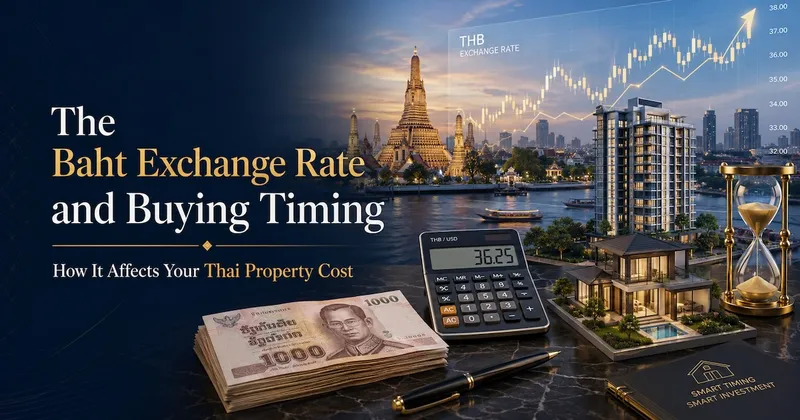
The Baht Exchange Rate and Buying Timing: How It Affects Your Thai Property Cost
Thai property is priced in baht, but your funds are mostly in another currency, so the baht exchange rate directly affects your real purchase cost and your take-home proceeds when you later sell. Put simply: the stronger your currency against the baht (the more baht it buys), the cheaper the purchase; weaker, and it costs more. The rate also affects off-plan instalments (long span, big swings), the amount you repatriate on sale, and your return in your home currency. But be clear-eyed: rates are hard to predict, don't rush to buy chasing a rate, and don't count on the rate to make money — the home's location, title and price are what matter. The rational approach is to treat the rate as a cost variable in the budget, use tools to compute, and convert in tranches to spread risk. This guide explains how the rate affects buying and how to treat timing rationally; rates are live, not investment or financial advice.
7/16/2026
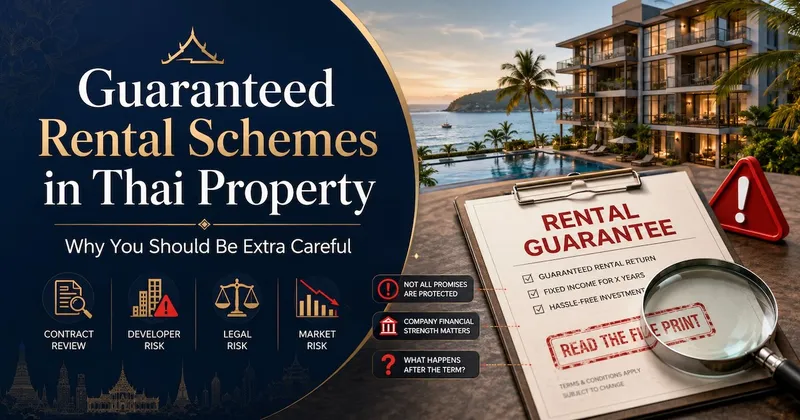
Guaranteed Rental Schemes in Thai Property: Why You Should Be Extra Careful
Buying Thai property, you'll often see developers promise 'guaranteed X% for X years' or 'hassle-free rent-back' — it sounds like sure money, but be extra careful. Three core problems: first, high rent-back is often baked into a higher price, so you're paid with your own money; second, whether it's honoured depends entirely on the developer or operator's long-term operation — if occupancy misses targets, they underperform, or the operator vanishes, the rent-back fails; third, the paying party, term, end-of-term arrangement and default remedies in the contract are often vague. Rent-back isn't untouchable, but review it as a 'conditional, risky operating arrangement,' not a 'guaranteed fixed return.' This guide breaks down how rent-back works, common tricks and review points, subject to the contract; not investment advice.
7/16/2026